
BRUSSELS – It’s crunch time for Ukraine.
When America’s top diplomatic trio descends on Europe in the coming days, European leaders will be on tenterhooks, eager to learn what Washington plans to do with Ukraine.
In other words: will the Trump administration continue to help Ukraine defend itself against Russian aggression? Or will it signal it’s withdrawing that support in the hopes such a step would bring about a quick end to the war?
Without continued American support, Ukraine would be likely be forced sue for peace because Europe alone simply doesn’t have the weaponry Kyiv needs to defend itself.
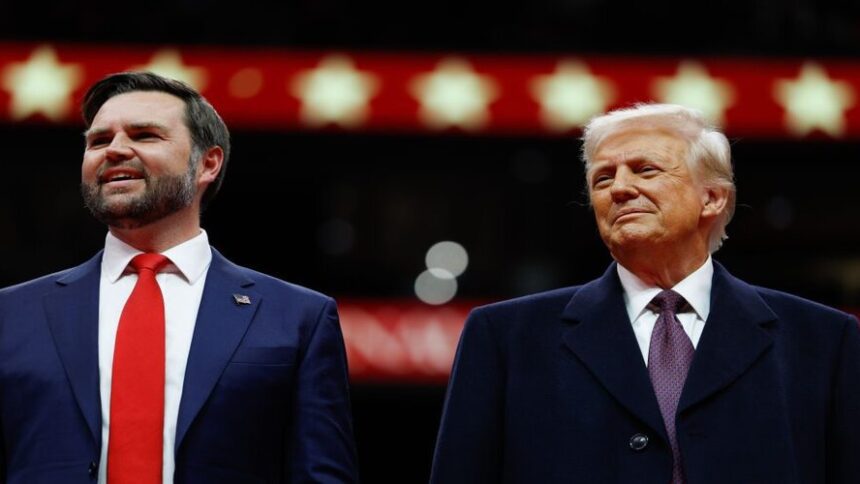
Senior US administration officials – Vice President JD Vance, Secretary of State Marco Rubio, and Defence Secretary Pete Hegseth – are heading to Paris, Brussels, and Munich this week for a series of first in-person meetings with their EU counterparts.
Trump’s special envoy for Ukraine-Russia, Keith Kellogg – the official most intimately involved in preparing the president’s ‘peace plan’ – will also be there.
European diplomats have jockeyed for weeks now to ensure they have a seat at the table in any future Ukraine peace talks.
This week offers them a first chance to state their case face-to-face, some of them after months of trying to get screen-time with the Trump entourage.
Flurry of talks
Vance is expected to have his first encounter with European Commission President Ursula von der Leyen and the EU’s top diplomat, Kaja Kallas, on the sidelines of the Paris AI Summit on Tuesday, before heading to the Munich Security Conference.
Rubio, meanwhile, is expected on Wednesday at the Weimar+ format talks – France, Germany and Poland, plus Spain, Italy, the United Kingdom and Ukraine – in support of Kyiv in Paris, according to people familiar with the plans.
Hegseth will attend a meeting of NATO defence ministers on Wednesday and a gathering of the Ukraine Defense Contact Group in Brussels – chaired by the UK instead of the United States for the first time – before heading to Poland.
But despite the volume of activity, Europeans are not expecting firm commitments from the US, several diplomats said.
“The worry is that obviously – like with everything else these days – that whatever we discuss or agree with American counterparts might only hold as long as Trump decides to change his mind,” one European diplomat said.
Art of a future deal
European diplomats privately say they had expected Trump’s Ukraine peace plans would be ready when his entourage lands in Europe this week.
Those expectations were reinforced as several members of the Trump administration had floated ideas in recent weeks.
But Kellogg denied reports he would do so at this week’s Munich Security Conference, according to two Western officials with knowledge of his contacts with European counterparts.
In the next few weeks, Kellogg is expected to coordinate its contents with all European NATO allies.
Trump’s guidelines for the plan are clear: Europeans have to take the lead when it comes to securing any future ceasefire and handling the financial burden.
Rubio last month said it was “dishonest” to claim Ukraine was capable of destroying Russia on the battlefield and returning to the pre-2014 state of affairs.
Next to drawing up a peace plan, Kellogg has indicated that both Kyiv and Moscow would have to make concessions if they were to successfully negotiate a solution.
Beyond that, Kellogg distanced his plan from the assumption that a ‘clean-cut’ peace could be achieved, telling New York Post it would be more feasible to land a ceasefire first and negotiate the details of a longer-lasting settlement later.
Ukraine, meanwhile, has put a rather Trumpian quid pro quo on the table to ensure US engagement: Kyiv receives security guarantees, and Washington gets access to Ukraine’s raw materials.
Ukraine had floated the idea of granting Western allies access to its critical minerals last autumn as part of its ‘victory plan’. Zelenskyy this week doubled down on it.
Russia is unlikely to deviate from the position it outlined last June, but said it was ready “ready to resume contacts with the US” on a settlement.
Their position remains that Ukraine must drop its NATO aspirations, adopt a neutral, non-aligned and non-nuclear status, and entirely withdraw its troops from four Ukrainian regions – Donetsk, Kherson, Luhansk, and Zaporizhzhia – annexed and largely controlled by Russian troops.
While Ukraine said those demands would be a non-starter, European officials stressed that they do not believe Russia would come to the negotiation table to make compromises.
“Sure, they’re keen to sit at the table, but from their viewpoint, they are unlikely to make any concessions, especially not as they currently feel that they are winning in Ukraine,” a second European diplomat said.
“It’s something that should worry us, perhaps more than the setting for talks,” they added.
Leadership desert
With three US heavyweights in town, Europe still appears to be lacking a clear and obvious figure to speak with authority on a common position.
Berlin will effectively be missing in action – with German Chancellor Olaf Scholz a lame duck – until they form a government after this month’s elections.
In Paris, French President Emmanuel Macron is grappling for relevance through his AI Summit, and will not even appear in Munich.
London is slowly stepping up, such as with the Ukraine Contact Group, and Warsaw is yet to see any serious first interaction with Trump’s camp.
The “leadership gap in Europe right now” makes apt timing for a rethinking of the continent’s “traditional alliance structures,” Alina Polyakova, president of the Center for European Policy Analysis (CEPA), said.
“The reality is that Europeans right now are waiting on the sidelines in the sort of traditional European manner, rather than coming to the White House” with proactive asks, she added.
[OM]
Source: Euractiv.com










Leave a comment