
Larnaca named European Capital of Culture for 2030
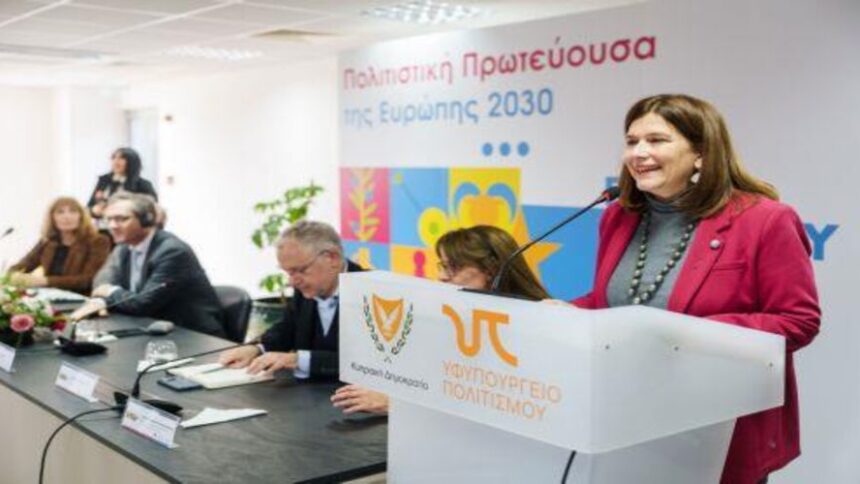
Larnaca is the Cypriot city that was selected as the European Capital of Culture for 2030. The results of the final phase of the “European Capital of Culture 2030” Competition, in which Limassol also participated, were announced on Thursday at a press conference at the Deputy Ministry of Culture, in Nicosia.
In her address, the Deputy Minister of Culture, Vasiliki Kassianidou, said that during the competition process for the selection of the Cypriot city that will be the European Capital of Culture in 2030 along with Leuven, Belgium, and Niksic, Montenegro, “all relevant regulations have been complied with and the integrity and strict equal treatment of the candidates has been fully ensured.”
At the same time, as she said, “in the context of supporting the institution, the state proceeded to a significant increase in funding for the European Capital of Culture, raising the amount from 6.5 million to 10 million euros, thus giving a strong boost to the city that will win the title.” The Deputy Minister of Culture also noted that “the funding starts as early as 2026 and will continue until 2031, practically helping the city that will win to implement the ambitious vision it has prepared.” The process is being completed just before Cyprus takes over the Presidency of the Council of the European Union, in the context of which the Commission will present the new proposal for the European Capital of Culture after 2033, she added.
Referring to the candidate Municipalities of Cyprus (Ayia Napa, Larnaca, Limassol, Nicosia and West Limassol), Vasiliki Kassianidou pointed out that “from the very beginning they responded to our call and worked with zeal for culture, Cyprus and Europe,” adding that “every effort has added value to the cultural action of Cyprus and they all deserve congratulations.”
Referring to the two municipalities that qualified for the final phase of the competition (Larnaca and Limassol), the Deputy Minister of Culture said that “the teams of both cities have worked throughout this period with dedication, with insight and a deep understanding of the importance of the institution for Cyprus and Europe”. Addressing the representatives of the two teams, she pointed out that “you have already benefited from your experiences, the collaborations you have developed and your entire contribution to your city and to the culture of the place more broadly.”
“The institution of the European Capital of Culture remains one of the strongest cultural projects of the European Union. It highlights the role of cities as living cradles of culture, where tradition and innovation meet, where artistic expression becomes a lever for collective upliftment and social cohesion,” the Deputy Minister of Culture pointed out.
“Winning the title of European Capital of Culture 2030 will have enormous benefits for the country, but even greater for the city that will win it, offering it recognition and visibility and prospects for development and progress,” she noted, adding that “for Cyprus this process has a deeper meaning, it gives us the opportunity to proudly, but also with a sense of responsibility, showcase our centuries-old cultural heritage and at the same time the creative potential of modern Cyprus.” “It also allows us to underline our commitment to the fundamental values of the European Union and to democracy, human rights, peace and respect for cultural diversity,” she said.
At the same time, she continued, “it gives us the opportunity to implement an important goal of the Government of Nikos Christodoulides, to promote Cyprus as a gateway to Europe from the East, a bridge with Asia, but also with Africa and as a crossroads of encounters of civilisations that have marked the history of humanity.” “We seek to highlight Cyprus as a cultural hub, leveraging the excellent relations with neighboring states, with the aim of promoting modern Cyprus through artistic creation and creating markets for the products of the Cypriot cultural industry,” she pointed out.
“Regardless of today’s announcement, both Larnaca and Limassol have already achieved something very important. They have mobilised their people, cultivated collaborations, and forged new paths for participation and cultural development,” Vasiliki Kassianidou said, adding that “this effort leaves a substantial imprint, which we as a State must support and utilise.”
“The city that will be declared the European Capital of Culture for 2030 today will undertake a great and beautiful project, to turn its vision into action and to represent Cyprus in an institution that unites, inspires and upgrades European cities,” the Deputy Minister of Culture said, noting that “the Deputy Ministry of Culture will be by its side at every stage, offering support, expertise and cooperation, in order to ensure the successful implementation of this great mission.”
Finally, Kassianidou warmly thanked both cities for the high level of their proposals, for their creativity and for their professionalism. “Your work has made us all proud,” she said.
On his part, Richard Kühnel, Director of Representation & Communication in Member States at the European Commission, said that ‘’European Capitals of Culture is an initiative which reinforces the connection between citizens and their local culture, but also one that makes them more aware of cultural expressions from other EU parts and beyond.’’
‘’European Capitals of Culture are bearers of European key values, like democracy, freedom of speech and expression, fight against discrimination, et cetera,’’ he pointed out, adding that ‘’European Capitals of Culture provide Europeans with opportunities to meet and to discover the cultural diversity which makes our continent so rich. It allows them also to take a fresh look at our common history and to get ideas about our common future,’’ Kühnel noted.
This way, he went on to say, ‘’the initiative is promoting mutual understanding and intercultural dialogue among our Union citizens and increase our sense of belonging to a wider and larger European community.’’ Along the years, he added, ‘’the European Capitals of Culture have become a laboratory for strategic and sustainable investment in culture. It allows our cities and regions to reflect in a participative way on the role culture and Europe play in their development and in the daily life of citizens,’’ he pointed out.
In addition, Richard Kühnel thanked the teams of Larnaca and Limassol, noting that ‘’you have already benefited from the bidding process and will pursue the work done, building on the strong momentum created and the bonds which you have established.’’ He also expressed hope that ‘’through your participation in the competition, you have already reinforced the notions of culture, diversity and Europe in your city, that you will keep implementing this participatory process which you started and that you will also continue promoting linkages with the rest of Europe and our joint European project.’’
In his address, the Chairman of the Committee of Experts, Toni Attard, thanked the teams of Larnaca and Limassol for making the Committee’s decision ‘’very difficult.’’
‘’We have studied your bids carefully, listened with great interest to the presentations, and asked many questions to deepen our understanding,’’ he said inter alia.
The announcement of the result of the competition by Attard was met with enthusiasm by the team of Larnaca.
Source: Parikiaki.com




Leave a comment