

The city in the drawing is crouched low, almost like an extension of the lagoon. The unknown artist’s gaze sweeps over ruins that still bear witness to the ferocity of the siege. Huts on stilts and wooden posts mark the fishing zones. Most public squares and streets are dirt and mud, while the squat houses are made of rough blocks of rock or wood and mud-brick.
“The city depicted in the drawing rises from the ruins; hardship coexists with hope, and everyday activity signals resilience and continuity,” comments Dr Spiridoula Demetriou, a historian and co-curator of the exhibition, “Messolonghi 1826: 200 Years since the Exodus,” which just opened at the Benaki Museum of Greek Culture.
The anniversary exhibition sheds light on a pivotal chapter of the Greek War of Independence, and this rare drawing – thought to be by a British artist who visited Messolonghi in the 1830s – is very much a focal point. “The City of Messolonghi” is a panoramic ink-and-pencil drawing on paper. Its provenance is unclear, as is its date; nevertheless, it serves as a valuable record of the city during its reconstruction. It comes from a private collection and joins pieces from Benaki’s collections and a small number of rarely seen items.
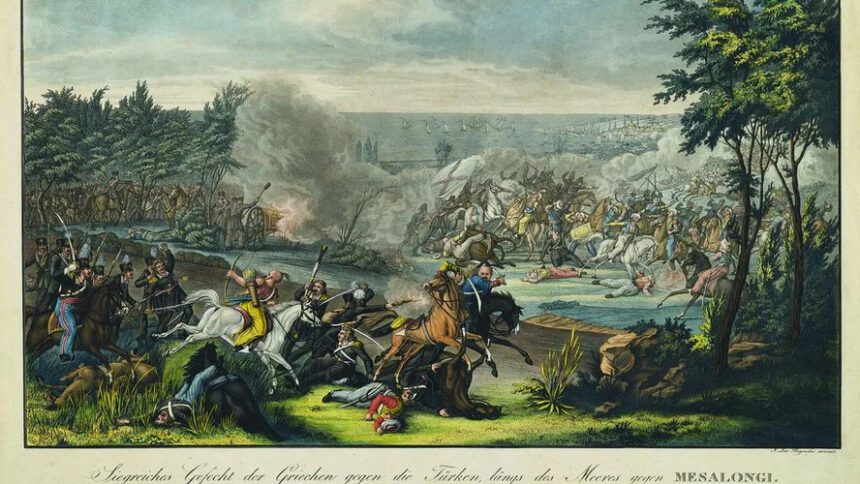
The exhibition brings together some 200 works – paintings, drawings, prints, books, and objects – offering a wide-ranging survey of the iconography surrounding Messolonghi, the Greek War of Independence and the philhellenic movement. Together, they present a sweeping historical portrait of Messolonghi from the early 19th century to the present. Ephemera are also featured, including broadsheets, posters, illustrated periodicals, poems and theatrical or musical works sold in support of the Greek fighters, many bearing the date 1826. The breadth of the material vividly underscores the impact and international resonance of the Exodus.
From the pre-revolutionary Messolonghi of the era’s travelers to the Greek War of Independence and the philhellenic movement, and from the deaths of Markos Botsaris and Lord Byron to the siege and the exodus of the “Free Besieged,” the narrative unfolds with historical precision and visual intensity. One focuses on the naval Battle of Navarino and the role of the Great Powers in the creation of the independent Greek state, before the journey culminates in Messolonghi as an enduring symbol of the struggle.
The exhibition is curated by Konstantinos I. Stefanis, Spiridoula Demetriou, and Australian collector John Robinson, and is accompanied by a bilingual catalogue.
The exhibition runs through May 3, at the Benaki Museum of Greek Culture (Vasilissis Sofias & 1 Koumbari). For more information, visit www.benaki.org.
Source: Ekathimerini.com










Leave a comment