

By Martin Banks
Democratic resilience must extend to the communities where democratic systems are most tested.
This means ensuring the full political participation of Roma citizens.
That was a keynote message to emerge from a conference in the EU parliament.
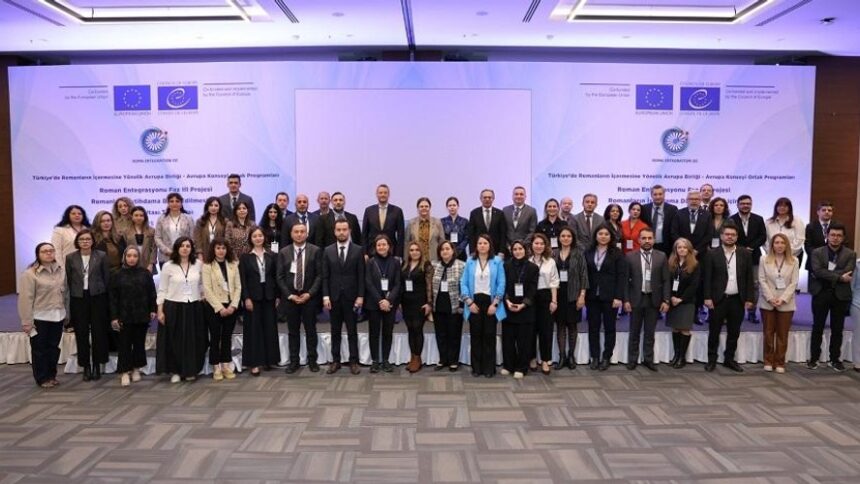
The Roma for Democracy Foundation convened the high-level roundtable at the parliament, bringing together senior policymakers, international election experts, and civil society leaders to examine how the European Democracy Shield (EDS) can be made operationally effective across all parts of Europe’s democratic landscape.
The closed-door discussion was co-hosted with Members of the European Parliament and titled “Strengthening Democratic Resilience: From Electoral Reality to the European Democracy Shield”.
Comment came from Nicolae Ștefănuță, Vice President of the European Parliament, saying “The current aspirations of the Shield show a weaker understanding of the complex dynamics on the ground. Roma participation is a key test of democratic resilience.
“We cannot focus only on external threats if the Shield fails to reach the political participation of 7-8 million Roma citizens, as well as those in candidate countries. We cannot afford this blind spot. What is not captured by the system is not protected by the system.”
Participants heard that with an estimated 7.8-12 million Roma citizens across the EU and its neighbourhood, Europe’s largest ethnic minority represents both a significant democratic stakeholder and a critical early-warning system for democratic erosion.
Drawing on more than 15 years of field monitoring in Roma communities, the RFD presented evidence of how electoral vulnerabilities develop and spread at the local level, and why this intelligence must inform the EDS if the initiative is to succeed.
Mensur Haliti, President at the Roma for Democracy Foundation, warned that overlooking Roma communities is no longer simply a minority rights issue, but a systemic vulnerability that anti-democratic forces are actively exploiting: “The Democracy Shield cannot succeed if it excludes the largest transnational minority in Europe – 12 million Roma citizens. We have seen in many cases that some states continue to overlook the democratic potential and capacity of Roma communities. However, this is exactly the kind of vulnerability that foreign actors and anti-democratic forces seek to exploit. Ignoring Roma may have been tolerated in the past, but this is no longer just a Roma issue – it now affects the overall health and resilience of democracy itself.”
A representative for the European Commission acknowledged the scale of the challenge: “Roma are among the most marginalised groups in the region. In a context where trust in institutions is already low, Roma experience even deeper levels of exclusion. As a result, they are more vulnerable to disinformation and polarised narratives that frequently target minorities.
“This affects how Roma perceive and participate in democratic life, and often prevents their full engagement. We all know that enlargement needs to involve all populations and citizens if countries are to advance towards democracy. The European Democracy Shield, launched by the Commission, offers a good opportunity to address these core issues. “
Zeljko Jovanovic, President of the Roma Foundation for Europe, pointed to the structural barriers that suppress Roma civic agency, noting, “The Democracy Shield can only succeed if Roma representation has been unlocked.
“Of course, there is a role for Roma communities, Roma representatives, and Roma self-organisation, and that is undeniable. At the same time, whether people have the conditions in which representation and participation in political processes is enabled and supported – or at least whether the door is open – then the agency within the community is much more easily activated. If people are intimidated, if they are oppressed by police, by social welfare, or through intimidation before elections by political parties or those facilitated or commissioned by them, then that representation is far more difficult.”
“We see generation after generation of young people who, instead of being encouraged to represent their community and contribute to society, are actively discouraged from doing so.” he added.
Participants also examined how better connecting policy design with ground-level evidence is essential to the Shield’s effectiveness.
Alexander Hudson, Senior Adviser at International IDEA, noted that aggregating the lived experiences of Roma individuals across different communities could help identify early signals of democratic stress: “Roma communities are among the most important in Europe when it comes to reflecting the diverse experiences of democracy across EU Member States and enlargement countries. If we can capture the lived, often anecdotal experiences of Roma individuals across different communities and aggregate them, we can identify early signals of challenges – whether related to elections, freedom of expression, or even individuals’ personal integrity and security.”
Keara Castaldo, Senior Election Adviser at the Office for Democratic Institutions and Human Rights (OSCE/ODIHR), underlined a structural gap in current election monitoring, stating, “One of the key challenges in election observation is the limited time missions spend in a country, especially compared to how long-term trends affect citizens and voters. Even with long-term observers deployed weeks in advance, this remains a short window to build trust within local communities and fully understand the dynamics at play.”
Ștefănuță reinforced the need for structural change: “‘Nothing about us without us.’ It is essential that Roma people are at the table, especially at the right moments, when programmes and budgets are being discussed. That is the first condition for ensuring your voice is truly heard. Secondly, we do not need another coordination mechanism where everyone works separately and only meets occasionally in Brussels. We need to embed this in legislation -in budgetary frameworks and legal texts – so that it becomes a binding obligation, not just coordination.”
Adela Militaru, Programme Director of the Roma for Democracy Foundation, reflected on the outcome of the discussion: “It was truly encouraging to see policymakers and experts at the roundtable align on a key point: strengthening European democracy requires high-functioning institutions that go beyond minimum compliance standards and genuinely serve the constituencies they are meant for, with integrity and consistency. This is how we can protect our democracy from internal erosion.”












Leave a comment