

By Martin Banks
A Belgian zoo is doing its bit to help save a bird species threatened with extinction.
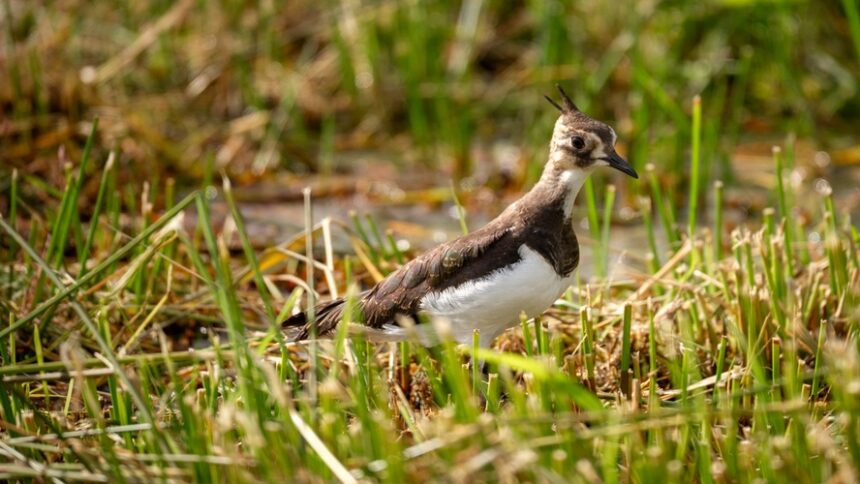
Once a familiar sight in Belgian meadows and fields, the Northern Lapwing has experienced a significant decline in recent decades.
Between 2007 and 2018, the lapwing population declined by nearly 75 percent in Flanders alone.
Intensive farming is said to be a main cause of their disappearance.
However, a pilot project at the nature reserve at ZOO Planckendael, just north of Brussels, promises to offer a new future for these meadow and farmland birds.
Northern lapwings often nest on agricultural land but when fields are ploughed or sown, eggs and chicks are lost.
To prevent this, volunteers from De Zegge, the Agency for Nature and Forests (Natuur en Bos), and Natuurpunt’s Meadow and Farmland Bird Working Group are joining forces to locate the nests.
Under the initiative, Lapwing eggs deemed at risk of destruction are transferred to the zoo and placed in an incubator.
The young birds are subsequently released back into the wild.
Frédéric Verstappen, Curator of Birds at ZOO Planckendael, told this site: “If protecting them on-site is impossible, the eggs are moved to the safety of ZOO Planckendael to continue incubating in an incubator.”
This spring, dozens of eggs have already been secured from an area of approximately 800 hectares in the Kleine Nete valley.
They have hatched at their own pace over recent months and ZOO Planckendael hopes to release around 40 young lapwings into De Zegge.
Verstappen said, “Every lapwing that takes flight is important for the preservation of the species. With this project, we aim to buy time for the population while contributing to the restoration of suitable habitat.”
Unsuitable habitats and predation make the species’ survival particularly challenging but, through this pilot project, ZOO Planckendael, De Zegge, and Natuurpunt are investigating how to effectively release young birds and how to combine nature restoration with species conservation.
The knowledge gained can subsequently be applied to other threatened meadow and farmland birds.
The project goes beyond simply rescuing eggs. In the long term,the three collaborators aim primarily to restore the habitat of the northern lapwing and other farmland and meadow birds.
But Toon Deswert, curator of the De Zegge nature reserve, warned this is only achievable through the involvement of farmers, volunteers, and nature conservation organizations.
He said, “Farmers play a fundamental role in the survival of ground-nesting birds. By taking nests into account during agricultural activities and investing in nature restoration, we can truly make a difference.”
“Meadow birds face immense pressure within our landscapes. The key to their long-term survival lies in simultaneously protecting their nests and improving their habitat.”
Griet Nijs of Natuurpunt’s Grassland and Farmland Bird Working Group, adds, “Only by providing a varied, species-rich habitat combined with sound water management can we lay the foundations for the sustainable conservation of these grassland birds.”
The De Zegge nature reserve is a fragile haven for rare flora and fauna and one of the few places in Belgium that still offers a unique marshland habitat featuring a significant peat bog.
It also serves as a refuge for various threatened species, such as the Eurasian bittern, marsh harrier, spotted crake, grass snake, and Eurasian water shrew, among others.











Leave a comment