
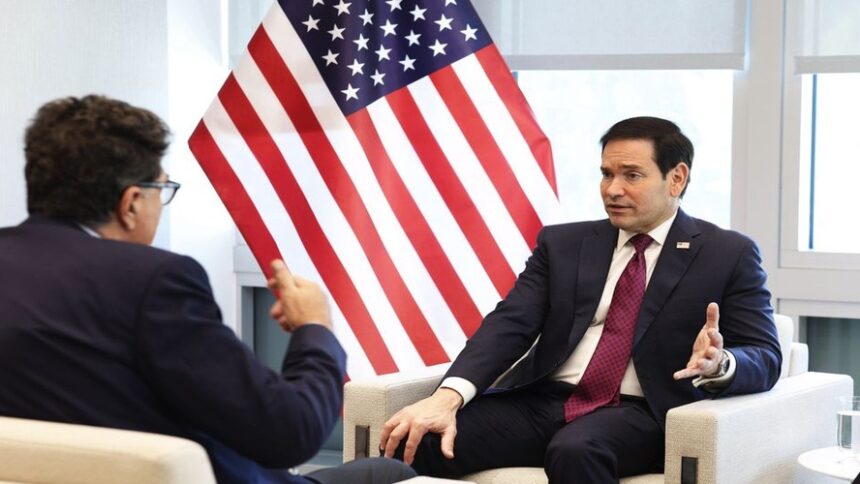

US Secretary of State Marco Rubio, speaking to Kathimerini in an exclusive interview during his visit to Athens on Wednesday, lays out the priorities shaping Washington’s approach to the most pressing issues in Greece’s neighborhood, from Greek-Turkish relations and Iran to defense, Ukraine, the Strait of Hormuz and energy.
Why are you in Greece now?
I don’t know if there is a reason for now. We should have been here as soon as we could. I don’t travel to a country unless the ambassadors are in place, so that was part of it, and I think it worked for our schedule. I do think this relationship is deep and enduring. We had opportunities to interact with the prime minister and the foreign minister at global gatherings in the past, and hosted them bilaterally and in the US. I hope we come back many times because US-Greek relations are something that I have been very involved in, going back to my time as a senator – though I didn’t get to visit as a senator – and one we continue to build on.
The US supports a new energy architecture in the area with the Vertical Corridor and the Great Sea Interconnector electricity cable. Is the US going to support the interconnector project in the Aegean, which faces a lot of irritants and obstacles?
If there is anything that has become obvious over the last few months, it is that we need to diversify the way the world gets its energy. I say that if the world has learned anything over the past five years, it is that we need to be able to do that. The Russia-Ukraine war reminds us of that, as is what is happening in Hormuz and potentially in the Red Sea with the Houthis. We need to diversify. Our supply chains are running to some of the most volatile areas of the planet. So this is a very important priority for us and one more example of how US and Greek interests overlap. So, we are very committed to it. We understand there are some potential impediments, there are some things standing in the way, and we intend to use our diplomatic efforts to remind all parties how important this is to us and why this matters. And I hope to find resolutions. As I said in the press conference, some of these issues are obviously not best resolved through media or communiques; they are best done privately and quietly within the diplomatic realm, but this is very important as we need to prioritize engagements from multiple countries.
President Trump has a personal relationship with Turkish President Erdogan. You are very involved in the area. Are we going to see any mediation on your side on this?
Well, I always sort of avoid discussing sensitive topics in the media because it only makes them harder to solve. That said, we engage with Turkey all the time. They are a member of NATO, and they have obviously been engaged in a number of other issues. For example, they have hosted talks in the past with Russia and Ukraine. It’s a relationship we have invested in as well; maybe that investment will help us in regard to these conversations. On issues like these, if you want to put out statements, you can put out statements, but if you want to get a resolution, they are often best dealt with within the confines of direct private conversations. That’s how diplomacy often works best.
One of the big issues, another sensitive issue, is whether Turkey is going to get the F-35s. You introduced the Countering America’s Adversaries Through Sanctions Act (CAATSA) bill as senator. What’s your assessment now?
‘To me, [a Greek-Turkish crisis] would be unimaginable. It wouldn’t be good for either Turkey or Greece, but it also wouldn’t be good for the United States. It is something we could never allow to happen’
Well, the status of that is the following: Number one, [Turkey] is a member of NATO. Number two, the president expressed the desire, if possible, to provide them, as they have paid for a few of them already. Obviously, these planes are many, many years away from delivery, but there are two that have already been paid for. But there is a law that was passed by the United States Congress. There’s a law, and there’s also a provision of the National Defense Authorization Act that places very strict conditions, so until those conditions are met, frankly, that sale can’t happen. And that’s been conveyed to the Turkish side. They’re aware of it; I think they’re trying to find answers for it. It revolves around the S-400 system. So, as of now, that issue hasn’t been resolved, and legally we can’t make that transfer until that is resolved. Perhaps it will be resolved – and there are various options – but as of right now, it hasn’t been resolved.
Greece has requested some specific weapons for its F-35s, some of the same ammunition that Israel is getting. Is there any response you can give on that now?
There is no formal response. It’s under strong consideration. Obviously, a country like Greece is an important ally of ours from a defense standpoint. We have a lot of interoperability already when it comes to defensive posture – and Greece adopted a very strong defensive posture when our presence in the region was being threatened. So, they’ll be given strong consideration in that regard. Obviously, that’s a decision that’s made through an interagency process in our own system. Ultimately, the decision is up to the president, but we obviously want to get input from the Department of War as well.
As you know, Greece has developed a close defense relationship with Israel. How do you see that from your standpoint?
We view that as a positive – obviously for the region – and I think the challenge is not just maintaining a relationship with Israel, but also how do you maintain good relations with other countries in the Middle East, whose relationship with Israel may not be as positive. We face the same challenge, obviously, and we navigate it. Our relationship with Israel is important. It’s deep, it’s historic. I speak to you today on the third anniversary of one of the most horrifying terrorist attacks ever, which really changed the world, not just Israel. So it’s an important relationship and one we’re invested in. And, of course, it has to be managed within the context of areas in the region that are impacted by what’s happening with Israel, such as Syria and Lebanon. You know, we’re engaged with all the countries in the region. I think Greece has tried to sort of play a similar role in that regard, which is to keep a strong relationship with Israel, but also have a strong relationship with many countries in the region.
One question I have asked many of your predecessors in the past is if things go sour with Turkey in the Aegean or Cyprus, is there going to be a US security commitment that you’re going to intervene and stop things from getting really bad?
To me, it would be unimaginable that something like that could happen. These are two NATO allies and two NATO partners – so it just can’t happen. It wouldn’t be good for anybody. It wouldn’t be good for either Turkey or Greece, but it also wouldn’t be good for the United States. So, rather than even think about it, I would just say it’s something that, to me, is unthinkable, something that we could never allow to happen, and I don’t believe will happen.
Looking at the situation in Iran, there hasn’t been a regime change and things have been complicated in the Gulf area. Where is the endgame? And when do you think this war is going to be over?
The endgame is that they can’t have a nuclear weapon. Iran can never have a nuclear weapon – that’s been clear from the very beginning. And I think what people misunderstand or perhaps don’t fully appreciate or perceive is that what Iran was trying to do was to have so many missiles and drones that they could wipe out the entire Middle East. Hold all of our troops at risk without us having a defensive capability to respond, and then do whatever they want with the nuclear program. In essence, they were trying to create a conventional shield behind which they could then develop their nuclear program. The president was never going to allow that to happen, and that’s why he destroyed their missile program. That’s why he’s going after their drone-making program. That’s why he destroyed their navy. That’s why he destroyed their air force – because they couldn’t hide behind this shield. Now, as it stands today, the Straits are open, and Iran does not control them. Oil shipments through the southern lane, which we cleared of mines, are now at almost 80% of pre-conflict levels. The only country that cannot reliably get oil out of the Middle East is Iran, whose shipments have all been blocked or stopped by a blockade. They’re facing crushing economic pressure, which will only grow exponentially in the next few weeks. As an example, all of the oil they got out during the MOU period is sitting out there in the Pacific and they’re about to sell the last barrels of that oil. After that, there is literally no Iranian oil anywhere in the world. They won’t have that source of revenue. So, when you talk about an endgame, I can tell you where we’re going to be in just weeks: They’re going to be facing the most cataclysmic economic catastrophe in the history of modern Iran, and it’ll all be the fault of the radical Shia clerics that run that country. And then they’ll have a decision to make: Do they want to be a country, or do they want a revolution? And I think that’s a decision they had to make a long time ago, but they’re going to be forced into that position. I don’t know what choice they’ll make, but I can tell you the choice they will never be allowed to make is to have a nuclear weapon. That simply will not happen.
Are you not concerned that there will still be a sort of militant regime still in place after all this?
Well, there’s a military regime in place there now and ultimately we never went into this with the goal of regime change. We definitely wanted to see the regime change its behavior – in essence, its sponsorship of terrorism. When the MOU happened and they were able to sell oil, they didn’t take that money and invest it in the country to rebuild it. They took that money and gave it to Shia militias in Iraq, to give it to Hezbollah, to give it to Hamas, to try build more missiles and drones. That’s what they spent it on. That’s what they’ve been spending it on for 20 years – and that has to stop. Otherwise, they continue to pose a threat. They are the world’s leading sponsor of terrorism as a state, and every penny they get they use for that purpose. So that’s what needed to change. But again, I go back to the goal of this operation. From the very beginning, it was that radical militant Shiite clerics could never be allowed to possess a nuclear weapon. And as long as President Trump is in office, they will not have a nuclear weapon.
There’s another war going on, in Ukraine. You have said that it’s not America’s war basically, but it’s a war that is still going on. Any chance it could be over?
Well, unfortunately, it seems to be going into its fifth year, which was never the original plan. I don’t think that was Putin’s plan for this war, so it hasn’t gone the way he planned it. And I think what it is now, unfortunately, is a strategic stalemate, which is a dangerous thing. Strategic stalemates are only broken in one of two ways: a) through a negotiated settlement, or b) through escalation by one side or both that ends up spreading beyond the confines of the original conflict. Right now, there don’t seem to be prospects of a negotiated settlement. We are prepared to play whatever role we can in making that happen. And we have tried in the past, but so far it’s been elusive. The Russians have defined victory as the totality of Donetsk; they’ve repeatedly stated that as their goal and they continue to state that as their goal. And that’s a condition that, for Ukraine, is simply unacceptable. And so, a diplomatic solution has eluded us, but we are prepared, if we can play a constructive role, to make it happen. In the meantime, we watch with great concern as escalation could happen. Just yesterday, some ships were attacked in the Black Sea through a coordinated drone attack. We’re worried about a sabotage operation in a neighboring country that can spiral out of control. And, obviously, I think there are clear indications that Russia will use the upcoming winter as something they want to use to destroy what remains of the electric grid in Ukraine and force them into capitulation. Meanwhile, Ukraine has grown more effective in its ability to conduct long-range strikes deep into Russia. So, we share the same concern. The whole world is going about this thing like something that could escalate and perhaps become a broader conflict. So, we stand prepared to facilitate and continue to explore any opportunity for a negotiated settlement. We think it would be good for Russia and Ukraine, but so far, it’s proving elusive.
You are giving a speech in a couple of hours at the birthplace of democracy. Is this a place to contemplate whether you’re going to run for president?
(Laughter) One of the points we want to emphasize is that one of the things that binds us to Europe, to a large degree, is what we share in common, the heritage we have in common. We have strategic relationships with countries all over the world. What makes our relationship with countries in Europe, especially places like Greece, so special is that so much of what we have in our country – literally, from the architecture to our system of government – is rooted in our shared cultural heritage; that’s at the core. That’s what keeps these things vibrant and alive. And we have to remind ourselves of that constantly. We should be proud of Western civilization, not apologetic for it. That doesn’t mean we hate other civilizations or other cultures or that we reject them. This is not discriminatory in any way. But we should be proud, not ashamed of our common heritage, because it is at the foundation of our system of government; it is the foundation of our history; it’s the foundation of our alliance. And so, I think it’s a very unique opportunity to remind people of that in a very historic setting.
Source: Ekathimerini.com












Leave a comment