
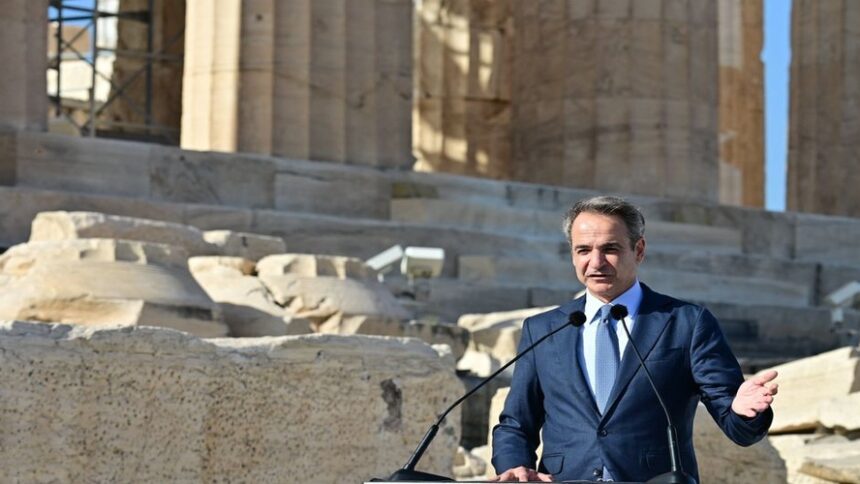

No agreement on the return of the Parthenon Sculptures can involve recognition of foreign ownership, Prime Minister Kyriakos Mitsotakis said Monday, reiterating that their reunification in Athens remains a non-negotiable national goal.
Speaking at the inauguration of the old Acropolis Museum, on the Acropolis itself, Mitsotakis said the dispute was not simply a legal claim over individual artifacts but a matter of restoring a monument that had been divided.
“The Parthenon was not built to be broken up,” he said, arguing that its sculptures were conceived as a unified whole and should be displayed together at the site for which they were created.

Mitsotakis described their return as a “great and non-negotiable national goal,” saying Greece was seeking to restore a monument left incomplete by the removal of parts of its sculptural decoration.
“No solution, no agreement can be reached if it recognizes foreign ownership,” he said. “The Parthenon was created as a unified whole, and that is how it must remain for all time.”
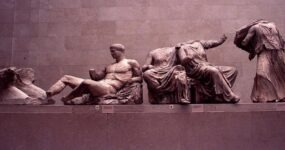
The sculptures, known in Britain as the Elgin Marbles, include sections of the Parthenon frieze, relief panels and figures that once adorned the 2,500-year-old temple on the Acropolis. They were removed in the early 19th century by Lord Elgin, then British ambassador to the Ottoman Empire, when Greece was under Ottoman rule, and taken to Britain. The British government purchased them in 1816, and they subsequently became part of the British Museum’s collection.
Greece has repeatedly called for their return to Athens, arguing that they were removed unlawfully and should be reunited with the surviving sculptures displayed at the Acropolis Museum. The British Museum maintains that Elgin acquired them legally, with the permission of the Ottoman authorities, and that they form part of its collection.

The reopening of the Old Acropolis Museum, which stands on the Acropolis beside the Parthenon, marks its return to public use after nearly 19 years. Its collections were transferred to the new Acropolis Museum, and the historic building subsequently closed. Mitsotakis said the government had opted to restore the building and incorporate it into the wider archaeological site rather than leave it to serve as a storage facility and office space.
The new Acropolis Museum, designed by Swiss architect Bernard Tschumi in collaboration with local architect Michael Photiadis, opened to the public in 2009. Located at the foot of the Acropolis, it was built in part to provide an appropriate setting for the sculptures remaining in Athens and to reinforce Greece’s case for the return of those held in London.
Mitsotakis said the government was also continuing restoration work on the Acropolis walls and improving access to the eastern plateau, as well as facilities for visitors with disabilities. He described the museum’s reopening as part of a broader effort to integrate the archaeological site into the daily life of the city.
Source: Ekathimerini.com









Leave a comment