
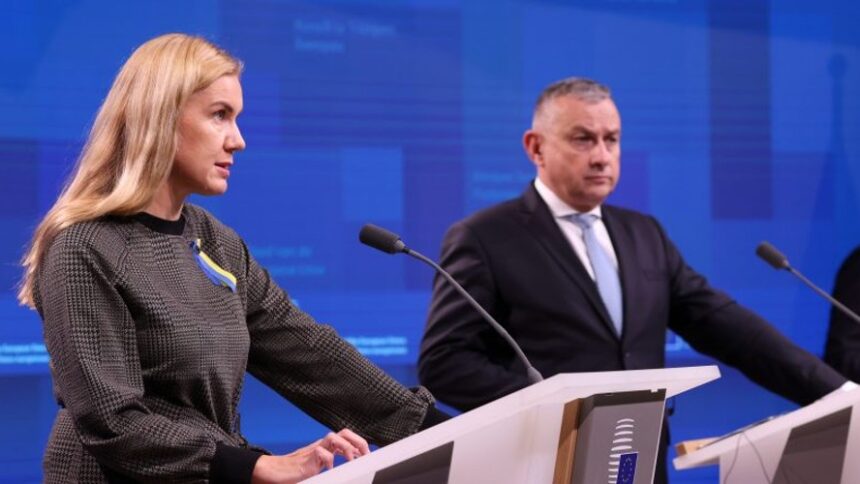
The European Commission will put forward a proposals to tackle high gas prices “soon”, the Czech EU presidency said after an extraordinary meeting of energy ministers on Friday (30 September).
Although EU countries agreed on emergency measures to tackle the energy crisis, this is not enough, said Czech energy minister Jozef Sikela, whose country holds the EU’s rotating presidency.
“We are in an energy war with Russia, which also strongly affects our industry. Further urgent and coordinated EU action is needed,” he insisted.
The main concern for EU countries is the surging price of gas and the impact it has on electricity prices, Sikela explained.
Measures to tackle this could include a price cap on all imported gas or a new European price benchmark for liquified natural gas (LNG) to reflect the declining importance of Russian pipeline gas in the EU’s energy mix.
The baton is now passed to the European Commission, which will work with EU capitals to develop these ideas before a summit of EU leaders next week, said Kadri Simson, the bloc’s energy commissioner.
“This work would ultimately form the basis of a legislative proposal that we would put forward,” Simson added.
Sikela told journalists he expected the Commission proposal to come “soon”, but the exact timing is yet to be announced. He added that the Czech presidency is prepared to take up any proposal from the Commission and deal with it in a “superspeed manner”.
“I’m ready to call as many extraordinary Councils as necessary,” he said.
No agreement on price caps
But EU countries are still split on capping gas prices.
“It is true that on the price caps at this moment, there is nothing near a consensus,” a senior EU diplomat said ahead of the meeting, adding that it is better to focus on the progress that has been made rather than “waste time on things which would divide us”.
15 EU countries have written a joint letter earlier this week asking the European Commission to introduce a price cap “applied to all wholesale natural gas transactions”. But in a paper shared with EU capitals this week, Brussels warned against security of supply issues this could create as LNG is traded on the global market.
The Netherlands, in particular, is critical of the wholesale gas price cap. Energy minister Rob Jetten told EURACTIV it would not lead to a decrease in consumption, which he says is necessary to mitigate a crisis driven mainly by scarcity in gas supplies.
The Germans are also cautious of a price cap, with minister Robert Habeck saying that LNG ships would go elsewhere if European customers do not offer a sufficiently good price.
“We must now allow too little gas to reach Europe,” he warned.
Luxembourg energy minister Claude Turmes also cautioned against a wholesale gas cap, saying it could distort the market and prevent gas from going to countries that need it.
Instead, Turmes advocated for dialogue with Europe’s trade partners and called for EU talks with the US about LNG prices as it is now a matter of EU security following the sabotage of the two Nord Stream pipelines.
Options on the table
Brussels agrees that intensifying talks with trade partners should be the top priority to secure additional sources of gas for Europe.
But views differ when it comes to capping gas prices.
While Simson reiterated the Commission’s preference for capping the price of Russian gas only, countries like Germany see this as a sanction against Russia, which would require unanimity, “and we don’t yet have a consensus on this,” she admitted.
Austria is opposed to the idea because of its dependance on Russian supplies and its refusal to jeopardise the country’s energy security, said minister Leonore Gewessler.
Germany’s Habeck, for his part, said Berlin would be open to a Russian price cap, as long as south eastern European countries are ready to accept cuts in deliveries from Moscow.
Capping gas in electricity generation
In the absence of consensus on capping Russian gas, Simson said the Commission was looking at other options and “is ready to develop a temporary EU-wide measure to limit price of gas in electricity generation”.
While views differ among member states on how such as price cap would apply, “there is also common ground” on the need to explore this further, she explained.
“This should be done at a level that helps bring down electricity prices without increasing gas consumption. These are far reaching measures that intervene substantially in the functioning of the European gas market and we are not proposing this lightly,” she explained.
But some countries want the European Commission to go further.
“Unfortunately, we think that the terms under which the Commission is making the proposals today fall short of what Europe needs,” Spanish energy minister Teresa Ribera said.
Another idea promoted by the Czech EU presidency is to strengthen joint purchasing of gas in order to leverage the spending power of EU countries. The Germans are now in favour of this, with Habeck supporting the establishment of a joint EU purchasing platform to bring down prices.
Europe should use its power wisely on world markets and act in a coordinated way to bring prices down, he added.
Source: Euractiv.com










Leave a comment