
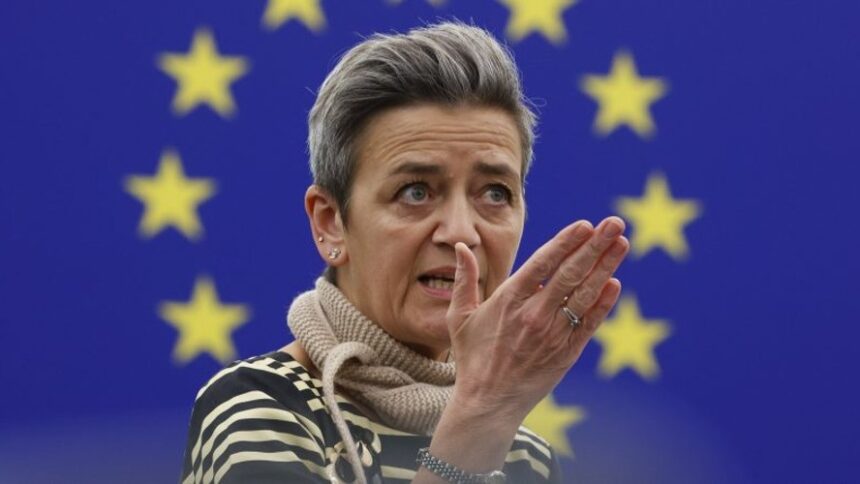
The executive vice-president of the European Commission, Margrethe Vestager, on Friday (13 January) proposed a ‘Temporary Crisis and Transition Framework’ for state aid.
If implemented, the framework will allow member states to more easily subsidise renewable energy technologies and to implement tax breaks for companies in strategic sectors that are at risk of diverting investments to third countries outside Europe.
Vestager outlined her proposal in a letter sent to EU member state finance ministers on Friday (13 January) ahead of the ministers’ meeting on Monday and Tuesday in Brussels.
In the letter, seen by EURACTIV, Vestager warns that the “competitiveness of European industry is facing a number of challenges” and that the US Inflation Reduction Act (IRA) “risks luring some of our EU businesses into moving investments to the US”.
The IRA is a bill pushed forward by the Biden administration, aimed at financing the green transition by means of generous subsidies, for example for electrical vehicles and batteries. A part of the subsidy scheme requires the products to be assembled in the US, thus putting EU companies at a disadvantage.
Specifically, Vestager proposed to amend the current ‘State Aid Temporary Crisis Framework’, which was adopted as a reaction to the war in Ukraine and the energy crisis, into a ‘Temporary Crisis and Transition Framework’ – and requested finance ministers’ views on the matter.
According to her letter, the amendments would “make the calculation of the aid amount simpler and the approval faster”. Moreover, the scope would be enlarged to cover “all renewable energy technologies”.
Under the amended framework, member states should also be able to entice companies to invest in the EU instead of diverting investments elsewhere.
“I envisage dedicated provisions to support new investments in production facilities, including via tax breaks,” Vestager writes, while adding that this should be “limited in time, targeted to those sectors where such risk [of diverted investments] really exists, and proportionate in terms of aid amounts.”
However, the liberal Commissioner also pointed out that, due to recent changes in the state aid rules and the general block exemption regulation (GEBR), member states can already dish out a majority of their state aid to companies without asking the Commission for permission.
First implemented in 2014, the GEBR exempts certain categories of state aid from the requirement of prior notification to the Commission, when the benefits outweigh the possible distortions of competition.
Moreover, a sizeable amount of state aid has already been paid out under the current temporary crisis framework.
“[T]he Commission has mobilised €672 billion of national funding so far under our State Aid Temporary Crisis Framework,” Vestager wrote.
More than half of this aid was dished out in Germany.
“53% of State aid approved has been notified by Germany while France represents around 24% and Italy over 7%,” Vestager wrote, pointing out the widely unequal distribution of state subsidies within the EU.
“Not all Member States have the same fiscal space for State aid. That’s a fact. And a risk for the integrity of Europe,” Vestager warned. She said that the Commission was “seeking ways to further boost the EU’s REPowerEU plan”, and “to set up a collective European fund to support countries in a fair and equal way”.
However, a new collective European fund is highly controversial among member states, with the German government being one of the most vocal opponents of the proposition.
While the Social Democrats and the Greens in the three-party German government might be open to new collective European funding, the liberal FDP is a staunch critic, arguing that this would lead to a situation in which German taxpayers would have to finance other EU member states.
Despite her own warnings about the threat of excessive national subsidies for the integrity of the Single Market, Vestager wrote that “the magnitude of the challenges ahead may require us to go even further to go greener”.
Vestager said that she would open a formal consultation on the proposed changes in the coming weeks.
Luca Bertuzzi contributed to the reporting.
[Edited by Nathalie Weatherald]
Source: Euractiv.com







Leave a comment