
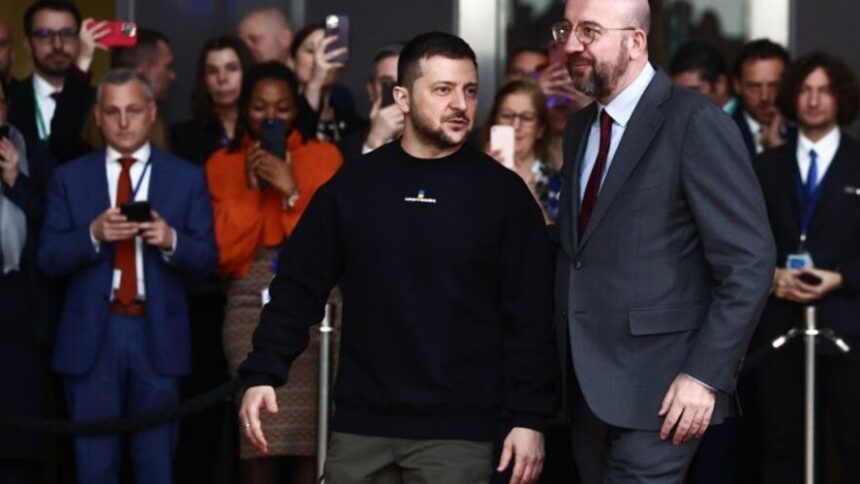

EU leaders are expected to discuss on Thursday (29 June) what future security commitments the bloc could provide to Ukraine, according to the latest draft conclusions of an EU summit to be held this week, seen by EURACTIV.
“The European Union and member states stand ready to contribute, together with partners, to future security commitments to Ukraine, which will help Ukraine defend itself in the long term, deter acts of aggression and resist destabilisation efforts,” the latest draft conclusions read.
“In this regard, they will swiftly consider the modalities of such contribution,” the current text states, without going into detail about what those could entail.
The wording, put forward by France last week, according to several EU diplomats, was in reference to French President Emmanuel Macron’s speech at a GLOBSEC conference last month.
In Bratislava, Macron had called for Ukraine’s partners to work in bilateral and multilateral contexts to craft “security assurances” for Kyiv.
Over the past weeks, France, with its partners of the Quartet (UK, US, Germany) has been working on crafting such security assurances, or commitments, for Kyiv.
In what could resemble US commitments to Israel, these assurances could take the form of a long-term pledge of support, including military aid, to help better equip and train Kyiv’s armed forces so they would be able to deter any future attack or defend themselves.
Lithuania’s Deputy Foreign Minister Mantas Adomenas told a Friends of Europe event in Vilnius earlier this month that to give “security guarantees” to Ukraine means giving it a “long-term commitment of support (…). It’s nothing beyond that”.
EU role unclear
EU leaders are now expected to “clarify” or “interpret” what those “security commitments” could be as a number of member states have asked for clarifications, three EU diplomats told EURACTIV.
It is not clear what the EU’s role could be – neither that of the member states, especially the neutral ones, they said, adding that Paris did not specify.
“Nobody knows exactly what kind of security commitments, how to provide them, how to finance them?” one EU diplomat complained.
“It’s like opening Pandora’s box,” the EU diplomat said, referring to the fact that the bloc neither has a clear defence policy framework nor a coherent approach to defence policy.
A second EU diplomat said that “what we understand is that Macron wants to highlight the role of the EU”, while a third one explained that “some member states want to make sure that this in no way contradicts the transatlantic debate, especially in the run-up to the NATO summit in Vilnius later this month”.
The EU has also been helping Ukraine via the off-budget fund of the European Peace Facility (EPF), used to reimburse the member states’ deliveries of lethal and non-lethal aid to Kyiv.
The EU has been working to accelerate the delivery of weapons to Ukraine by pushing its member states to jointly procure equipment, especially ammunition and missiles, and the industry in ramping up its ammunition production.
Some member states believe the future security commitments provided by the EU itself could be the “re-labelling” of the already currently existing activities of the EU.
At the same time, the discussion is likely to cause discomfort with neutral EU member states.
The text states that “these commitments will be taken in full respect of the security and defence policy of certain member states and taking into account the security and defence interests of all member states”, as a move meant to allow each member state to decide on its contribution according to its own laws and traditions.
Austria, Malta and Ireland are neutral countries. Hungary has declared it would stay neutral in the context of the Ukraine war and has refused to support Ukraine militarily.
[Edited by Zoran Radosavljevic]
Source: Euractiv.com







Leave a comment