
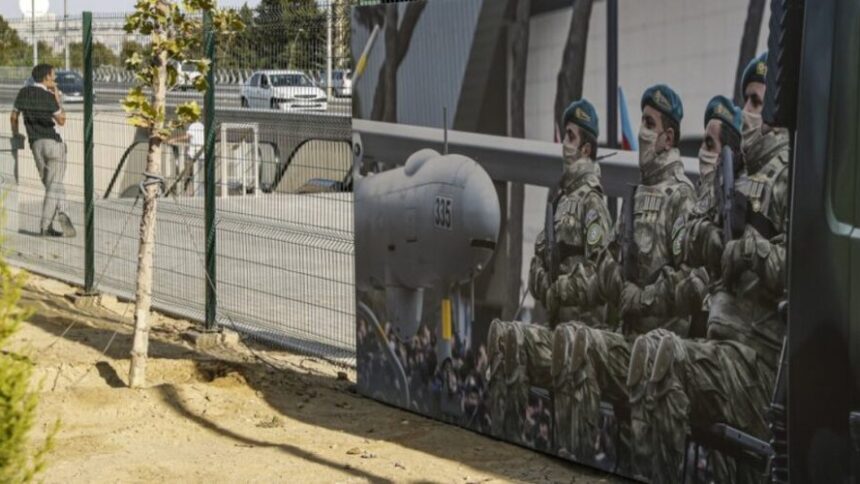
The EU condemned the military escalation in Nagorno-Karabakh on Tuesday (19 September) after Azerbaijan launched an attack in the contested breakaway territory, a step that could herald a new war.
In a statement announcing its operation, Azerbaijan’s defence ministry on Tuesday said it intended to “disarm and secure the withdrawal of formations of Armenia’s armed forces from our territories, (and) neutralise their military infrastructure”.
It said it was only targeting legitimate military targets using “high-precision weapons” and not civilians as part of what it called a drive to “restore the constitutional order of the Republic of Azerbaijan”.
Air raid sirens were heard wailing in Stepanakert, the de facto capital of the unrecognised state of Nagorno-Karabakh, according to reports on social media.
Civilians were free to leave by humanitarian corridors, it added, including one to Armenia, whose prime minister, Pashinyan, said the offer looked like another attempt by Baku to get ethnic Armenians to leave Karabakh as part of a campaign of what he called “ethnic cleansing” – an accusation Baku denies.
Ethnic Armenian forces in Karabakh said Azerbaijani forces were trying to break through their defences after heavy shelling, but that they were holding the line for now, Reuters reported.
Armenia, which had been holding peace talks with Azerbaijan, including on questions about Karabakh’s future, condemned what it called Baku’s “full-scale aggression” against the people of Nagorno-Karabakh and accused Azerbaijan of shelling towns and villages.
“Driven by a sense of impunity, Azerbaijan has openly claimed responsibility for the aggression,” Armenia’s foreign ministry said in a statement.
Until the last few days, Baku had imposed sweeping restrictions on the Lachin corridor – the only road linking Armenia with Karabakh – and had blocked aid on the grounds that the route was purportedly being used for arms smuggling.
Yerevan had said that Baku’s actions had caused a humanitarian catastrophe, something Azerbaijan denied, and were illegal.
Armenia, which says its armed forces are not in Karabakh and that the situation on its own border with Azerbaijan is stable, called on members of the UN Security Council to help and for Russian peacekeepers on the ground to intervene.
Russia, which brokered a fragile ceasefire after the war in 2020 which saw Azerbaijan recapture swathes of land in and around Karabakh that it had lost in an earlier conflict in the 1990s, called for all sides to stop fighting.
Setback
The prospect of renewed war in the South Caucasus would be seen as a major diplomatic setback for the EU, which has been courting Azerbaijan as an ally and alternative gas supplier to Russia.
“We call for the immediate cessation of hostilities and for Azerbaijan to stop the current military activities,” the EU’s chief diplomat Josep Borrell said in a statement.
He added that the EU remains fully engaged in facilitating the dialogue between both parties.
European Council President Charles Michel, who has led talks with Armenia and Azerbaijan in recent months, said the reports of renewed fighting were “devastating” and insisted the “military actions of Azerbaijan must be immediately halted to allow for a genuine dialogue between Baku and Karabakh Armenians.”
The EU has been operating a civilian mission to help monitor Armenia’s volatile border with Azerbaijan since the beginning of the year, which has been seen as an aim to bolster the bloc’s role in a region viewed by the Kremlin as Russia’s backyard.
Its establishment came after Moscow — focused on its war in Ukraine — has been losing influence after decades of domination over its neighbourhood.
Azerbaijan earlier this year had established a checkpoint at the start of the Lachin Corridor, the only road route linking Armenia to Nagorno-Karabakh, in what Armenia called a “gross violation” of a Moscow-brokered 2020 ceasefire agreement between the two sides.
Russia is an ally of Armenia through a mutual self-defence pact, but also has good relations with Azerbaijan.
“After mediating the 2020 ceasefire, Russia has been unwilling to take sides in the conflict, effectively allowing Azerbaijan to steer the situation”, Marie Dumoulin, Director of ECFR’s Wider Europe Programme, said.
“Whether Russia is now able to mediate a renewed ceasefire remains to be seen. This would probably come with a high political cost for the Armenian government,” she added.
[Edited by Nathalie Weatherald]
Source: Euractiv.com











Leave a comment