
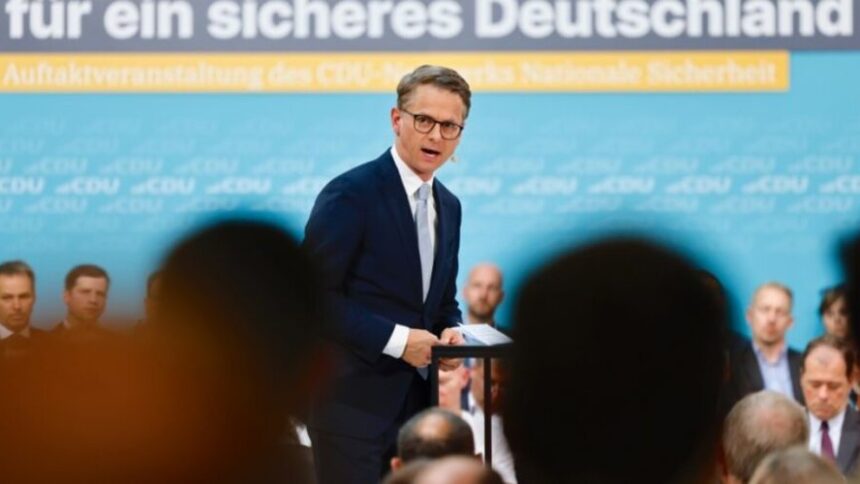

With the German federal election of 2021 being re-run for half a million eligible voters in Berlin, conservative opposition CDU is hoping for a boost in votes, calling upon voters to send a ‘stop sign’ to the governing centre-left coalition of chancellor Olaf Scholz.
Due to severe mistakes in the organisation of the federal election across Berlin in September 2021, which led to missing ballots, long queues and polling stations being open much longer than intended, 550,000 people will be called to vote again on 11 February 2024.
This comes after a decision by the federal constitutional court in December, largely confirming the partial repetition of the election as proposed by the German Bundestag in 2022.
While the partial rerun will not change the majorities in the Bundestag, it could well lead to some MPs losing their seats and others entering parliament. For the three-party coalition of Chancellor Olaf Scholz (SPD/S&D), it may be another setback after the recent government crisis over a top court ruling on the coalition’s budget policies.
“We see this repeat election as an opportunity,” Carsten Linnemann, secretary general of conservative opposition party CDU (EPP), said when presenting the election campaign in December. As of Tuesday (2 January), parties are allowed to hang election posters in the 455 affected polling districts, which are spread across Berlin.
“We want to show the ‘traffic light’ government a stop sign that things cannot go on like this,” Linnemann said, referring to Scholz’s three-party coalition, adding that “Berliners have the chance to make this clear now.”
Last year, the Berlin state election, which was held on the same day as the federal election in September 2021, had to be repeated in full, with CDU coming first and Kai Wegner (CDU) taking over as mayor after 21 years of SPD-led governments.
Berlin as ‘trendsetter’?
This year, the CDU hopes the Berlin re-run will “set trends” by penalising the ruling coalition of Social Democrats, Greens and Liberals, which surveys show as largely unpopular.
In a survey conducted by Infratest Dimap for broadcaster ARD in December, only 17% of respondents said they were satisfied with the federal government’s performance, while 82% said they were less or not at all satisfied.
Discontent spiked last year during a months-long dispute within the coalition over a proposed bill to ban new oil and gas heatings, as well as following the budget dispute.
“At the moment, we only have poll results from institutes that clearly show that the ‘traffic light’ government is slipping in the polls,” Linnemann said.
“Now, for the first time, we are getting reliable figures, and they will go straight to the heart of the matter,” he added.
While CDU is leading in the national polls with 32%, the far-right AfD party (ID) comes second with 21%, way ahead of the governing Greens (15%), Scholz’s SPD (14%) and liberal FDP (Renew Europe, 4%).
Far-right leading in East Germany
Later this year, Germany will head to the polls for the European elections on 9 June alongside multiple local elections, but most attention will be on three state elections in East Germany in September, in all of which AfD currently polls first.
A poll for Saxony, published on Tuesday by Sächsische Zeitung, showed AfD at 37%, ahead of CDU at 33%. Scholz’s SPD would miss the 5% threshold needed to secure seats in the state parliament.
“The current polls are a warning to us,” SPD co-leader Saskia Esken told dpa.
“In the coming months, we will make it clear that our country is at risk of great damage if the AfD gains political power,” Esken said, calling the party a “major threat to democratic culture, our common good and our business location.”
Source: Euractiv.com











Leave a comment