
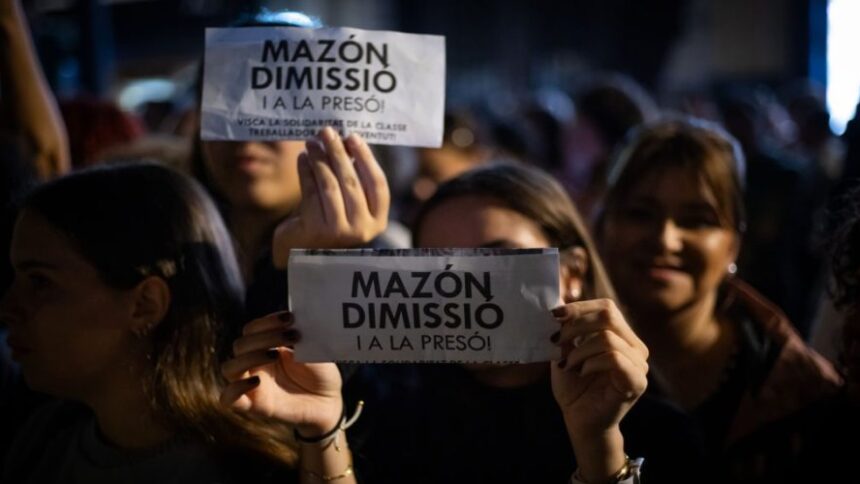

The regional President of Valencia, Carlos Mazón, refused to resign on Sunday, a day after thousands protested, accusing the centre-right politician of mishandling the disaster.
More than 130,000 people gathered at a demonstration in Valencia on Saturday to demand Mazon’s immediate resignation over the emergency management of the 29 October floods. They blamed him for the late response to the tragedy and the lack of effective coordination.
Levante-EMV reported that the leading banner of the demonstrations featured an image of Mazón (Partido Popular/EPP) with his head down and wearing an emergency vest. Other signs carried slogans such as “We are stained with mud, you are stained with blood” and “Mazón, resign.”
The participants were called to Valencia, the regional capital and the most affected province, by social and civil organisations and left-wing trade unions,El País reported.
Thousands also marched in Alicante, another city in the Valencia region, and several hundred in Madrid.
The left-wing Sumar party, a junior partner in the coalition government, demanded on Saturday that PP leader Alberto Núñez Feijóo sack Mazón if the head of the Valencian government does not resign in the next few hours or days.
“Valencia spoke very clearly (at Sunday’s demonstration)”, Sumar figures wrote on X.
Despite the protests, the regional government’s Vice President, Susana Camarero, rejected Mazón’s resignation on Sunday.
Spanish public broadcaster RTVE reported that Camarero (PP) respected “the pain” of those affected but insisted that the resignation of the regional leader “is not an option at this time”.
Controversy over early emergency warning system
Since the beginning of the tragedy, many voices have questioned the Mazón government’s response to the crisis. Over the weekend, several Spanish media outlets called for the dismissal of Salomé Pradas, the regional justice and interior minister in charge of the Department of Emergencies.
RTVE reported that Pradas admitted that she was unaware of the existence of a mobile phone alert service (ES-Alert), which has been in operation since 2022, to warn the population in the event of serious meteorological emergencies.
As the search for the missing and the clean-up and reconstruction of damaged areas continue, the political confrontation over the management of the disaster between the government and the Partido Popular, the main opposition force in parliament, has intensified.
Partido Popular blames Ribera
Partido Popular has also taken advantage of the crisis to blame Teresa Ribera, the future Commissioner for Competition and Vice-President for a Clean Transition, who faces her hearing before the European Parliament on Tuesday.
The right-wing party reproaches Ribera for having been – in the opinion of the right-wing party – absent during the worst moments of the crisis.
Esteban González Pons, deputy secretary of the Partido Popular and vice-president of the EU Parliament, said Ribera “does not deserve to represent Spain in the European Commission.”
From the first hours, thousands of people improvised and organised emergency aid for the victims in the region of Valencia, which was the worst affected, as well as in Castilla-La Mancha and Málaga.
In the first days, 45,000 and 50,000 volunteers travelled to Valencia to bring food and help clean up.
EFE reported that Javier Serrano, a lecturer at the Department of Human Geography at the University of Valencia (UV), calculated the figure based on data collected from civic groups, associations set up after the disaster, and volunteers coordinated by the Valencian government.
On Monday, the Spanish government of the PSOE and the left-wing platform Sumar announced an initial €10.6 billion relief package for the nearly 80 municipalities affected by the devastating floods.
The aid package aims to alleviate personal and material damage to homes and household goods, local businesses, and industrial, commercial, and service establishments.
Huge property damage and multimillion-euro insurance claims
The preliminary death toll from the flash floods stood at 223 on Saturday, while authorities reported at least 78 missing, with many bodies still unidentified.
Over the weekend, dozens of emergency workers – including Civil Guard agents, firefighters, and Military Emergency Unit members – continued searching for the missing in the Albufera nature reserve, south of Valencia.
“It’s meticulous work, but we have to do it in a very rigorous way and with all the protocols”, Captain Sergio Hernandez, in charge of the underwater search, told EFE.
Hernandez said that the flood had washed away “a lot of debris and wood” and that they were “combining all the resources for real effectiveness”, including the use of boats, divers and drones.
The Insurance Compensation Consortium has received 116,000 claims from flood victims, 46% of which have already been processed.
According to the consortium and the Valencian government, the registered claims correspond to 33,852 homes, 66,067 motor vehicles, 6,834 shops and warehouses, 509 offices, 2,195 industrial buildings, and 23 public buildings.
Meanwhile, the Spanish police have sent six mobile offices to the flooded areas to issue new identity cards to those affected.
Three family support offices have been opened for citizens to facilitate the reporting of missing persons and their subsequent identification, including in the municipalities of Alfafar and Algemesí, Valencia.
(Fernando Heller | EuroEFE.Euractiv.es)
Source: Euractiv.com












Leave a comment