
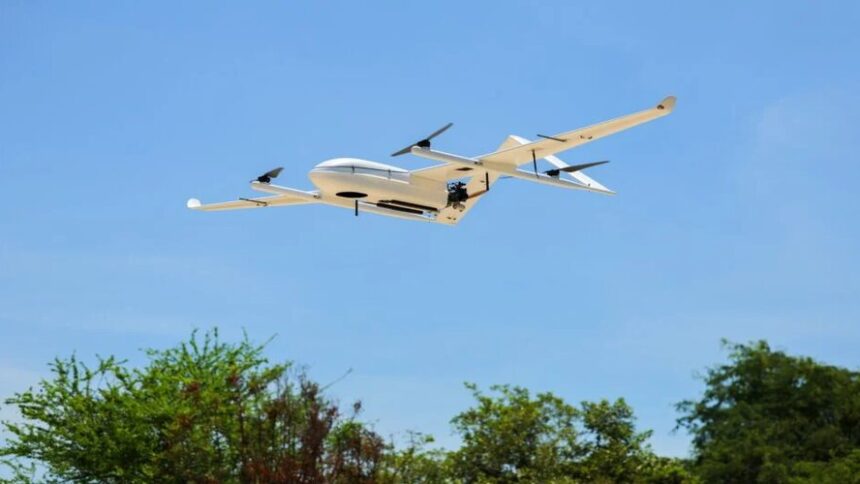
The Hellenic Center for Defense Innovation (HCDI) announced a new program on Thursday aimed at bolstering domestic production of unmanned systems. The tender calls for the development of a cargo unmanned aerial vehicle (UAV) intended for multiple-use applications – military, commercial and humanitarian. According to HCDI the UAV “will ensure rapid and precise delivery of supplies, especially in remote or inaccessible areas where conventional means are neither feasible nor efficient,” reducing personnel exposure to danger while enhancing operational flexibility.
The tender, valued at €24 million, requires the procurement of four systems. The UAV is expected to have a payload capacity of over 100 kilograms, with a minimum operational flight ceiling of 3,000 feet and a desired altitude of 12,000 feet above sea level. It must be capable of launching and landing in adverse conditions, including wind speeds exceeding 20 knots. In addition, the system must feature advanced navigation, obstacle avoidance, and resilience against jamming and cyberattacks. Integrated control stations and safeguard measures will also ensure effective operation in areas with weak or spoofed GPS signals.
HCDI’s initiative follows its recent tender for unmanned surface vessels (USV), signaling a strategic commitment to nurturing indigenous technological capabilities. A domestic UAV that is built and maintained locally is seen as a stepping stone toward creating a broader technological ecosystem capable of supporting larger, more advanced unmanned platforms. Currently, surveillance missions over Greek terrain are primarily executed using Israeli Heron UAVs.
In a related development, HCDI also issued a tender for a surge limitation system designed to protect the electrical grid and critical ship equipment against transient voltage spikes. This system will monitor network voltage in real time, identify surges, and automatically activate the appropriate level of protection. The tender was issued only days after a similar announcement for a combat management system for naval gun platforms.
These programs are part of a broader strategy to gradually reduce reliance on foreign technology. While the step toward a Greek “Bayraktar” has yet to be taken, Greek capabilities are evolving in a clear and deliberate direction.
This series of initiatives aims to lay the foundation for a robust, homegrown defense technology industry in Greece.
Source: Ekathimerini.com












Leave a comment