
It’s been nearly four years since the Greek government ultimately decided – after lengthy negotiations, several changes of course and considerable behind-the-scenes tensions – to purchase three French-designed and -built frigates, the FDI class, also known until then as the Belharra. This type of ship was practically unknown, as none had previously been built. Greece, together with France, would become the first countries to move ahead with the acquisition of these frigates. The technological risk assumed by the Hellenic Navy was significant and was discussed and deliberated at length within the circles of the Hellenic Navy General Staff (HNGS). Those who followed the process closely at the time remember attempts to compel the Hellenic Navy to acquire a type of ship whose production has since ceased and which is now regarded as a failed experiment.
The contract
The responsibility for preparing the technical content of the contract had been assumed entirely by the chief of the HNGS at the time, Stelios Petrakis, leading a team in which his deputy chief, George Kampourakis, played a pivotal role. Interestingly, Admiral Petrakis retained the right to the final say at the Supreme Naval Council meeting that decided the names of the new frigates (Kimon, Nearchos, Formion and Themistocles), deliberately avoiding names of a geographical nature (such as Epirus, Macedonia etc) or the name Hellas, a position shared by the then commander-in-chief of the fleet, Panagiotis Lymperis. The only ship ever to bear the name Hellas had been blown up in the civil strife of 1831 by Andreas Miaoulis during a confrontation with the impoverished newly founded Greek state, and was therefore regarded by the Hellenic Navy as “unlucky.”

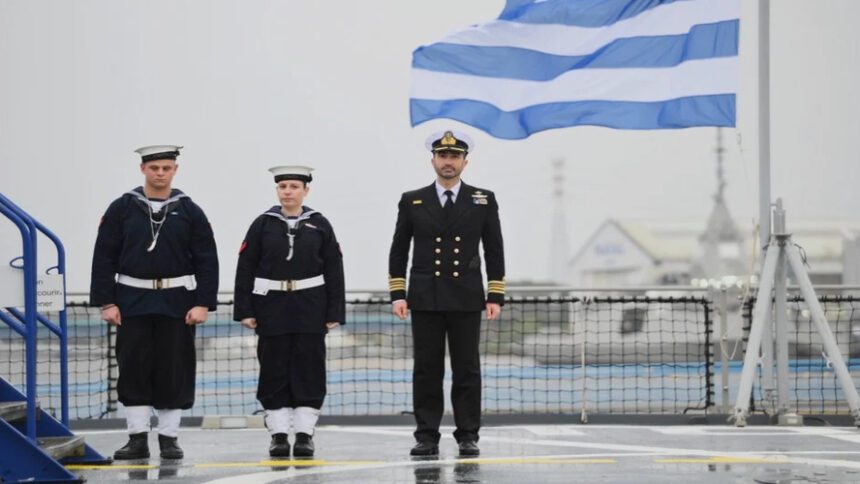
For weeks, a room in the Hellenic Navy General Staff building at the Ministry of National Defense had become a second home for the officers who devoted their days to ensuring that the deadline would not be missed. Many of them were there last Thursday, in Lorient, Brittany, to witness the Greek flag being raised on the mast of the Kimon, symbolically marking its formal delivery to the Hellenic Navy.
The aircraft chartered by Rear Admiral (retired) Panos Laskaridis – who has devoted both time and substantial financial resources to supporting the Hellenic Navy – carried several of the figures who played a decisive role in ensuring that the Kimon, bearing hull number F-601, would become the vehicle for the transition of Greece’s naval capabilities into the 21st century.
The risks
Among naval circles, the acquisition of the Kimon is often likened to that of the battleship Averof. Launched in 1910, it was a vessel that also entailed a degree of technological risk for what was then the Royal Hellenic Navy, as it was the first ship that, in operational parlance, could sustain a productive battle line. Greece’s resounding victory in the Aegean over the Ottoman navy, which belonged to an earlier technological era, stands as the historical proof that this risk was ultimately a successful one.
History and tradition are elements that are organically woven into the very fabric of the Hellenic Navy. This is why, the moment when Laskaridis, the sponsor of the new frigate, presented the ship’s first commanding officer, Commander Ioannis Kizanis, with the sextant once belonging to Royal Hellenic Navy Admiral Pavlos Kountouriotis, those present on Kimon’s bridge – wearing, or having once worn, the national insignia and the Navy uniform – felt that this historical heirloom symbolized the passing down of a historical responsibility to the new generation of officers: to carry forward a tradition spanning centuries, during which the Navy has never once struck its flag.
That same night, the first 20 officers and non-commissioned officers – out of the ship’s total complement of 126 – slept aboard the Kimon. Over the coming days, the entire crew will gradually be transferred from their hotels in Lorient. It includes 25 women, a ratio of one in five, which largely reflects the trend seen across other units of the Hellenic Navy. And then, in a few days, the ship will sail a short distance north of Lorient to Brest, where, at a French Navy naval base, it will take delivery of the frigate’s weapons load (missiles, ammunition, torpedoes, and related systems).

The men and women of the Kimon’s crew will spend New Year’s in Brittany, and shortly after Epiphany, the ship will put to sea in the Bay of Biscay, heading south and west before turning east toward Gibraltar and the Mediterranean. The Kimon’s arrival at Salamina is expected around January 15, and the entire naval base is already looking forward to welcoming the ship that marks the first step in the Hellenic Navy’s transition to a new era.
The first tests
The various tests and training activities needed for the ship to be deemed fully operational and combat-ready are expected to last around three to four months. Extensive technical work will also be carried out during this time to identify and address any potential “teething problems.” It is worth noting that the first FDI, the Amiral Ronarc’h, was delivered to the French Navy just three months ago. While the French have shared a significant amount of information with the Greek side, the Aegean, the Eastern Mediterranean, and the Atlantic present important differences.
The accompanying graph illustrates many of the main weapons systems carried by the Kimon. It also includes several systems that are expected to be installed within the next two to four years, most notably long-range missiles with a range exceeding 1,000 kilometers, capable of delivering strategic strikes.
 However, the new frigate’s most significant contribution – not only to the Hellenic Navy but to the overall operational philosophy of the Armed Forces – is its network-centric operational capability. By 2030, when the F-35 fighter jets are expected to be fully integrated into the Hellenic Air Force, the Kimon and any other FDI frigate will be able to exchange critical information in real time, providing the Armed Forces with a level of situational awareness they currently lack.
It hardly needs to be emphasized that while the Hellenic Navy may lag behind the Turkish Navy in terms of numbers, the addition of the FDI frigates gives Greece a clear qualitative advantage – one that is extremely difficult to ignore.
The crew
The 126 men and women who crew the Kimon will return from France as ambassadors of the Hellenic Navy. The Navy may once again be acquiring technology worthy of its history, but it has yet to find adequate answers to retain its personnel, especially younger service members, who in recent years have been resigning due to extremely low pay.
Last Thursday, all 126 appeared as a unit, determined and fully prepared to honor the legacy handed down by those before them: If and when the need arises, the Kimon will sail forward, full speed ahead.

The Kimon’s executive officer, Stylianos Lioulis, oversees the crew’s official embarkation following the raising of the flag. The frigate is expected to arrive at the Salamina Naval Base in mid-January. [Christos Pelekoudas/Defense Ministry Press Office]
Source: Ekathimerini.com












Leave a comment