

By Martin Banks
Failure by the international community to respond to perceived attacks on the sovereignty of other nations risks sending the wrong signal.
That was a message from the former Finnish Prime Minister of Finland at an event in Taiwan.
Sanna Marin was speaking at the opening of the 10th Ketagalan Forum in the Taiwanese capital.
The event, hosted by the Taiwanese Ministry of Foreign Affairs and the Taiwan Institute of Economic Research, focused on security issues in the Indo-Pacific region.
The gathering was timely with tensions in the region once again on the rise.
Comparisons have been drawn by some between the ongoing war in Ukraine, now entering its 5th year, and the perceived threat to the sovereignty of Taiwan.
The former Finnish PM, a keynote speaker at the event, said, “We need to understand that the matter of Ukraine, just like the matter of Taiwan, isn’t an issue of a single country. If we let countries like Russia attack an independent sovereign nation without serious and long-lasting consequences, it will set an example for others to use aggression to get what they want,” she added.
The majority of nations adhere to what is called the “one China policy” which, generally, means they recognize the People’s Republic of China (PRC) as the sole legal government of China.
China sees self-ruled Taiwan as a breakaway province that will eventually be under Beijing’s control. It consistently claims Taiwan as its own territory and has not ruled out the use of force in reclaiming the small island across the Taiwan Straits.
However, Taiwan takes a very different view and insists it is distinct from the Chinese mainland, with its own constitution and democratically-elected leaders.
Taiwan has strong links to China, its biggest trading partner. And many Taiwanese have business and family connections across the strait. But over time, polls show that the number of people who identify as Taiwanese, as opposed to Chinese, has gone up.
The former Finnish PM, a keynote speaker at the one day event, said, “We need to understand that the matter of Ukraine, just like the matter of Taiwan, isn’t an issue of a single country.
“If we let countries like Russia attack an independent sovereign nation without serious and long-lasting consequences, it will set an example for others to use aggression to get what they want” said Marin, who was visiting Taiwan for the first time
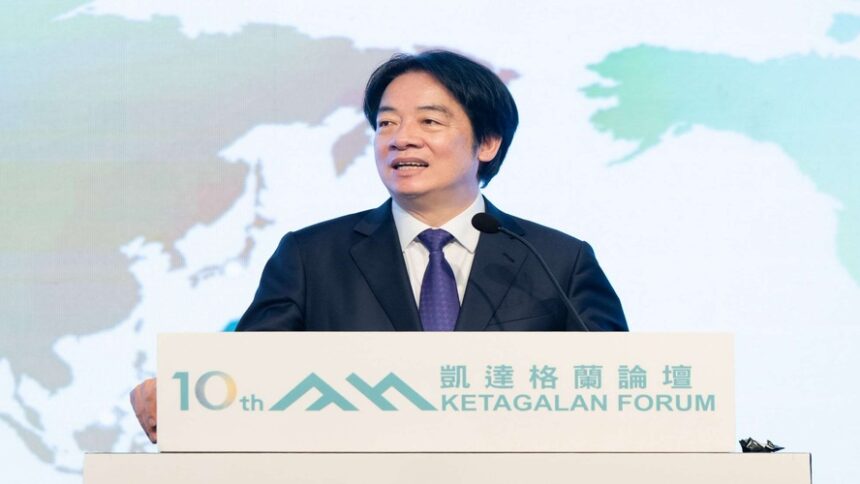
Further comment came from Taiwan President Lai Ching-te who, notably, spoke out against China’s Ethnic Unity and Progress Promotion Law which, he told the gathering, “infringes upon Taiwan’s sovereignty, and persecutes religions and minority groups.”
The president added, “The entire international community should come together and staunchly oppose this malicious law.”
The event was used to launch a campaign to express concern and counter China’s Law on Promoting Ethnic Unity and Progress.
Both the president and former Finnish PM spoke at the opening of the 10th Ketagalan Forum which was held at the Grand Hyatt Taipei on August 4. It was the 10th edition of the forum.
The event has become one of the premier international conferences on strategy and security in Taiwan.
Taiwan hoped the event might serve as a platform for fostering dialogue and cooperation among participants.
Other participants included the Prime Minister of Eswatini Russell Dlamini and Chairman Emeritus of the US House Foreign Affairs Committee Michael McCaul.
The event was attended by 12 prominent political leaders, parliamentarians, scholars, and experts from nine countries across the Asia-Pacific, Europe, North America, and Latin America.
An event spokesman said, “Participants engaged with their Taiwanese counterparts in discussions on the practice of democratic resilience, construction of joint defenses for the Indo-Pacific region, and the shaping of non-red supply chains.”
The spokesman said that, as part of the campaign against the controversial Chinese law, “like-minded allies and partners” in the international community were encouraged to “collectively monitor China’s attempts at extraterritorial jurisdiction and transnational repression, unite in countering this law, and together forge a resilient global defence.”











Leave a comment