

The perfect place to begin your first day is Hora, the island’s main town. With its whitewashed houses, narrow alleyways and flower-filled balconies, it is one of Greece’s most beautiful island settlements. Crowning the hilltop is the Venetian Castle, offering sweeping views over Kapsali, the open sea and the islet of Hytra.
Just below Hora is Kapsali, the island’s most cosmopolitan seaside village. Besides driving there, you can also reach it via an easy footpath that starts at the castle. Twin bays frame the waterfront, while the climb to the lighthouse offers some of the island’s best coastal views.


A short walk beyond Kapsali Beach leads to Sparagario, a small cove hidden at the end of a narrow gorge. Its secluded setting makes it feel far removed from the bustle of the village. If you’d rather skip the hike, Melidoni Beach, about 14 kilometers away, offers equally inviting waters in a quieter setting.
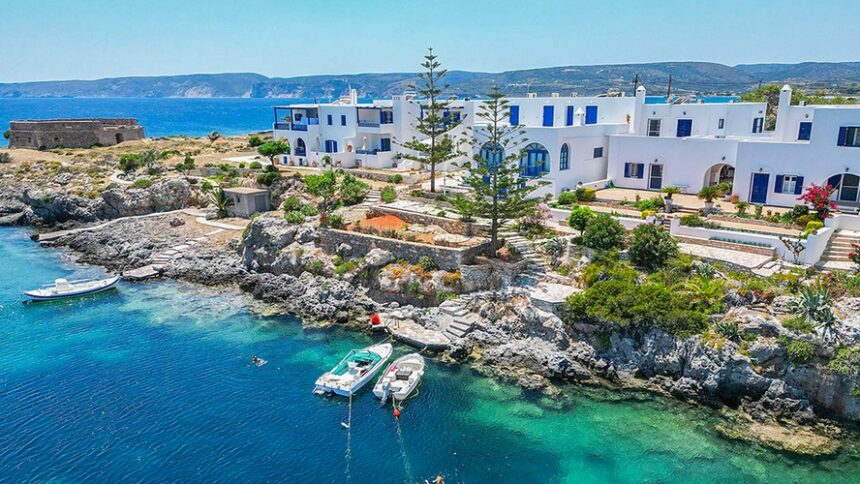
Continue towards the much-photographed village of Avlemonas, stopping along the way at some of Kythira’s best beaches. Halkos is known for its distinctive reddish pebbles and sheltered bay, while Kombonada offers a long shoreline of turquoise water and large white stones. Kaladi, perhaps the island’s best-known beach, is divided into three small coves connected by dramatic rock formations. Reaching it requires descending about 120 stone steps, but the scenery more than justifies the effort.

Day two: Waterfalls, hidden pools and beautiful villages
The second day is dedicated to Kythira’s lush interior. Mylopotamos is a mountain village that, despite suffering extensive damage from wildfires, remains one of the island’s richest landscapes. A footpath beginning below the village square leads down into a ravine with a tall waterfall that flows most reliably in spring and early summer. The scenic trail passes old watermills before reaching Kato Hora, the island’s abandoned medieval settlement. Kato Hora preserves the remains of a once-fortified town where ruined churches, stone houses, and castle walls overlook the sea. Sunset from the old fortress is among the most memorable on the island.

From there, a paved road leads to Limnionas Beach, a sheltered cove dotted with small fishermen’s cottages, evidence of the area’s long maritime tradition. From the beach, a walking trail continues to a heart-shaped emerald pool, whose water levels may be considerably lower after mid-summer.
Among the mountain villages worth exploring on this side of Kythira are Potamos, the island’s largest village, and Karavas, known for the natural springs of Amir Ali. From Potamos, a road also leads to Palaiohora, often referred to as the “Mystras of Kythira.” Perched on a rocky outcrop in the middle of a gorge are the remains of this once-thriving fortified settlement, home to nine Byzantine churches. This was the site of the island’s former capital, Aghios Dimitrios, which was destroyed and plundered by the Ottoman admiral and corsair Barbarossa, who enslaved many of its inhabitants. Following the attack, the settlement was abandoned and, over time, came to be regarded as a cursed place.


Day three: exploring the north
Spend your final day exploring the island’s northern and eastern coastlines, using Aghia Pelagia as your starting point. South of the village are several inviting beaches, including Fyri Ammos, famous for its striking red sand, and the small cove of Lorentzos, where sea caves shape the rocky shoreline.
The same road continues to Kakia Lagada, a vast beach with deep, crystal-clear waters. At the end of the paved road, a dirt track continues towards the gorge of the same name, which also passes through the medieval fortified settlement of Palaiohora.

From Aghia Pelagia, you can also reach Platia Ammos, the northernmost village on Kythira. From there, an easy coastal footpath leads to the staffed Moudari Lighthouse in around 30 minutes. Nearby stand the remains of the old Signal Station, built in the early 20th century and once used to communicate with passing ships.
Just below the lighthouse lies the secluded Aghios Nikolaos Beach, easily reached via a dirt path in about 15 minutes.
Three days are enough to discover Kythira’s character, but never enough to see everything. There is always another beach tucked beneath the cliffs, another village to wander, another trail to follow. By the time the ferry pulls away from the harbor, many visitors are already thinking about their next trip back.
Source: Ekathimerini.com












Leave a comment