
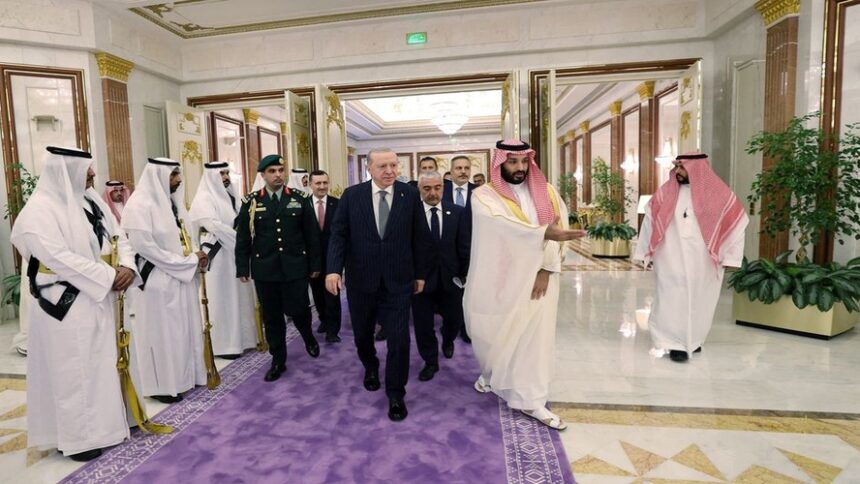
Athens is being pushed to reassess its strategy in the Middle East and North Africa following the expected but unwelcome signing of a mutual defense agreement among Turkey, Pakistan and Saudi Arabia. The pact provides for reciprocal military assistance if one of the three countries invokes the clause.
Egypt has so far remained outside the alliance, although Turkish Foreign Minister Hakan Fidan acknowledged that Cairo had been approached. Fidan described the initiative as an effort to restore stability to a region that, he said, has lacked it since the “departure of the Ottoman Empire.”
Egypt’s reluctance appears linked to its preference for avoiding clear alignment in disputes involving Saudi Arabia and the United Arab Emirates, Greece and Cyprus versus Turkey, and India versus Pakistan. Egypt is also wary of risks to revenues from the Suez Canal and may be seeking distance from a bloc that could eventually confront Yemen’s Houthi movement.
Greek officials expect Egypt to remain an important partner while continuing to deepen ties with Turkey. A meeting held in Egypt roughly two months ago involving the foreign ministers of Egypt, Turkey, Saudi Arabia and Pakistan, alongside Massad Boulos, a senior adviser to US President Donald Trump, underscored both regional engagement and apparent US backing for the alliance.
The development is seen as undermining projects in which Greece had invested politically, particularly the India-Middle East-Europe Economic Corridor (IMEC). The project may now face the same fate as the EastMed pipeline, hindered by costs and shifting geopolitical realities, while support grows for the Middle Corridor route through Azerbaijan, Georgia and Turkey.
The alliance also strengthens Turkey’s position in Syria and raises new strategic dilemmas for Athens as Israel seeks closer coordination with Greece, the United Arab Emirates and India.
Source: Ekathimerini.com












Leave a comment