
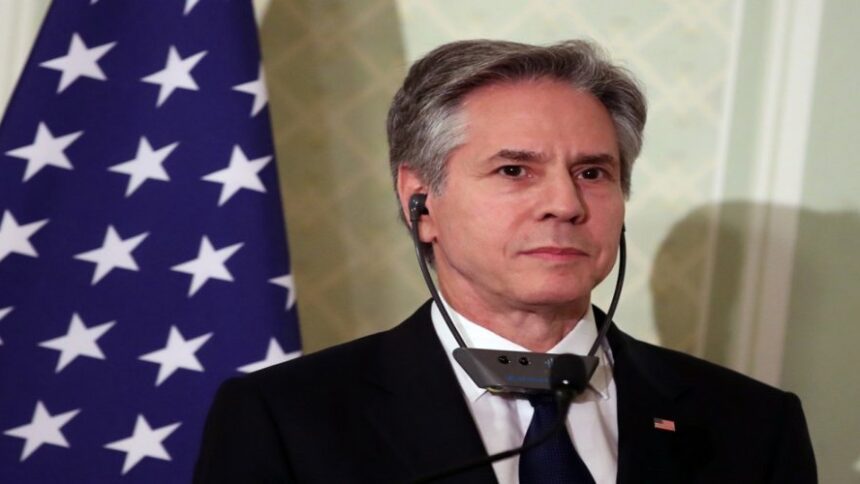

US Secretary of State Antony Blinken warned on Monday (9 December) that Islamic State will try to use this period to re-establish capabilities in Syria, but said the United States is determined not to let that happen.
Blinken said Syrians have to choose their future, adding that statements by rebel leaders toward building inclusive governance are welcome but that the real measure will be in the action they take, not just what they say.
Syrian rebels seized the capital Damascus unopposed on Sunday after a lightning advance that sent President Bashar al-Assad fleeing to Russia after a 13-year civil war and more than five decades of his family’s autocratic rule.
“The end of this regime is a defeat for all who enabled its barbarity and its corruption, none more than Iran, Hezbollah and Russia. So, this moment presents a historic opportunity, but it also carries considerable risks,” Blinken said at an event at the State Department.
“History shows how quickly moments of promise can descend into conflict and violence. ISIS will try to use this period to re-establish its capabilities, to create safe havens. As our precision strikes over the weekend demonstrate, we are determined not to let that happen.”
The ouster of Assad, after rebel forces swept into Damascus this weekend, shattered Iran’s network of influence in the Middle East, but Israel, the United States and Arab powers must now deal with the risk of instability and extremism from the mosaic of forces that replaces him.
Islamic State in 2014 swept through large swaths of Syria and Iraq and established an Islamic caliphate before it was driven out by a US-led coalition by 2019.
Blinken said the US would continue to protect its personnel from any threats.
The US Central Command said its forces conducted dozens of airstrikes on Islamic State targets in central Syria on Sunday. In a statement, CENTCOM said its strikes were aimed to ensure Islamic State does not take advantage of the current situation in Syria.
US seeking to engage with rebel groups
The Biden administration is seeking ways to engage with Syrian rebel groups who ousted Assad and is reaching out to partners in the region such as Turkey to help kick start informal diplomacy.
Speaking at a State Department briefing, spokesperson Matthew Miller said Washington had a number of ways of communicating with various groups, one of which Washington has designated a terrorist organization.
“We have been engaging in those conversations over the past few days. Secretary himself has been engaged in conversations with countries that have influence inside Syria, and we’ll continue to do that,” Miller said.
Governments across the region as well as in the Western world are scrambling to forge new links with Syria’s leading rebel faction Hayat Tahrir al-Sham (HTS), a group formerly allied with Al Qaeda and which is designated a terrorist organization by the US, European Union, Turkey and the UN.
Blinken has been working the phones and speaking with regional leaders and has twice over the past four days spoken with Hakan Fidan, the foreign minister of Turkey, Miller said.
Turkey has troops on the ground in northwest Syria, and provides support to some of the rebels who were intending to take part, including the Syrian National Army (SNA) – though it considers HTS to be a terror group.
When asked if the United States was looking to engage with HTS leader Ahmed al-Sharaa, better known as Abu Mohammed al-Golani himself, Miller declined to say but he did not rule it out either.
“We believe we have the ability to communicate one way or the other, directly or indirectly, with all the relevant parties,” Miller said.
The US designated Golani a terrorist in 2013, saying al Qaeda in Iraq had tasked him with overthrowing Assad’s rule and establishing Islamic sharia law in Syria, and that Nusra had carried out suicide attacks that killed civilians and espoused a violent sectarian vision.
Over the past decade, HTS, previously known as the Nusra Front, has tried to moderate its image, while running a quasi-state centered on Idlib, where, experts say, it levied taxes on commercial activities and the population.
The group was “saying the right things” at this stage but that it was too early to say what was going to happen in Syria, a senior US official briefing reporters on Sunday said.
US Hostage affairs envoy Roger Carstens was also in the region in Beirut as part of intensive efforts to locate Austin Tice, US journalist captured in Syria 12 years ago.
(Edited by Georgi Gotev)
Source: Euractiv.com







Leave a comment