
The European Commission’s top brass have not yet found an agreement on the delicate issue of Ukraine’s grain exports in their meeting on Wednesday (6 September), with only a week to go until current restrictions on the matter expire.
EU import restrictions for certain Ukrainian agricultural products – wheat, maize, rapeseed, and sunflower seeds – are currently in place until 15 September, but even with this end date fast approaching, it remains unclear if and how restrictions will be extended.
In its weekly meeting on Wednesday (6 September), the College of Commissioners discussed the question of the EU’s solidarity lanes – an initiative launched by the EU executive in May 2022 which established alternative logistics routes for Ukraine’s exports using all relevant transport modes – along with the trade restrictions on Ukraine’s exports.
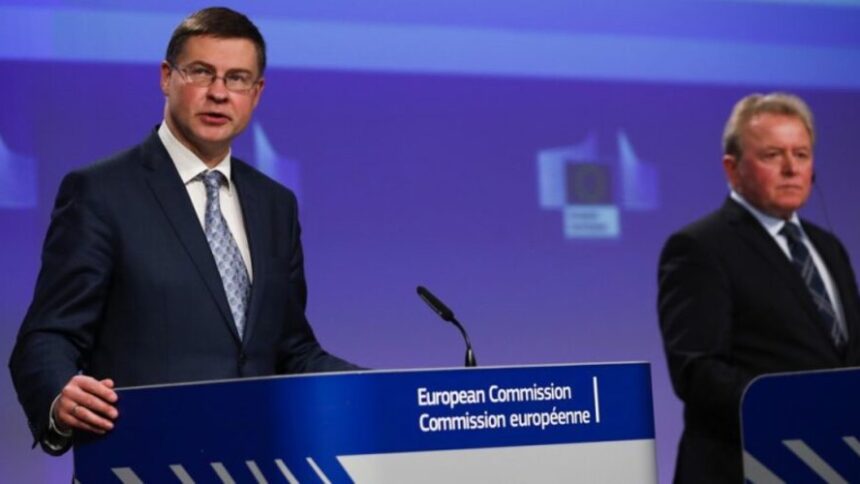
However, the cabinet of Commission President Ursula von der Leyen did not take a decision on the matter, Vice-President Valdis Dombrovskis confirmed at a press conference after the meeting.
“There is important work ahead of us in the coming days and weeks,” he added.
According to Dombrovskis, work on the matter will now continue through the Joint Coordination Platform, a body launched in June to coordinate the efforts of the Commission, the frontline states – Bulgaria, Hungary, Poland, Romania, and Slovakia – and Ukraine to improve trade flows.
Agri commissioner’s proposal met with hesitancy
The lack of results on the matter during Wednesday’s meeting also means that Agriculture Commissioner Janusz Wojciechowski, who went into the meeting to argue in favour of prolonging the import restrictions, has not yet convinced his colleagues.
“Banning ‘border’ imports and allowing only transit has proved beneficial not only to farmers in the five border countries but also to Ukraine itself, which, using only transit, has increased its grain exports,” Wojciechowski said on X, formerly Twitter, on Thursday, adding this is what he “presented” to the Commission.
During a hearing in the European Parliament’s agriculture committee last week, Wojciechowski first presented his “personal proposal” on what should be done in terms of grain exports. This included a prolongation of the current restrictions, flanked by financial support for the transport of Ukraine’s produce to other parts of the world.
Shortly afterwards, however, a Commission spokesperson stressed that this advance was not based “on any sort of official contribution from the Commission”.
The Commission’s balancing act
Wojciechowski’s push to extend trade restrictions is in line with the position of his home country, Poland, which, along with other frontline countries, has called for the extension of the import restrictions and threatened unilateral measures otherwise.
Such unilateral import bans on the part of several countries had already prompted the EU to introduce the current import restrictions, which foresee that the goods in question can transit via the frontline countries but must not circulate there.
The EU countries bordering Ukraine argue that the influx of cheap grain means their farmers are crowded out of the market. On the other hand, agricultural exports are a main source of revenue for war-torn Ukraine and key for funding its defence against Russia’s invasion.
Both sides, Dombrovskis stressed, will be taken into account in the Commission’s decision.
[Edited by Gerardo Fortuna/Zoran Radosavljevic]
Source: Euractiv.com

Related Post






Leave a comment