
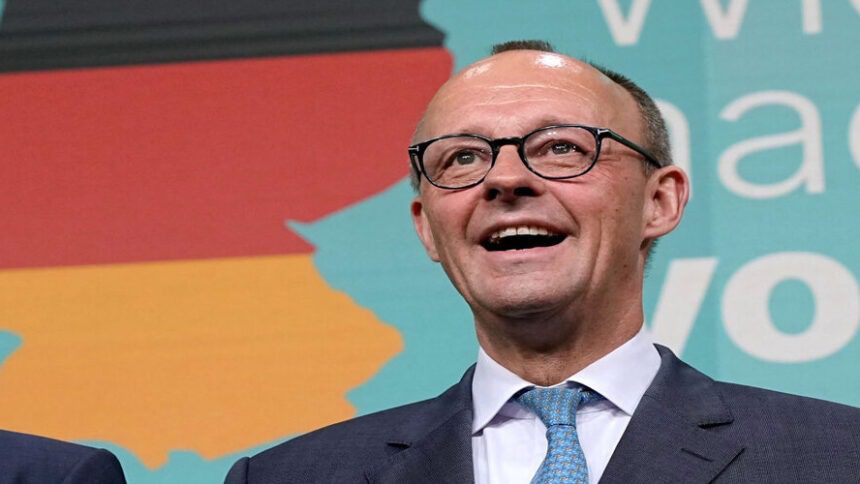

BERLIN – Germany’s centre-right won a clear victory in Sunday’s national election, heralding a major political shift in Europe’s largest country and clearing the way for Friedrich Merz, leader of the opposition Christian Democrats, to become Germany’s next chancellor.
Less certain was what shape a future coalition might take amid a fractured political landscape that will leave Merz with few options. By early Monday it appeared that Merz would have to the votes for a two-way alliance with the Social Democrats, but the outcome remained uncertain.
“It’s now about creating a government that is capable of acting as soon as possible with a solid parliamentary majority,” Merz said after his win. “The world out there isn’t waiting for Germany, and it isn’t waiting for long-winding coalition talks.”
Germans turned out in droves to vote (83% of those eligible cast a ballot, the highest rate since German reunification), leaving no question that they wanted change.
The governing Social Democrats suffered the brunt of voters’ ire, recording the party’s worst loss in more than a century, while putting an inauspicious end to the tenure of Chancellor Olaf Scholz.
The far-right Alternative for Germany (AfD) surged, finishing second – but the party’s showing was in line with expectations, prompting a sigh of relief from many observers who feared the anti-foreigner force would draw even more support in the final stretch following a series of violent attacks committed by asylum seekers.
The main unresolved question by late Sunday was a big one: whether Merz would need one or two coalition partners.
Preliminary official results put Merz‘s centre-right bloc, which also includes the Bavarian Christian Social Union (CSU), at 28.5%, the far-right Alternative for Germany (AfD) at 21 % and the Social Democrats (SPD) at 16.4%.
The Greens won 11.6%, the Left 8.8%, and the liberal Free Democrats (FDP) 4.3%, falling short of the 5% threshold necessary for entry into parliament.
The Sahra Wagenknecht Alliance, a populist, leftist movement named for its founder, finished at 4.97%, appearing to miss the cut-off. However, with the results only preliminary, and a recount possible, it wasn’t clear early Monday if the party would be in or out.
The ramifications of the party’s status are considerable. If the BSW makes it into parliament, the Christian Democrats would need to get the Greens on board to secure a majority. If the BSW falls short of 5%, however, Merz would be able to pursue a two-way coalition with the SPD.
A two-way pairing with the SPD, which is generally considered to be less ideological than the Greens, would clearly be Merz’s preference, as well as that of his Bavarian partners.
Asked if his Greens would approach the CDU over a possible coalition, Vice Chancellor Robert Habeck suggested it was Merz’s prerogative to initiate those discussions. But he also made clear the Greens were willing to join a coalition.
“This is the only possibility,” Habeck told ZDF public television. “One has to let it sink in what this result means: We are in a very difficult situation.”
Whatever the eventual coalition math, the election results, which were roughly in line with the polls, signalled a substantial shift to the right in Germany’s electorate since 2021, with the centre-right bloc and AfD recording a collective 49%, a significant jump from 35%.
Given that Merz has ruled out forming an alliance with the AfD, however, the prospect of a coalition between the two is slim to zero.
‘Rambo zambo’
While Germany’s establishment parties look set to maintain their hold on power, the results pointed to a sea change in the country’s politics, marking the first time since the World War Two that the Christian Democrats and SPD did not take the first two places in a national election.
That may explain why few of the parties seemed in a mood to celebrate, even those that improved their results. While the Christian Democrats fell short of the 30% mark they’d been aiming for, the AfD, which ran on an anti-migration platform, was also hoping to break well above 20%.
The biggest winner of the evening, measured by enthusiasm, was the Left. The successor to East Germany’s communist party, the Left appeared to be on its last legs just months ago following a split that led its most charismatic figure – Sahra Wagenknecht – break away and form her own party.
But with a clever campaign and the support of leftist Greens, who opposed their own party’s overtures to Merz, the Left managed to stage a comeback.
Personal triumph
The projected centre-right win marks dramatic personal triumph for Merz, who had all but abandoned his aspirations of becoming chancellor more than 20 years ago after his then-rival, Angela Merkel, outmanoeuvered him for the party leadership.
After decades in the political desert, Merz (despite Merkel’s best efforts to thwart him) returned as head of the party in 2022 after two unsuccessful bids for the party leadership in 2018 and 2021.
“Now is the time for rambo zambo at the Adenauer House,” an elated Merz told supporters at the Adenauer House, the Christian Democrats party headquarters in Berlin. “Tonight we’ll celebrate, and from tomorrow we’ll get to work.”
Personal defeat
For Scholz, there was nothing to celebrate. The chancellor and former finance minister, whose ascent other the chancellorship in 2021 surprised many, led the party to its worst national election result since 1887.
Though Scholz managed to silence his detractors for a while with his surprise win in 2021, as chancellor he proved incapable of reining in his fractious three-party coalition. He was ultimately forced to trigger its collapse in November, a year before the end off its regular term.
“This is a bitter result for the Social Democratic party, it is also a defeat – it needs to be said loud and clear,” Scholz said Sunday, signalling that he would step away from the limelight.
Supporters were dead silent in the party’s headquarters when the SPD result was announced.
‘Elefantenrunde‘
Merz said during the election night Elefantenrunde roundtable talkshow of top candidates that he hoped to form a new government by Easter, and that he wants to talk “properly” to the Social Democrats after a tough exchange of blows on the campaign trail.
He also repeated his rejection of a coalition with the AfD, while underscoring the urgency of building a coalition quickly amid the growing uncertainty surrounding the transatlantic alliance and the war in Ukraine.
“The world is not waiting for us. Europe is waiting for us, for Germany, to take on a stronger leadership role again,” Merz said.
Merz, a keen transatlanticist, added that Europe should prioritise agreeing on a united position on the US’s negotiations with Russia on Ukraine.
“For me, it will be an absolute priority to strengthen Europe as quickly as possible so that, step by step, we can really achieve independence from the USA,” he stressed, noting that “the Americans, at least this administration, are largely indifferent to the fate of Europe.”
The CDU’s leader in the European Parliament, Daniel Caspary, hailed the victory as a win for Europe.
“The largest European country, in the heart of Europe, is now back on track,” Caspary told Euractiv.
If so, it will have to make do without some familiar faces.
Christian Lindner, the former finance minister whose departure from government hastened the collapse of Scholz’s coalition government, announced his resignation after the FDP crashed out of parliament.
[mk, OM]
Source: Euractiv.com







Leave a comment