
There’s a special expression in southern China to describe the natural world after a light rain: “Yan yu meng meng” evokes the mist and haze that envelop both the landscape and the people within it. “It creates a beautiful scene. Many ancient stories and poets describe and write about this landscape after the rain,” director Meng Jinghui tells us on a rainy day in faraway Wuzhen, in Zhejiang Province.
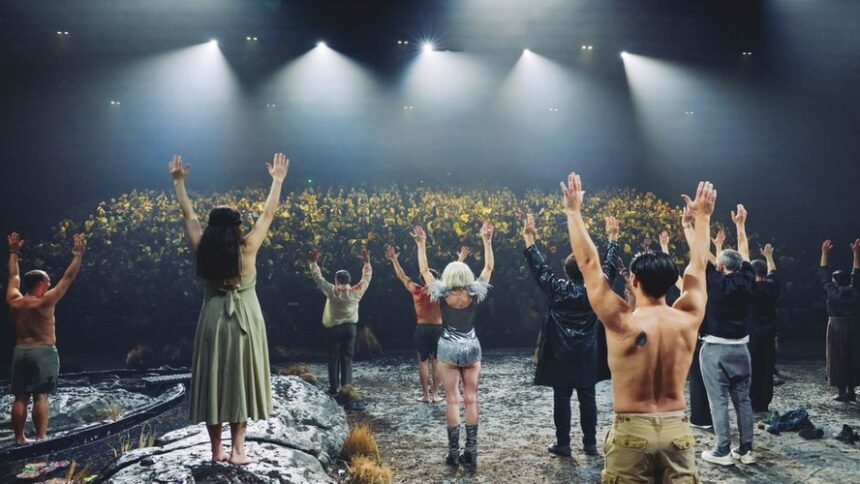
It is Friday, October 23, and by the time we meet the artistic director of the Wuzhen International Theater Festival, we have already spent two days in the small historic town. In a country of 1.4 billion people, it is little more than a dot on the map. Yet every October, for 10 days, Wuzhen, with its population of 60,000, hosts a festival featuring contemporary productions from China and abroad, introducing local audiences to contemporary theatrical trends. This year’s international lineup included “Hippolytus,” directed by Katerina Evangelatou for the Greek National Theater.
‘The Chinese public still has a rather stereotypical idea of what a production of ancient Greek drama looks like and how it is performed’
Kathimerini met with Meng just a few hours before the Greek company was to take the stage to explore the questions at the heart of Euripides’ tragedy: Who is responsible for our fate? Humans or the gods?
“The Chinese public still has a rather stereotypical idea of what a production of ancient Greek drama looks like and how it is performed,” Meng tells us, making a gesture that evokes an exaggerated style of acting. “We wanted to show audiences how a Greek female director interprets and approaches this ancient Greek text.”
Those who grew up in the 1990s in particular, he explains, were eager to learn more about Western culture, and ancient Greek tragedy was part of that. “Today, young people have the Internet and many more choices, but I don’t know whether ancient drama is something they want to see or not. That’s why I feel a duty to introduce them to more unusual, more unconventional works that have a particular idea behind them.”

To get to Wuzhen, we traveled by road from Shanghai, a distance of about 130 kilometers. If China’s largest city, with a population twice that of Greece, overwhelms visitors with its sheer scale, skyscrapers rising across its vast expanse, cameras monitoring their every move and stark contrasts, Wuzhen is equally striking for the understated beauty it owes to one defining natural element: water.
‘Venice of China’
Wuzhen’s history dates back to the 7th century and the Tang Dynasty. Built around a network of canals and small rivers, it is connected to one of China’s great waterways, the Grand Canal, which links rivers and lakes and has connected the north and south of the country since ancient times. Today, it is protected by UNESCO. It is often referred to as the “Venice of China,” but as we walk along its cobblestone streets, I find myself thinking that the comparison is overly cliched and does a disservice to both historic cities. One thing they certainly have in common, however, is the crowds of tourists everywhere.
Following an extensive heritage restoration program – much of the town’s historic fabric was destroyed during the Cultural Revolution – traditional buildings were restored and new tourist facilities developed in an effort to bridge the past and present. The result is an idyllic vision of ancient China that evokes mixed feelings. Its beauty is undeniable, yet it is hard to escape the impression that the town has become something of a picture-perfect stage set for tourists.
Indeed, during our time there, the narrow streets would fill with groups of tourists photographing the wooden houses with their dark, curved roofs, now home to small shops and restaurants; the stone bridges adorned with traditional motifs that span the canals; the Buddhist temples; and the White Lotus Pagoda, which rises 50 meters above the ground. Meanwhile, posters advertising performances and visitors wearing yellow and orange badges as they search for tickets serve as reminders of the theater festival taking place alongside the tourist bustle. As wooden boats glide along the canals, performances are held in the open air outside Wuzhen’s ancient academy.
The Wuzhen International Theater Festival was founded in 2013 by three artists working in collaboration with the local community: Meng; Huang Lei, one of China’s most celebrated actors (whom we repeatedly saw being pursued by fans seeking autographs); and director and playwright Stan Lai, known for his play “Secret Love in Peach Blossom Land,” which was also staged in Greece in 2018.
“The festival is structured around four pillars,” says Lai, as we dig into our bowls of steaming noodles. “These include the productions we bring in from abroad, the competition for emerging artists, the discussion forums, and the theater and music performances that take place in the streets. From day one, we said we wanted the festival to be a window through which China could see the world through theater, and vice versa. I think the first part is working. As for the second, the ‘world’ has yet to arrive. The theater productions come, but we’re still waiting for the day when tourists start coming from places like Greece, for example.”
The sun has set and the reflections of Wuzhen’s red and yellow lights on the water create a mesmerizing spectacle. As we make our way to the performance of “Hippolytus,” in one of the festival’s largest venues, I find myself reflecting on the productions that stood out during our visit. We saw works from Germany, France and China itself, telling stories that did not shy away from political and social questions.

All the productions are subject to government scrutiny, and as the festival organizers explain, there are certain boundaries that cannot be crossed. “We try to discourage visiting directors from submitting proposals that are overtly political. But as an artist today, it’s impossible not to be political. Chinese audiences are intelligent. They understand what a performance is really about,” Lai says. “I know this may seem difficult or strange from your perspective, but this is our reality, and we do the best we can.”
Around the world
Eva Manidaki’s set, a marshy landscape of shrubs, stalks of wheat and water symbolizing desolation and the gradual disintegration of human existence, took three months to reach China by sea, bypassing the Suez Canal for safety reasons.
The 1,300-seat auditorium was packed for the premiere, as the audience watched the goddess Aphrodite (Elena Topalidou) toy with the desires and destinies of Phaedra (Kora Karvouni), Theseus (Yannis Tsortekis) and Hippolytus (Orestis Chalkias), setting them on a path to destruction. At the end, the applause was somewhat subdued, as audience members were busy holding up their phones to photograph the actors. We were told that Chinese theatergoers immediately post photos and reviews on social media, rating the performances they see. “Hippolytus,” we learned, scored 7.8 out of 10 – a very good rating.
This was Katerina Evangelatou’s fourth invitation to stage a play in China. Following the premiere of “Hippolytus” at Epidaurus in 2023, the Greek director took both smaller- and larger-scale versions of the production to the Aranya Festival near Beijing and to Hong Kong. A few months ago, she was also commissioned to direct Aristophanes’ “Lysistrata” at the National Theater of Shanghai, with a Chinese cast. “It’s a great honor to be here,” she tells us over coffee before the production’s second performance.
“Over the years I’ve been coming to China, I’ve seen how eager people are to discover something new. They want us to hold workshops and discussions. They ask questions, they’re curious and engaged. The restrictions imposed by the sociopolitical climate have an impact on how they perceive art. There’s a gap when it comes to contemporary theater, and the festival organizers recognize that. They appreciated our work here and invited a company of 40 cast and crew members to travel from Athens. That’s no small undertaking. It was a major investment on their part,” she says.
For the record, Evangelatou did not have to make any cuts to Euripides’ text for this production, only to cover up the nudity. The only thing that actually needed trimming was the natural vegetation used in the set, so it could be shipped back to Greece.
Source: Εkathimerini.com









Leave a comment