

By Martin Banks
Think Belgium and things like Manneken Pis, trappist beer and les frites may spring to mind.
There is, of course, also chocolate, probably the most iconic of Belgian products.
One of the country’s finest and best-known chocolate makers is Leonidas (which ironically has Greek connections) and it has just marked a highly significant milestone in its long and successful history.
The company has moved, lock stock and barrel, to brand new premises with the official opening taking place on 15 October.
Its new home is a sprawling site on an industrial estate near Nivelles, about 30 km south from where it had been based for many years in Anderlecht, Brussels.
With over 1,200 points of sale across 40 countries, the Leonidas praline brand is a favourite among Belgians and internationally, too with 50% of its production exported.
The new site occupies a five-hectare plot in the Nivelles-Nord industrial zone and includes offices, production facilities, and warehouses—previously spread across two sites in Brussels.
This arrangement has reduced the need for transport between sites and the associated environmental impact.
The new factory comprises 8 industrial lines and 3 artisanal lines—including 5 brand-new ones—and this will enable an expansion of the product range, offering consumers a more diverse and innovative selection in terms of product categories, flavours, shapes, and decorations.
The research and development division has also been strengthened, with nearly 1,000 m² dedicated to laboratories and pilot production lines.
The new plant has earned “BREEAM Excellent” certification, which recognizes the environmental performance of what is a major project.
This certification evaluates factors such as worker health and well-being, energy and water management, transport and mobility, the materials used, and waste management.
Geothermal energy, photovoltaic panels and rainwater harvesting systems all further contribute to this sustainability.
The original idea, according to Leonidas CEO Philippe de Selliers, had been to find somewhere in or close to Brussels, near its former location which, due to its success, it had outgrown.
But, failing to find somewhere suitable, it was decided to move the entire operation.
The whole workforce has therefore moved from Anderlecht to Nivelles which has quick and easy transport links, affording even more accessibility to the 40-plus countries where the brand is distributed.
The company says it is pleased with the way its staff has embraced the relocation. In fact, 100% of the workforce—including management, office staff, and production workers—joined the chocolatier for this new chapter in its story.
Chocolate isn’t the only thing the new premises can boast – it also features its very own chocolate museum and an “experience centre” where visitors can better understand what goes into the chocolate making process.
The centre is an immersive space that seeks to showcase the Belgian chocolatier’s sustainable and ethical craftsmanship, with the aim of inspiring new careers within the sector.
The site also includes a creative workshop where guests can roll up their sleeves and craft their own praline alongside a Master Chocolatier.
“Through this immersive space, Leonidas aims to boost the appeal of careers within the Belgian chocolate industry,” said a spokesman.
Chocolate is a flagship of the national food sector in Belgium. The chocolate industry generates nearly 7.7 billion euros in revenue—accounting for 10% of the entire food industry’s turnover. It employs over 14,200 people across 600 companies and seeks approximately 800 new talents every year.
As a standard-bearer for Belgian chocolate, Leonidas hopes to “reveal the richness of these professions and inspire a new generation to pursue them,” said the spokesman.
The official inauguration included Pierre-Yves Jeholet, Vice-President and Minister of Economy for the Walloon Region and Bernard De Ro, Mayor of Nivelles who spoke of the importance of the move to the local economy.
Speaking at the launch of its new home – which comes after an investment of some €100 million – de Selliers told this website he was “very excited” about the new venture, saying, “The first choice was to stay in Brussels because that is where we had been as a business for a long time but we are very happy to have found this new site.
“We needed to find somewhere large enough to cope with increased production and where we could also relocate all our staff which I am happy to say we have managed to do.”
He added, “It is vital for us that our product remains as affordable as possible and that we keep prices as low as possible. Being here at this new site will enable us to do just that.”
Including international companies, Leonidas, with 400 shops in Belgium, currently occupies 4th spot in overall chocolate making sales in Belgium.
The CEO’s comments were echoed by Chantal Goosens, the company’s commercial director, who also said it was hoped to expand more internationally including in the UK.
There are, so far, only about 15 Leonidas stores in the UK, mostly in London but also Brighton, but the aim is to use the facilities at its new Nivelles production to steadily expand in the coming years.
She told this site, “The UK is an important market for us and, going forward, it certainly has lots of potential.”
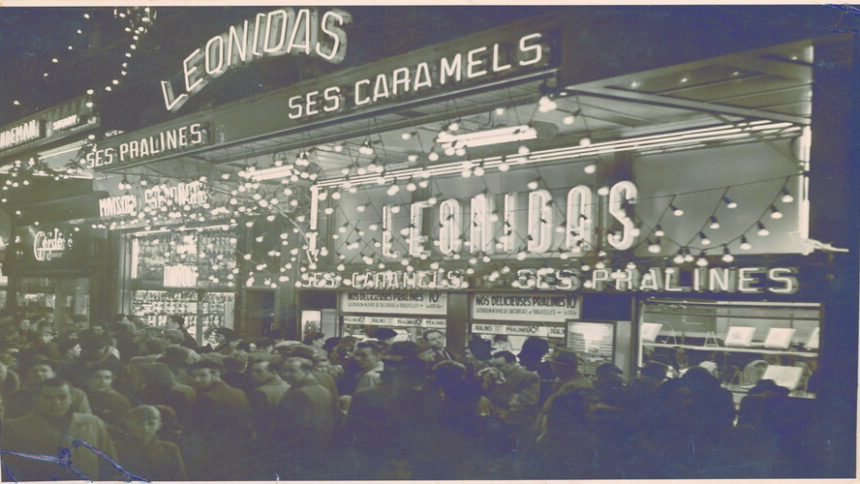
Since its inception in 1913, Leonidas has established itself as an iconic Belgian family business.
The size of the business today is a far cry from its relatively humble beginnings.
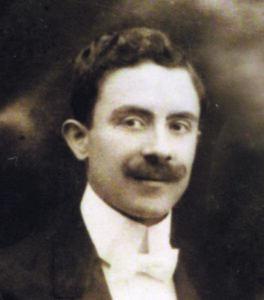
It was founded back in 1913 by Leonidas Kestekides, a confectioner who had Greek origins.
It was not long before it started winning awards for its chocolate.
The first came in 1910 with a bronze medal at the World Expo in Brussels with the second coming three years later at the Gent World Expo (this time a gold medal).
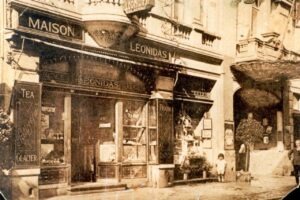
As told in the new on-site museum in Nivelles, Leonidas met and fell in love with a Belgian woman, one Joanna Teerlinck, married and settled in Gent where the first Leonidas shop opened.
The second followed, in Blankenberge on the Belgian coast, with a third opening in Brussels soon after.
Leonidas’ nephew, Basile, has played a key role in the company’s success story over the years.
This started, somewhat ignominiously, when he was given, in 1935, a police warning about illegal street vending Brussels.
His reaction was to rent a small room in the city centre and display his praline chocolates on the windowsill of an open window from where he sold them directly to passers-by.
It was, at the time, seen as a revolutionary idea and the rest, as they say, is history.
The company and brand survived the ravages of WW2 and Nazi occupation of Belgium thanks to cocoa reserves which had been, very cleverly, secured by Basile.
In fact, during the war and occupation Leonidas pralines became an “essential” food for Belgians to the point where the Belgian Government actually added them to the list of basic necessities, alongside bread and milk.
Another key milestone in the company history came in 1937 when Basile chose what has become the famous and eye catching Leonidas logo and the one that appears on all of its products. This is the head of the Greek King of Sparta – Leonidas.
Basile chose it as a tribute to his uncle and the company’s founder.
de Selliers says that, today, Leonidas has now turned a new page in its history by inaugurating its new production facility in Nivelles.
It is, he said, designed to support the company’s growth in Belgium and internationally.
“The site helps make the pleasure of chocolate even more accessible to everyone across the 40 countries where the brand is distributed,” he said.
During the opening, reporters were given a sneak look at the new site, including the experience centre which takes visitors through the different stages of chocolate production.
This starts with cultivation of the cocoa bean – Leonidas sources its blend of cocoa beans largely from three countries in West Africa: Ghana, Togo and the Ivory Coast. Some also come from Vietnam and Venezuela.
As told by Daniel Stallaert, Maitre Chocolatier Leonidas, the process is, in essence, “much the same as it always has been.”
Daniel explained how the process continues with drying, roasting and cracking to mixing and refining and, finally, the moulding of the chocolate in the shapes you see in shops.
I watched as workers, mostly female, busily sorted and packaged the whole vast range of Leonidas chocolates on assembly lines into gift boxes, including some already being readied for the enormously important upcoming Christmas period.
One of the reasons the company has relocated to the new site in Wallonia is to accommodate increased production and, in doing so, keep it ahead of the game in Belgium.
The new factory is noticeably larger than the one in Brussels, spread over 30,000 square metres compared with 25,000 sq mt in Anderlecht.
The potential for increased production means new products could soon be rolling off the production line.
At present the biggest consumers of pralines – the type produced in Belgium – is Belgium itself, followed by France and Germany.
Tours take about 3 hours and for school trips and companies, of the museum and experience centre will be available (though they are not open to the public).
More than 110 years after its founding, Leonidas says the aim is to remain true to its core identity while looking firmly toward the future: continuing to promote Belgian chocolate, both within Belgium and far beyond its borders.

Related Post











Leave a comment