
By Martin Banks
It is easily Belgium’s most popular tourist attraction … and has just got even better.
Pairi Daiza attracted neary 3m visitors last year and has won an armful of top international awards.
It has recently opened a new feature which is sure to cement its place at the top of the visitor attractions pile.
The latest development is called Edenya and it is a marvel on different levels.
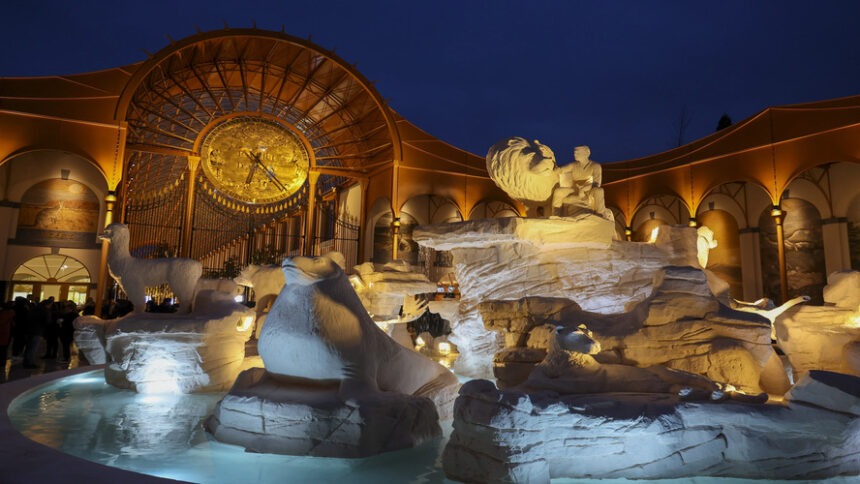
The size of no less than six football pitches, this is an indoor tropical world – a massive greenhouse, if you like – which sits beneath a massive glass canopy.
Belgium may not feature in the Guiness Book of Records too often but this place has already found a place in that well-known publication – as the world’s largest tropical greenhouse.
This huge eco system also holds another record: for plant diversity in tropical greenhouse, with no less than 1,800 species. On records alone, nothing else in Belgium,surely, can compare.
All this has been achieved even though Edenya opened only a few months ago (February).
It is, for sure, a sight to behold.
But any visit to Pairi Daiza traditionally starts with the park itself, which is outdoors and is, also, a wonderful experience.
First, a bit of history.
It was Eric Domb, a lawyer by training, who first launched the whole place, way back in 1994.
The site had been the former Cistercian abbey of Cambron, founded in 1148 in Brugaletter, in the heart of Picardy Wallonia. With the support of his family =– and a “visionary banker” – Eric opened Paradisio, an ornithological park which was home to 2,500 birds representing 400 species.
The impressive “cathedral” aviary is still among the largest in the world.
In 2006, it reached a new level with the creation of an authentic 4.50 hectare Chinese garden ( visited by no less than the Chinese President Xi Jinping in 2014).
Fast forward to 2010 and Paradisio was renamed Pairi Daiza, a name derived frm the old Persian “Pairi daeza” which means walled garden or paradise.
Today, the park, far more than a mere zoo, is broadly divided along five thematic sections: the “first wonder” (the animals), the second (trees and gardens), third (minerals), fourth (human creations) and fifth (called “love that protects”).
Arguably the main attraction that continues to lure so many visitors to this place are the animals themselves…. And what a collection it boasts.
There are over 7,000 of them (800 species) including the largest herd of elephants in Europe.
But these wonderful creatures are not there just to be gawped at as if exhibits.
They are,lest we forget, living creatures like the rest of us and lovingly cared for by over 100 keepers and veterinarians and park itself continues to do its bit for animal protection across the world.
Pairi Daiza, it should be noted, takes part in over 100 European endangered species breeding programmes which help preserve the genetic diversity of the estimated 47,000 endangered species globally.
It also plays a key role in global conservation and provides a refuge for rare treasures of the animal world such as the Komo-do dragon.
Eric Domb, founder and chair of Pairi Daiza, says the “sweetest of miracles” is to see the park’s animal inhabitants “live without fear, in peace and carefreeness.”
Also worth a mention is the Pairi Daiza Foundation which aims to promote respect and love for animals and supports scientific research and education on animal welfare. The figures are impressive: in 2025 alone the Foundation devoted more than €2m across 23 new projects.
If you have the time you can even enjoy a sleep over at this terrific place as there are plentiful rooms available across the whole site for an overnight stay.
This also extends to its latest feature, Enenya, which was unveiled earlier this year after an investment of some €215m, by far the largest sum ever spent at the park.
Visitors (there’s a small additional entry fee to pay) meander through jungle, rivers, a particularly impressive waterfall and even a sunlit beach, all populated by more than 230 animal species, including manatees, otters and pygmy hippos and jaguars (there are 4 duplex suites with direct views of the great cats) as they move around their enclosure. There are, in fact, some 88 new immersive hotel suites which make for an extra special visit to what is an extra special place.
There’s 1,800 species of rare plants including “legendary” cocos de mere (or sea coconuts) which are found only in the Seychelles.
Aside from some remarkable wildlife (like the park itself), Edenya has what is thought to be Europe’s only full underwater resto.
Edenya, brought to live by dozens of Belgian and international companies, manages to maintain a warm and humid climate in a greenhouse over 20metres tall, regardless of weather conditions or season.
Thierry Gerard, assistant director of the park’s major projects, says, “Edenya is a unique construction, one that defies traditional building classifications.”
it also does its bit for the environment, boasting no less than 94,000 solar panels and over 100 charging stations for electric vehicles.
Of course, all this was initially made possible by Eric Domb’s decision, years back, to take a very different career path.
Though trained as a lawyer and financial expert, he remained, at heart, a traveller and gardener and, ultimately, became a fierce defender of animal welfare.
He was just 32 when he discovered the old Abbey – parts of which are still intact here – and decided to give his career a new direction altogether, turning his childhood dream into reality.
The rest, as they say, is history.
This place has a special fondness for this writer as it was one of the first places my family visited when I moved to Belgium some years ago.
We had not visited since and it revived happy memories of walking round the very sizeable site with our, then, very young kids.
On our visit we saw lots of families with young kids again but it was Belgium’s national day and pretty hot too. As such, quite a few of the animals were, as can happen at such places, taking a well earned snooze but they are as pretty much as wonderful to behold fast asleep as they are awake.
The site, among all its other activities, also holds special events from time to time and, the national day marked the latest: a series of top line acts and entertainment on various stages erected over the whole site. Best to consult the website for what’s coming up.
Pairi Daiza, which has a 900-strong workforce and was voted Europe’s best zoo last year, has earned its reputation by constantly evolving and expanding (Edenya is a good example) and this continues.
The latest example is the birth of two golden snub-nosed monkies, the world’s rarest primates. These are houses in only a handful of European zoological parks but the new birth of these two infants at Pairi Daiza represents a significant achievement for its international breeding and conservation programme.
If you are looking for a great day out (or even an overnight stay) in Belgium this summer then this fantastic place will not let you down.
Further info: www.pairidaiza.eu










Leave a comment