
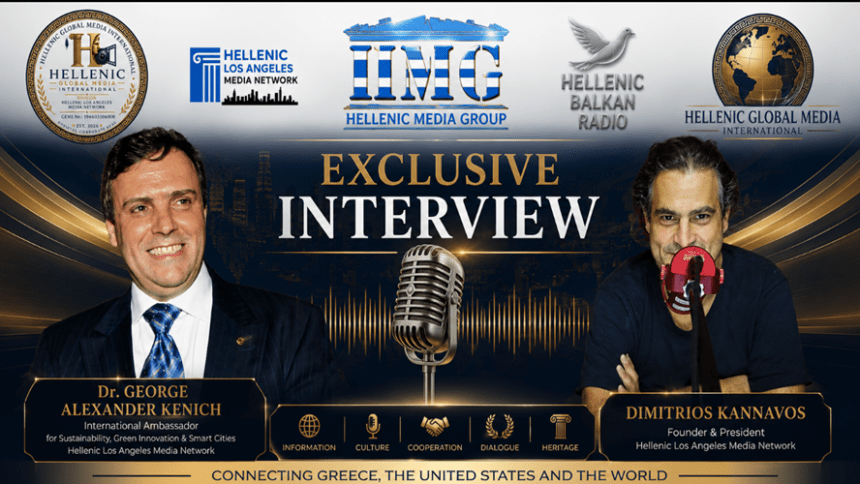

Our guest today is a globally recognized engineer and sustainability expert whose work has contributed to some of the Middle East’s most iconic developments. Featured on the cover of Construction Week magazine as the “Green City Guru,” Dr. George Alexander Kenich has dedicated more than three decades to advancing sustainable cities, renewable energy, and smart infrastructure across the world. It is a great honor to welcome him to the Hellenic Los Angeles Media Network for this exclusive interview.
Dr. Kenich, your career spans more than three decades across sustainable cities, renewable energy, and mega infrastructure projects. Looking back, what has been the defining moment of your professional journey?
Looking back over more than three decades, I would say the defining moment of my professional journey was realizing that, the urban development is the transition from managing isolated commercial construction to engineering fully autonomous, mixed-use smart cities. A defining moment arrives when developing the phased capital expenditure and operational framework required to support thousands of residents and annual visitors. It is the exact point where traditional construction evolves into creating a self-sustaining and Autonomous ecosystem.Ιt is about shaping the future of communities.
It is a profound and incredibly powerful reflection on a three-decade journey. Moving from the transactional metrics of traditional construction—simply delivering on time and within budget—to the holistic engineering of living, breathing autonomous ecosystems is a monumental shift in perspective.
My philosophy outlines a clear evolution in how we must approach the built environment. It reframes development not as a series of isolated structural projects, but as the creation of dynamic, interconnected entities.
Early in my career, success was often measured by delivering projects on time and within budget. Over the years, however, working across sustainable cities, renewable energy, and large-scale infrastructure transformed my perspective. I came to understand that the true value of a project lies in its long-term social, environmental, and economic impact.
One of the most significant milestones was contributing to projects that integrated renewable energy with urban development. Seeing how innovative engineering could improve quality of life while reducing environmental impact reinforced my belief that sustainability is not a constraint—it is an opportunity for innovation and growth.
Another critical turning point is the integration of next-generation power into these massive urban grids. The challenge of balancing Battery Energy Storage Systems (BESS) and photovoltaics with the theoretical and practical application of Small Modular Reactors (SMRs) or microreactors forces a massive leap in strategic thinking. When these systems are managed through advanced digital twins and utilized to power massive undertakings like coastal technology hubs, the infrastructure stops being passive and becomes a highly dynamic entity.
That realization has guided every major decision since. Whether leading multidisciplinary teams, advising governments, or overseeing complex infrastructure investments, my focus has always been on creating resilient systems that will continue to serve future generations.
Ultimately, I believe my career has been defined not by any single project, but by a consistent commitment to leaving places better than I found them—building green Cities and infrastructure that is not only technically excellent, but also sustainable, inclusive, and future-ready.
The most profound realization in such a career is recognizing that mega infrastructure is not just about concrete, securing strategic investment funds, or ensuring structural integrity. It is about understanding the deeper connectivity of the systems and the people within them. Just as quantum entanglement dictates that entities remain inextricably linked across space, a true master-planned city weaves its clean energy grid, its physical engineering, and the human inspiration of its citizens into a single, unified consciousness. It proves that structural integrity is not just physical; it is systemic and social. Much like the principles of quantum physics and the Dirac equation, where entities remain inextricably linked across space, a true master-planned city weaves together clean energy, engineering, and human inspiration into a single, unified vision.
You have contributed to internationally renowned developments such as Masdar City and Yas Island. Which project has had the greatest impact on your vision for the cities of the future, and why?
While both Mega developments were monumental, Masdar City fundamentally reshaped my blueprint for future urban infrastructure. This is a brilliant and highly compelling vision for the future of urban design. Perfectly articulated the classic tension in modern city planning: the divide between the purely utilitarian “green laboratory” and the high-yield, purely commercial “entertainment hub.”
Masdar proved that a localized Green City, transportation, energy saving buildings design, livable environment, autonomous microgrids and district-wide renewable integration are not just theoretical concepts, but practical realities. The whole development shifts from being a drain on regional resources to a self-sufficient ecosystem. It embeds resilience directly into the bedrock of the development. It pushed the boundaries of how we implement new technologies, energy, passive cooling, district cooling and battery energy storage systems (BESS) at scale, demonstrating that a city can effectively function as its own decentralized power plant.
However, if Masdar provided the technical backbone, Yas Island provided the vital lesson in human-centric, fast-track development. Yas is a masterclass in building massive, mixed-use economic engines that draw millions of people and create vibrant, high-energy environments. Yas Island proves that scale and speed do not have to come at the expense of human magnetism. The city is a destination. If the streets, public squares, and mixed-use zones do not generate energy, culture, and capital, the “smart City Development” and “smart” infrastructure beneath it goes to waste.
My vision for the cities of the future is the direct synthesis of these two extremes. We can no longer build smart cities that function merely as green laboratories, nor can we build commercial hubs that ignore energy resilience and structural integrity. The future lies in creating fully autonomous, self-sustaining ecosystems that are also deeply engaging, culturally rich places to live and work.
In both projects, we have targeted the exact sweet spot where the cities of tomorrow need to exist. Sustainability is not just a hidden utility; it is woven into the cultural and social fabric of the city. Passive cooling designs can become architectural centerpieces, and autonomous transit enhance human connection rather than isolating individuals.
This philosophy effectively moves urban development past the “proof-of-concept” phase and into the era of holistic, human-centric resilience.
Sustainability without livability becomes sterile, while economic vitality without resilience is ultimately doomed.
Climate change is one of the greatest global challenges of our time. What practical actions should governments, businesses, and local communities prioritize over the next decade?
Tackling a challenge as vast as climate change requires shifting from abstract goals to aggressive, localized implementation. To make a meaningful impact over the next decade, the focus must move away from long-term pledges and toward immediate, structural changes across every level of society.
Governments, private sector and local communities must be creating the economic and physical infrastructure that makes sustainable choices the default.
Government has to:
Modernize the Grid: Renewable energy is useless if the grid cannot handle it. Implement
Aggressive Carbon Pricing: Whether through a carbon tax or a cap-and-trade system
Overhaul Building Codes and Zoning: Mandate strict energy efficiency and zero-emission standards for all new construction. New Zoning laws should be rewritten
Private sector (Businesses) has to:
Transition to Circular Economies: Move away from the “take-make-dispose” model. Businesses should design products for durability, repairability, and end-of-life recycling.
Tackle Emissions: It is no longer enough for a company to power its own offices with green energy. Businesses must audit and decarbonize their entire supply chain, requiring suppliers and logistics partners to meet strict emission reduction targets.
Climate Risk Audits: Companies must aggressively assess how physical climate risks (extreme heat, flooding, supply chain disruptions) will impact their operations and invest in physical resilience, not just emission reductions.
Local Communities has to:
Develop Autonomous Microgrids: Taking a cue from projects like Masdar City, neighborhoods should invest in community solar projects tied to localized battery storage. This not only democratizes energy production but ensures communities keep the lights on during extreme weather events when the main grid fails.
Deploy Green Infrastructure: To combat the “urban heat island” effect and manage severe rainfall, communities must aggressively expand urban tree canopies, install green roofs, and replace concrete with permeable surfaces.
Prioritize Active Mobility: Reclaim street space from private vehicles to build safe, protected infrastructure for walking, cycling, and electric micro-mobility. This directly cuts local emissions while making neighborhoods more vibrant and engaging.
Real progress over the next decade relies on these three pillars working in tandem: government policy creating the framework, corporate innovation scaling the solutions, and local communities adapting the infrastructure to their daily lives.
As someone internationally recognized as the “Green City Guru,” how do you define a truly sustainable city in the twenty-first century?
A truly sustainable city in the 21st century is a living, breathing hybrid. It is no longer just about planting trees or minimizing carbon footprints; it is about building a highly efficient, decentralized ecosystem that people actually want to live, work, and thrive in.
It sits at the intersection of ecological resilience and human magnetism, defined by three core pillars:
Circular Metabolism (Resources independence). The 20th-century city was linear: it imported vast amounts of energy and water, and exported vast amounts of waste and pollution. The 21st-century city is circular.
Decentralized Energy: It generates its own power. Every rooftop, facade, and district serves as a node in a localized microgrid, backed by utility-scale Battery Energy Storage Systems (BESS) that keep the city running even when the regional grid fails.
Closed-Loop Systems: Waste is no longer a liability; it is fuel. Blackwater is treated and reused for district cooling, solid waste is converted to energy or composted for urban agriculture, and the city acts as a zero-drain environment on the surrounding ecosystem.
Human-Centric Engine (Economic & Cultural Yield). A city can be perfectly green, but if it is culturally sterile, it will fail economically and socially. Sustainability must be woven into a livable environment.
Hyper-Proximity (The 15-Minute City): Daily necessities—work, education, healthcare, and entertainment—are within a 15-minute walk or cycle. This naturally eliminates the need for mass private car ownership while massively boosting local commerce and street-level vibrancy.
Cultural Density: Public squares, mixed-use zoning, and seamless autonomous transit are designed to force human interaction. The city remains a destination—a powerful economic engine that draws talent and capital.
Adaptive Physiology (Climate Resilience). The physical structure of the city must anticipate a harsher climate, using nature as a technology rather than just an aesthetic afterthought.
Passive Architecture at Scale: Buildings are oriented and designed to cool themselves naturally through wind tunnels, shading, and advanced materials, drastically reducing the load on HVAC systems.
Sponge Infrastructure: Concrete is replaced with permeable surfaces, urban wetlands, and deep-root tree canopies. This mitigates the urban heat island effect while safely absorbing and storing floodwaters from extreme weather events.
Renewable energy technologies are evolving rapidly. Which innovations do you believe will have the greatest impact over the next ten years?
The next decade will mark a shift from simply deploying renewable generation to fundamentally upgrading how we store, manage, and dispatch that energy. We are moving past the era of bulk solar and wind into an era of hyper-efficient, resilient, and localized power systems.
The following innovations positioned to have the most profound impact by 2035:
Next-Generation Storage: Solid-State and Ultracapacitors. The problem of renewables is intermittency. While lithium-ion Battery Energy Storage Systems (BESS) will continue to scale, the next ten years will see the commercialization of technologies that handle specialized loads.
Solid-State Batteries: Offering double the energy density and significantly higher safety (non-flammable) compared to traditional lithium-ion, these will revolutionize both EVs and compact urban storage.
Ultracapacitors: For applications requiring rapid, high-power bursts rather than long-duration storage—such as stabilizing grid frequency or powering heavy electric mobility—ultracapacitors will become a crucial complement to chemical batteries.
Advanced Photovoltaics: The Perovskite Revolution. Silicon solar panels are approaching their theoretical efficiency limits (around 29%).
Tandem Cells: By layering perovskite materials over traditional silicon, tandem cells can capture a broader spectrum of sunlight, pushing efficiencies well past 30%.
Thin-Film Flexibility: Perovskites can be manufactured cheaply and applied to flexible surfaces, turning building facades, windows, and curved architectural elements into active energy generators without compromising the structural integrity of the design.
Small Modular Reactors (SMRs) and Microreactors. While nuclear is distinct from traditional renewables, achieving a zero-carbon grid practically requires a reliable baseload to partner with wind and solar. SMRs and even smaller microreactors are moving from design to deployment. Their factory-assembled, plug-and-play nature makes them ideal for powering autonomous city districts or heavy industrial hubs without the massive footprint and decade-long construction timelines of traditional nuclear plants.
Autonomous Microgrids and AI Orchestration. The hardware is only as good as the software managing it.
As cities become decentralized power plants, AI will be required to manage millions of dynamic nodes—predicting weather patterns to optimize solar output, routing power to ultracapacitors for immediate dispatch, or trading surplus energy between autonomous microgrids in real-time. This digital management is what will allow complex ecosystems to function seamlessly without human intervention.
Green Hydrogen for Heavy Industry. Electricity cannot solve everything. Heavy industries (like steel and cement) and long-haul transport (shipping and aviation) require high-density combustible fuels.
Green hydrogen, produced by using excess renewable energy to electrolyze water, will scale dramatically. It acts as both a long-term energy storage medium and a zero-emission fuel for sectors that are notoriously difficult to decarbonize.
Having worked with governments, universities, and multinational organizations worldwide, what qualities distinguish successful international partnerships from those that fail?
When dealing with multi-jurisdictional mega-projects, the difference between a monumental success and a high-profile failure rarely comes down to the initial vision. Both sides usually start with an abundance of enthusiasm and capital.
The fracture point almost always lies in the structural integrity of the partnership itself. Successful international collaborations are built on ruthless clarity, whereas failing ones are built on assumptions.
Here are the defining qualities that separate the two:
Objective Asset and Pipeline Evaluation. Failed partnerships often run on momentum and “handshake” optimism. Successful ones rely on clinical, objective data to rank and prioritize assets before a single dollar is committed.
The Scorecard Approach: Winning teams utilize rigorous project scorecards to evaluate international pipelines. Every asset is ranked against strict, agreed-upon metrics (e.g., jurisdictional risk, CapEx requirements, grid connectivity) rather than internal politics or personal preferences.
The “No” Committee: If a partnership lacks a mechanism to rapidly and objectively kill a bad idea, it will eventually drown in them.
Structural and Jurisdictional Integrity. In global development, a brilliant engineering plan will fail if the legal and financial structures beneath it are fragile.
Quality Failed Partnerships Successful Partnerships
Corporate Structure Rely on single, rigid entities that struggle with cross-border tax and legal nuances. Utilize layered investment structures (e.g., dual-tier setups across strategic jurisdictions) to isolate risk and optimize funding.
Documentation Use boilerplate NDAs and vague capability statements. Draft airtight, bespoke documentation. Every clause in an NDA or investment proposal is calibrated for the specific cultural and legal reality of the partner.
Capital Phasing Commit massive upfront CapEx without tied operational milestones. Implement strict, phased capital expenditure linked to clear, independent deliverables.
Grounded Cultural Diplomacy. It is a mistake to assume that a successful blueprint in one region can simply be copy-pasted into another. Global scale requires local grounding.
Beyond the Boardroom: The strongest partnerships recognize that large-scale infrastructure (especially energy and urban development) is fundamentally political. They actively engage in cultural diplomacy, recognizing that aligning on shared values—sometimes through direct cultural events or diplomatic touchpoints—builds the trust necessary to weather inevitable project delays.
Ego Mitigation: Failed partnerships often feature one dominant culture trying to impose its operational style on the other. Successful ones create a synthesized project culture that respects local law and custom while maintaining international standards.
The Fast-Track Balance (Speed vs. Diligence). The defining tension in modern mega-developments is the need for fast-track execution versus the necessity of structural diligence.
Successful partners align on pace. They know exactly when to move aggressively (securing land rights, early-stage designs) and when to slow down (finalizing technical specs, closing multi-clause legal agreements). A partnership will inevitably crack if one side treats a project as a 10-year systemic overhaul while the other treats it as a 24-month commercial flip.
You have lectured at Harvard University and spoken at major international conferences. What advice would you give to young engineers, researchers, and future leaders who aspire to make a global impact?
If we look at the individuals who are actually moving the needle on global infrastructure, energy, and urban development, a very clear pattern emerges. Here is the advice I would distill for the next generation of engineers and leaders:
Master the Intersections (Engineering is Not Enough). The greatest bottleneck to global impact is rarely a lack of technical innovation; it is a lack of structural translation. An engineer who understands thermodynamics is valuable. An engineer who understands how a Battery Energy Storage System (BESS) or a microreactor translates into a phased capital expenditure model, a risk-weighted project scorecard, and an international investment thesis is unstoppable.
Do not isolate yourself in the technical specs. Learn the language of multi-jurisdictional legal frameworks, corporate structuring, and high-level financial pipelines. The people who change the world are the ones who can bridge the gap between a technical schematic and a boardroom strategy.
Seek the “Quantum Connections”. It is easy to view disciplines in isolation—physics in one box, urban planning in another, and human emotion in a third. But true visionaries look for the entanglement.
Just as principles in quantum mechanics like the Dirac equation reveal profound, unseen connections in the physical universe, you must look for the underlying mechanics that connect your technical work to human inspiration. How does the invisible flow of a decentralized grid connect to the palpable, vibrant energy of a culturally rich city square? When you start seeing your projects not just as concrete and code, but as deeply intertwined with the human experience, your work transcends basic utility.
Build for Human Magnetism. As you design the cities and systems of the future, remember that a perfectly optimized, sustainable environment is ultimately doomed if it is culturally sterile.
Never lose sight of the human element. The speed, scale, and technological brilliance of a project must never come at the expense of human engagement. Whether you are designing an autonomous transit route or drafting an international partnership proposal, ask yourself: Does this generate culture and vitality? If a development does not draw people in and make them feel alive, the “smart” infrastructure beneath it goes to waste.
Ground Global Ambitions in Local Diplomacy. To build at a massive scale, you cannot simply copy and paste a master plan across borders. High-level international development is fundamentally an exercise in cultural diplomacy.
Before you pour concrete or sign a multi-clause agreement, you must understand the local fabric. Successful leaders know how to host the conversation, align shared values, and celebrate local traditions. Whether it is through organizing international cultural events or simply sharing a traditional, home-cooked meal, the trust required to execute mega-projects is built on the ground, human to human.
As International Ambassador of the Hellenic Los Angeles Media Network, what are your expectations from this new collaboration, and what message would you like to share with our international audience?
Stepping into this role is a profound honor. The Hellenic Los Angeles Media Network (HLAMN) stands as a vital bridge between Greece, the United States, and the global diaspora, and this collaboration represents a powerful opportunity to elevate our shared cultural footprint.
My expectation is that we will significantly amplify the global voice of Hellenism. By working together, we can transform this network into an even more dynamic hub for cultural and creative exchange. Specifically, I anticipate:
Showcasing Global Talent: We aim to highlight the incredible achievements of Greek filmmakers, artists, journalists, and innovators—giving them a platform that reaches far beyond their local borders.
Fostering International Cooperation: This collaboration is fundamentally about building bridges. I expect us to deepen the connections between the Greek-American community and international audiences, creating a space where education, heritage, and modern media intersect.
Driving Meaningful Engagement: Through initiatives like our Cultural & Media Ambassadors program, I expect us to move beyond simply broadcasting news and instead actively cultivate a vibrant, interactive global community.
Greece possesses exceptional natural resources, scientific talent, and strategic geographic importance. In your opinion, what opportunities exist for Greece to become a regional leader in sustainability, renewable energy, and green innovation?
Greece is currently sitting at a critical inflection point. The country has already proven its capacity for generation—frequently pushing past 50% of its electricity consumption from renewables and aggressively scaling its solar PV capacity. However, generating power is only the first step.
To transition from a participant to the undisputed regional leader in green innovation, Greece must capitalize on its unique geopolitical position and transition its infrastructure into a decentralized, highly advanced network. The greatest opportunities lie in three distinct areas:
The Intercontinental Energy Gateway. Greece’s most valuable asset is its geography. It is the natural bridge between the massive solar potential of North Africa, the Middle East, and the high-demand energy markets of the European Union.
Strategic Interconnectors: Projects like the GREGY interconnector—designed to transmit thousands of megawatts of clean energy from Egypt directly to the Greek mainland—are transformative. By expanding these high-voltage direct current (HVDC) links, Greece stops being just a localized producer and becomes the primary transit hub for green energy entering Europe.
Green Hydrogen Export: Excess renewable energy can be utilized for domestic green hydrogen production. Greece’s expansive coastline and shipping heritage make it an ideal candidate to establish the port infrastructure necessary to export liquid green hydrogen to the rest of the continent.
Advanced Financial Structuring for Mega-Projects. Unlocking Greece’s full potential requires capital far beyond traditional domestic lending. The country must position itself as a frictionless destination for international sovereign wealth and institutional investors.
Multi-Jurisdictional Capital Pipelines: To fund utility-scale infrastructure, developers must bridge European regulatory safety with global liquidity. The most effective route is establishing sophisticated, multi-tiered investment structures—for example, pairing a European regulatory vehicle like a Cyprus Registered Alternative Investment Fund (RAIF) with capital hubs like an Abu Dhabi Global Market (ADGM) structure. This creates a secure, highly attractive pipeline for Middle Eastern and international capital to flow directly into Greek renewable assets.
Regulatory Evolution and BESS Integration. As Greece rapidly adds intermittent solar and wind to its grid, the risk of energy curtailment (wasting generated power because the grid cannot absorb it) skyrockets.
Aggressive BESS Deployment: The immediate technical opportunity lies in utility-scale Battery Energy Storage Systems (BESS). Scaling BESS allows Greece to store peak daytime solar yields and dispatch them during high-demand evening hours.
Modernizing Greek Energy Law: To make this viable, energy policy must keep pace with the technology. Implementing dynamic pricing models, clear frameworks for autonomous microgrids, and streamlined permitting for decentralized storage will turn Greece into a sandbox for smart city development and coastal technology hubs.
Greece possesses the raw materials, the engineering talent, and the geographic leverage. The winner of the next decade will simply be the jurisdiction that builds the most resilient financial and physical infrastructure to support it.
Finally, if you could leave one message for future generations about protecting our planet and building resilient communities, what would it be?
Protecting our planet and building the resilient communities of tomorrow is not a problem to be solved with a final, static solution; it is an ongoing commitment to balance.
If there is one message to leave for the future, it is this: Never treat sustainability as an obligation or a restriction; treat it as an upgrade to the human experience.
We must stop building our cities as if humanity and nature are tenants occupying separate halves of the same structure. The next generation must design spaces, energy systems, and economies where ecological resilience and human vitality are completely inseparable.
Build cities that function as their own living, breathing ecosystems—decentralized, self-sustaining, and powered by the earth’s natural rhythms.
Never sacrifice human connection, culture, and warmth for the sake of sterile technological efficiency.
Remember that true resilience is not just about surviving a crisis; it is about creating places so vibrant, deeply rooted, and alive that people are naturally inspired to protect them.
The technology, the blueprints, and the raw potential are already within our reach. The future belongs to those who have the courage to weave them together with empathy, vision, and uncompromising care for our shared home.
Sources
www.lagr.us
www.hellenicmediagroup.com

Related Post









Leave a comment