
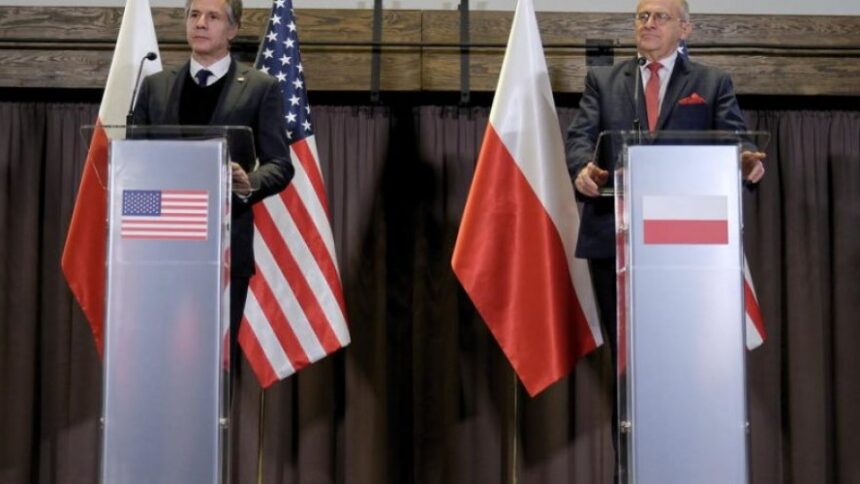
US Secretary of State Antony Blinken was in eastern Poland on Saturday (5 March), kicking off a visit to several regional countries amid Russia’s intensifying offensive across the border in Ukraine.
Over the following days, Blinken will visit critical allies to demonstrate Washington’s support for their security and shore up Western unity against Moscow.
After Poland, he will visit Moldova, which has also experienced a significant inflow of Ukrainian refugees and faced its own frozen conflict with Transnistria, its breakaway region controlled by Russian-backed separatist forces.
Early next week, he will visit the three Baltic States- Estonia, Latvia and Lithuania- hosting three NATO battlegroups and the strategic so-called Suwalki corridor. This stretch separates the Russian exclave of Kaliningrad on the Baltic Sea from Belarus, now host to thousands of Russian troops.
“If there are diplomatic steps that we can take that the Ukrainian government believes would be helpful, we’re prepared to take them — even as we continue to support Ukraine’s ability to defend itself,” Blinken told reporters on Wednesday, before his trip.
His Eastern European lap comes after meeting foreign ministers of NATO, G7 and EU on Friday (4 March) in Brussels to discuss the West’s efforts to deter Russia through a programme of harsh sanctions.
In Poland, Blinken engaged in talks with officials on cooperation on defence and humanitarian support related to the conflict.
The country is currently hosting roughly 10,000 US troops, with more than half having arrived in recent weeks, but Warsaw said it is seeking more in the long term.
NATO members are providing military aid to Ukraine’s government forces for their fight against Russia’s military, much of it passing through Poland. But the alliance has declined Ukrainian demands to enforce a no-fly zone over the country, saying this could provoke a much broader and even more dangerous conflict.
More US aid for refugees
Poland’s southeastern city of Rzeszów, roughly 80 kilometres from the border with Ukraine, has become a hub for flights and trucks carrying humanitarian aid.
Blinken praised the country for its open embrace of hundreds of thousands of fleeing Ukrainians and said Washington was preparing to set aside funding for the humanitarian crisis.
“The people of Poland know how important it is to defend freedom,” he said after talks with Polish Foreign Minister Zbigniew Rau.
“Poland is doing vital work in response to this crisis,” he added.
Blinken also visited the Polish-Ukrainian border, meeting with refugees at a disused shopping mall in Korczowa that serves as a reception centre for hundreds of people at a time, with foldout camp beds arranged in front of empty shops.
Including other neighbouring countries, the number of refugees could rise to 1.5 million by the end of the weekend from a current 1.3 million, the head of the United Nations refugee agency UNHCR said on Saturday. More than half of them are expected to flee to Poland.
The White House was seeking €2.51 billion to support those leaving Ukraine and countries that accept them after Russia began its invasion on 24 February, Blinken said.
“Russia’s aggression in Ukraine caused a humanitarian crisis of an unimaginable scale,” Rau said, speaking alongside Blinken. “Our priority is organising effective aid to hundreds of thousands, and soon to be millions of refugees.”
Rau also pledged not to discriminate between refugees of different nationalities after reports circulated in Washington that Africans and others fleeing from Ukraine were being stopped at the Polish border.
War crimes
Warsaw announced it is also setting up a centre to document war crimes committed in Ukraine, which will be done in cooperation with the United States.
Poland will not accept any territorial changes brought about by “unprovoked, illegal aggression” and Russian forces committing “war crimes” by shelling in residential areas, Rau said.
“Due to its own painful experience in the past, Poland will consequently demand prosecuting war criminals,” he added, specifically citing the Nazi bombing of the city of Wielun, sometimes known as the ‘Polish Guernica’, at the start of World War II.
Russia describes its actions as “a special military operation”, not an invasion. It says it aims to disarm Ukraine, counter what it views as NATO aggression, and capture Ukrainian leaders it calls neo-Nazis.
After meeting with Blinken in Rzeszow, Polish Prime Minister Mateusz Morawiecki called for tougher sanctions against Russia, saying they should be “hitting Vladimir Putin’s war machine”.
Morawiecki called for all Russian banks to be excluded from the SWIFT payment system and said asset freezes “should be as extensive as possible”.
[Edited by Alice Taylor]
Source: Euractiv.com









Leave a comment