
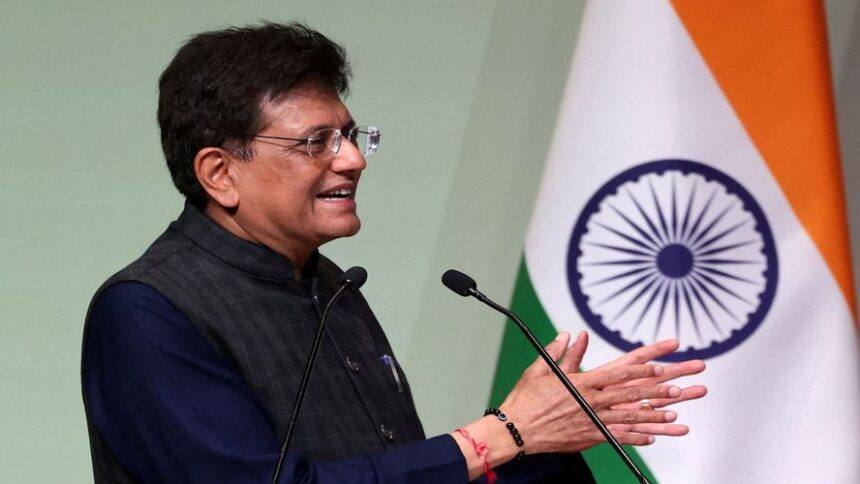

“The Port of Piraeus can play an important role in strengthening India – Greece and India – Europe connectivity,” said Piyush Goyal, India’s union minister of commerce and industry, in an interview with Kathimerini.
On the occasion of Goyal’s official visit to Athens for trade talks, Kathimerini spoke with him about the “package” of cooperation initiatives that was at the center of his discussions with the Greek government, with an emphasis on ports, renewable energy sources, and the deployment of specialized personnel to Greece.
During Prime Minister Modi’s last visit to Athens in 2023, you stated that “by awarding the Grand Cross of the Order of Honor to Prime Minister Modi, Greece honored 1.4 billion Indians.” Three years later, at what level do our bilateral relations stand?
The visit of Honorable Prime Minister Narendra Modi to Athens in August 2023, the first by an Indian prime minister in nearly four decades, was a landmark moment that elevated India – Greece relations to a strategic partnership. This was further reinforced by the state visit of Prime Minister Kyriakos Mitsotakis to India in February 2024, which deepened bilateral engagement across key sectors.
Since then, the relationship has become more action-oriented, with a clear focus on expanding trade, investment, and industrial cooperation, supported by regular institutional and business-to-business engagements. Both sides share the objective of significantly enhancing bilateral trade volumes in the coming years through diversification of trade baskets, increased value-added exports, and deeper integration of businesses and supply chains. Economic cooperation is expanding in priority sectors such as shipping, logistics, renewable energy, infrastructure, pharmaceuticals, agriculture, and digital technologies, with increasing participation from the private sector on both sides.
In the recent landmark “free trade” agreement (FTA) with the European Union, exports of European products, such as wine and agricultural goods, are expected to increase, while the 45% tariff on Greek olive oil will be eliminated. What are the main pillars of this trade agreement between the two sides?
The first pillar of the FTA is the scale and complementary nature it brings together. India and the EU represent nearly two billion people with a combined market estimated at $24 trillion, which are highly complementary rather than competitive. India brings strength in labor-intensive exports and knowledge-based services, while the EU brings strength in high-technology and capital-intensive sectors such as finance, telecom, and maritime services. The second pillar is the comprehensive coverage of the agreement, spanning 20 chapters across goods, services, intellectual property rights, sustainability, and digital trade, with 99.5% of India’s exports receiving preferential treatment in the EU and India extending preferential treatment to nearly 97% of EU exports.
A third pillar is the calibrated protection of sensitive sectors. The agreement balances liberalization with domestic sensitivities by maintaining safeguards for highly sensitive agricultural products and other vulnerable sectors on both sides. At the same time, it creates meaningful new opportunities in selected areas. For example, India has provided phased market access for European wines through gradual tariff reductions over seven years. Similarly, tariffs on olive oil will be reduced to zero within five years, benefiting producers in countries such as Spain, Greece, and Italy while expanding consumer choice in India.
A fourth pillar is the boost to services trade, alongside meaningful provisions on professional mobility, student mobility, digital payment integration including “UPI,” global capability centers, cybersecurity, and e-commerce. The fifth and final pillar is the creation of a future-oriented economic partnership. Beyond tariff reductions, the agreement establishes frameworks for cooperation in innovation, sustainability, digital trade and regulatory alignment. It aims to support long-term economic integration while ensuring that growth remains inclusive, resilient, and environmentally sustainable.
Based on discussions with businesses and banking groups in Greece, Indian companies appear interested in investing in ports, broader infrastructure, and logistics, positioning Greece and Cyprus as regional hubs. What specific investments are being discussed, and what are your priorities?
Greece’s strategic location at the crossroads of Europe, Asia and Africa offers significant opportunities for Indian companies seeking to strengthen their presence in European markets and integrate with regional value chains. We see considerable potential for Indian businesses to explore opportunities in sectors such as ports and logistics, infrastructure, renewable energy, tourism, technology and services. As discussions progress between businesses in both countries, we expect greater collaboration in areas that align with our shared economic priorities. We already have successful examples of cooperation. The partnership between India’s GMR Airports Ltd. and GEK Terna for the development of the new international airport at Kastelli, Crete, is a notable example of the confidence Indian companies have in the Greek economy and the potential for long-term collaboration.
Could the Port of Piraeus evolve into a strategic hub in our bilateral trade relationship?
Yes, the Port of Piraeus can play an important role in strengthening India – Greece and India – Europe connectivity, given its position as a major maritime gateway to Europe. India recognizes Greece’s strategic location and strong maritime tradition. Ports like Piraeus already function as key logistics hubs in the Mediterranean, and their integration with road and rail networks into Southeast and Central Europe enhances their value as gateways for wider continental trade. As India – Europe trade continues to grow, efficient port infrastructure can help improve transit times, reduce logistics costs, and strengthen supply chain resilience. In this way, the Port of Piraeus can contribute to smoother and more reliable cargo movement between Asia and European markets.
In December, during the first “Greece – India Maritime Dialogue,” among the topics discussed were the mutual goal of doubling bilateral trade to $4 billion by 2030, as well as the IMEC economic corridor. What is the current status of discussions regarding IMEC’s implementation?
The “India – Middle East – Europe Economic Corridor (IMEC),” announced during India’s G20 Presidency in New Delhi in 2023, is a transformational initiative aimed at strengthening connectivity, trade flows and economic integration between India and Europe. India attaches high importance to IMEC, as it can contribute to resilient supply chains, improved logistics networks and enhanced economic cooperation. Given Greece’s strategic location, there are clear complementary and significant opportunities for cooperation. Discussions among partner countries are ongoing to identify practical and mutually beneficial pathways for implementation of the corridor.
On the agenda of your discussions is also the facilitation of skilled and seasonal workers, with more than 50,000 already employed in Greece. Are you discussing further labor mobility?
People-to-people linkages have always been an important pillar of India – Greece relations. India has a young, skilled and dynamic workforce that can contribute meaningfully to global economic growth. Cooperation in skilled mobility can create a mutually beneficial partnership by addressing evolving skill requirements while also providing opportunities for professionals. Both sides continue to explore ways to enhance cooperation in skill development, mobility and the creation of transparent and structured pathways for workforce movement.
Source: Ekathimerini.com








Leave a comment