
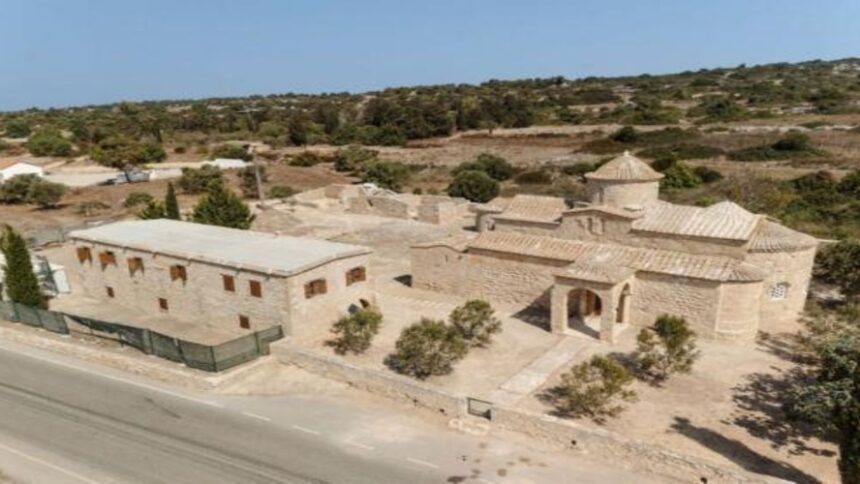
The conservation works at the monastery and church of Panagia Kanakaria of Lythrangomi in Turkish occupied Karpasia have been completed. This site is one of the most significant monuments of Cypriot cultural heritage, showcasing a blend of ancient craftsmanship and modern conservation.
The conservation project, which was funded by the European Union, was implemented under the technical guidance of the UNDP, in collaboration with Greek Cypriot and Turkish Cypriot experts and technicians, as part of the Technical Committee on Cultural Heritage.
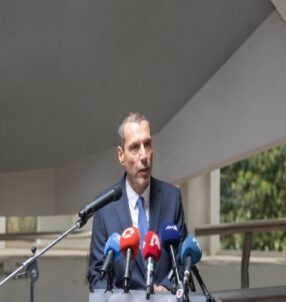
In statements to the Cyprus News Agency (CNA), the Greek Cypriot co-chair of the Technical Committee, Sotos Ktoris, noted that “the restoration of Panagia Kanakaria is yet another tangible confirmation that cooperation between Greek Cypriots and Turkish Cypriots can yield concrete results with strong symbolism.”
The church of Kanakaria, he added, “as well as all the monuments of Cyprus, Christian and Muslim, strengthen our connection to the land and its history. They remind us that Greek Cypriots, Turkish Cypriots, Maronites, Armenians, and Latins shared the same geography for centuries and that the monuments of Cyprus stand as the undeniable witnesses of this multicultural heritage of Cyprus.”
The church is a rare architectural testament, as it preserves elements from the early Christian and Byzantine periods.
Panagia Kanakaria was built on the ruins of a 5th-century wooden-roofed early Christian basilica and it is a stunning example of local limestone masonry and intricate frescoes.
Of particular archaeological and historical interest is the semicircular apse of its first phase, which housed the famous mosaic of the enthroned Virgin Mary with angels and medallions of the apostles, dating back to the first third of the 6th century.
The church has undergone successive architectural interventions: after the destruction of the original wooden-roofed church, it was transformed in the 8th century into a barrel-vaulted three-aisled basilica, until its reconstruction in the 12th century when the dome and the narthex were added, documenting a continuous historical presence of over fifteen centuries.
According to a post on UNDP’s Facebook page, conservation works included replacing deteriorated stones and consolidating the structure, removing organic growth from the masonry and surrounding areas and preserving and conserving mural decorations.
There was also conservation of mosaic fragments and repairs on the roof and conserving wooden elements while the floors were consolidated and missing sections of the boundary walls were restructured.
According to the Deputy Ministry of Culture website, the walled mosaics of Panagia Kanakaria, dating back to the 6th century AD., are highly important works of art and among the few remaining early Christian mosaics in the world. The mosaic of Apostle Markos, which was violently detached and stolen from the church, between 1977-79 by Turkish looter and art dealer Aydin Dikmen, along with the rest of the mosaics depicting the Apostles and other saints, was recovered and repatriated to Cyprus from the Netherlands. The mosaic was located in the Principality of Monaco by the Dutch private detective Arthur Brand, known for tracing major works of art, working with the police authorities of many countries.
The mosaics were broken down into pieces and found their way in the international art markets.
Pieces of the mosaics, such as the figures of Apostles Luke, Bartholomew, Matthew, James, Thaddeus, Thomas and Andrew, as well as the upper part of the Virgin Mary and Christ, the hands of the Virgin Mary and the hand of Archangel Gabriel, have been gradually repatriated since 1983. In 1989, four fragments depicting the upper part of Christ, two apostles and an archangel were handed back after a high-profile case in Indianapolis.
The Department of Antiquities, in cooperation with all responsible authorities and bodies, continues its efforts to repatriate the remaining mosaics from the Church of Panagia Kanakaria, as well as all other cultural treasures that have been illicitly removed from the occupied areas of Cyprus, the website added.
Cyprus has been divided since 1974, when Turkey invaded and occupied its northern third. Repeated rounds of UN-led peace talks have so far failed to yield results. The latest round of negotiations, in July 2017 at the Swiss resort of Crans-Montana ended inconclusively.
Source: Parikiaki.com





Leave a comment