
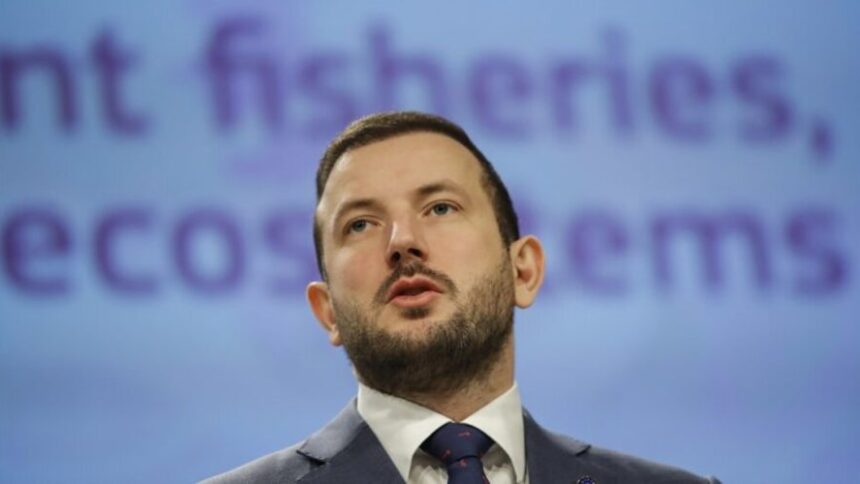
The Green Deal must be the EU’s response to both past and present crises, Environment Commissioner Virginijus Sinkevičius told EURACTIV France, adding that he will continue to meet with MEPs to explain his side of the debate.
Read the original interview in French.
Virginijus Sinkevičius is European Commissioner for the Environment, Oceans and Fisheries. He spoke to EURACTIV France about issues on the European Commission’s current agenda, including the fight against overfishing and the EU’s proposed nature restoration law.
The European Parliament is currently the scene of political confrontation. Many MEPs – particularly on the right and far-right – are vigorously opposing the law on nature restoration that is currently being discussed. Is there an anti-ecological axis in the Parliament?
It’s difficult for me to answer that question. All the political strands are involved in the trilogues to defend their positions, and that’s the beauty of decision-making within the EU.
The idea is to reach a compromise that can be supported by all the co-legislators. I hope that we will follow this logic for this crucial piece of legislation on nature restoration.
As always, we in the Commission try to be an honest broker and engage in constructive dialogue with all the co-legislators, trying to explain the thinking behind our proposals.
Some European Peoples’ Party (EPP) parliamentarians have accused you and Frans Timmermans (Vice-President of the Commission) of holding meetings with lawmakers to urge them to support the law on nature restoration. There has been talk of “blackmail” and “unfair manoeuvring”. What is your response?
I’ve been a Commissioner for almost four years, and I’ve been meeting members of Parliament for four years. I consider this a privilege because my democratic legitimacy comes from the members of Parliament. So I feel it is my duty to explain the legislation and to meet them.
I have done so and will continue to do so, if they so wish, of course. We don’t agree on everything, but our conversations have always been productive, and it has been extremely useful for me to hear their views.
There are parliamentarians, but there are also heads of state: Emmanuel Macron recently called for a “regulatory break” in the implementation of the Green Deal. So did the Belgian Prime Minister. What are your thoughts on this?
About Emmanuel Macron. We need to put things in context: he was talking about the new legislation he was proposing [future “green industry” law]. He stressed the need to combat climate change while ensuring economic competitiveness. His speech was very good.
France was one of the key countries that signed the agreement on the Global Biodiversity Framework in Montreal (COP 15), on which we worked hard with France’s Ecology Minister, Christophe Béchu.
I know France’s position: it is very much in favour of legislation on nature restoration. This was confirmed by the Prime Minister.
The EU recently approved the World Trade Organisation (WTO) agreement voted in June 2022, which bans fishing subsidies that could threaten global fish stocks. How is this a step forward for the protection of the oceans?
The WTO agreement has been finalised after 20 years of negotiations. It is a crucial step in ensuring that fisheries subsidies take sustainability into account as a primary objective and avoid damaging oceans and fish stocks. This agreement also helps maintain fair competition between the world’s coastal communities.
And it’s not just about objectives: the 164 members of the WTO have jointly signed up to concrete rules for sustainable fishing. This is a first.
The agreement only covers public funding and only concerns fishing in territorial waters. Does the legislation need strengthening?
The current agreement is a first step, and there will, of course, be other steps to come. We hope to be able to extend the agreement on subsidies to limit overfishing, which we plan to do at the next WTO Ministerial Conference in February 2024.
Illegal, unreported and unregulated fishing is a major challenge to the preservation of resources. It is estimated that 26 million tonnes of fish – 15% of all catches – are caught illegally every year. How is the Commission controlling these abuses?
The Commission has a series of policies, particularly with regard to Asia, and a very effective information system. We have data and information on countries involved in illegal, unregulated and undeclared activities. In the event of an inspection, these countries can be given a yellow card if it’s the first time, and then, if it happens again, a red card with a ban on all commercial activity.
Following negotiations, the Commission has succeeded in bringing this matter to the 164 member countries of the WTO. The June 2022 agreement also ensures that no subsidies are given to these illegal activities.
The theme of Ocean Day is “Planet Ocean: Tides are changing”. Are political currents changing in France and Europe on environmental issues?
The world is changing and has never changed so quickly. When this Commission took office in 2019, the first thing we did was the European Green Deal. But remember, back then, there were [Fridays for Future] protests in every European city every Friday asking politicians to take action.
Then we had to deal with the pandemic, and for a year now with Russia’s devastating, unjustified and illegal invasion of Ukraine. These crises are putting enormous pressure on our economy and society as a whole.
The Green Deal must be a response to all these new challenges, not forgetting the climate crisis and the loss of biodiversity. This is what our citizens expect of us.
[Edited by Natasha Foote/Nathalie Weatherald]
Source: Euractiv.com




Leave a comment