
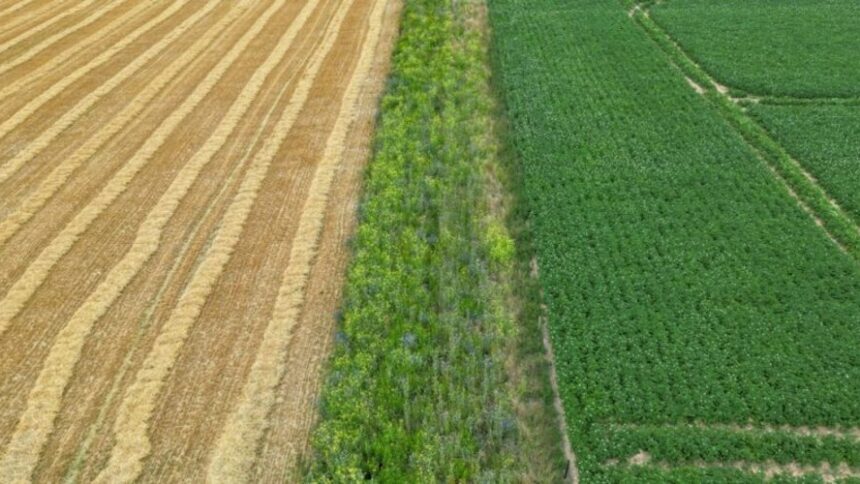

Eco-schemes, a new instrument within the Common Agricultural Policy (CAP) to reward sustainable farming practices, have been taken up by far fewer farms than hoped in Germany, according to new data from the country’s agriculture ministry.
Read the original German story here.
The eco-schemes are one of the major innovations within the new Common Agricultural Policy (CAP), which came into force in January this year, and aim to incentivise sustainable farming practices.
Through the schemes, farmers can get extra CAP funds in exchange for implementing climate or environmental measures from a catalogue defined by each member state.
This flexible, voluntary catalogue of measures means that the desired environmental effect will only be achieved if enough farms participate in the individual schemes.
Yet according to data from the German Agriculture Ministry, this might not be the case in the country. Interest in these eco-schemes is “more restrained than expected”, the ministry said in a press release.
Fewer farms than hoped take part
The ministry’s data compares the number of farmed hectares for which farmers have already applied to such schemes with projections made by the government-owned Thünen Institute, which the federal and state governments used to design the measures.
Except for one measure, the cultivation of regional-type crops, all eco-schemes fell short of expectations, in some cases by a wide margin, according to the compared data.
For example, farmers can receive extra funding under these schemes if they plant certain-sized flower strips on arable land, which serve as a habitat for insects and other species.
But while the Thünen Institute had forecast that this would happen on around 175,000 hectares, applications have so far only been submitted for just under 1,300 hectares – less than 1% of the planned value.
Farmers complain, among other things, that the minimum width of the flower strips is often not feasible, especially on smaller parcels of land.
For the introduction of agroforestry systems, such as combining arable farming or livestock breeding with forestry elements, the actual implementation lags even further behind the forecast.
Indeed, the institute had predicted 25,000 hectares for this measure, but only about 50 have been registered – about 0.2% of what was predicted.
Optimistic ministry
Other eco-schemes were more widely implemented, but still fell short of expectations.
Such is the case of the scheme that rewards less intensive cultivation of permanent grassland, which saw farm areas accounting for two-thirds of the initially predicted targets adopt such practices. The same goes for cultivating a more diverse range of crops, which accounted for 65% of the predicted target.
Despite this, Germany’s Agriculture Ministry dismissed the low figures and expressed optimism that the take-up of eco-schemes would improve during the agricultural funding period, which runs until 2027.
Pointing out that the first two years of the new CAP are still in a “learning phase”, the ministry maintains farmers are still reluctant to take up the scheme because of the novelty of the support and the “changed economic and political conditions as a result of Russia’s war of aggression on Ukraine”.
The data will now be “evaluated with the federal government and the states and discussed what adjustments can be made to the design and offer of the eco-schemes – possibly also at short notice”, it added.
Lack of financial incentives?
The low incentive level of such schemes has already been repeatedly criticised by the German Farmers’ Association (DBV), which points to the low financial reward for implementing costly measures in many cases.
In a position paper published at the end of May, the DBV identified the “excessively low subsidy rates” as the “main reason” why many organic schemes remained “significantly unused” this year.
“For 2024, above all, the subsidy rates for existing eco-schemes should be increased to ensure that the budget is fully utilised and thus that the subsidy targets are achieved,” the association demands.
Source: Euractiv.com










Leave a comment