
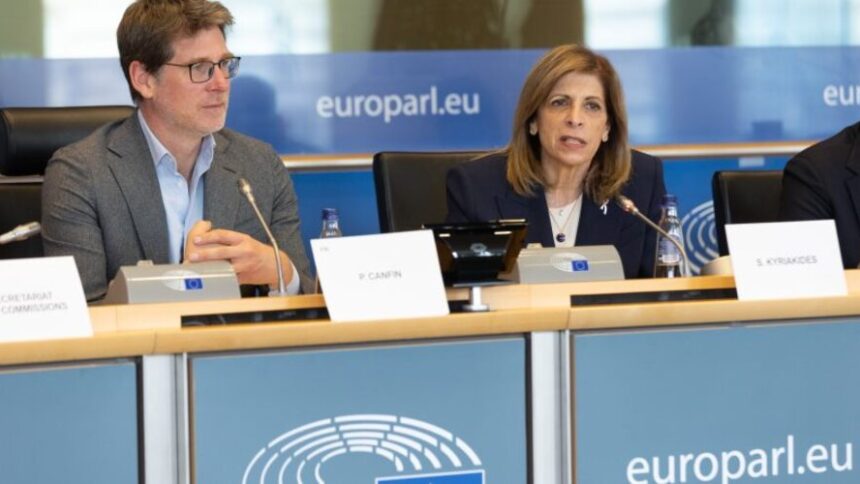

Members of European Parliament welcomed the proposed revamp of the bloc’s regulatory framework for pharmaceuticals during a discussion this week but did not shy away from criticising certain aspects.
The Parliament’s Public Health Committee (ENVI) this Wednesday (20 September) opened one of the biggest health files within this debate – the Commission’s proposal for a new directive and regulation that revise and replace the existing general pharmaceutical legislation.
After receiving the translations of the proposal earlier in September, approving the file within this mandate seems unlikely.
“[In the parliament] we still put health as a priority,” German Socialist MEP Tiemo Wölken, rapporteur of the regulation, reassured on Wednesday, referring to the Commission’s delays in presenting the file and the fact that the Commission President Ursula von der Leyen did not address health in her State of the European Union speech.
While Wölken reassured MEPs of commitment to the file, its complexity means there is much work ahead, something both lawmakers and Commission representatives recognised.
The proposal aims to revamp the bloc’s regulatory framework, unlocking timely and equitable access to safe and effective medicines for all EU citizens while at the same time boosting the attractiveness of the EU pharmaceutical industry.
However, lawmakers did have criticisms that they voiced during the session.
Bring back research and innovation
One of the main focuses of the Commission’s document is incentivising research and innovation inside the EU to ensure competitiveness and independence from third countries.
“Europe is no longer at the center of innovation”, said Belgium liberal Frederique Ries stressing the need to promote research inside the EU. “It was maybe 25 years ago, but one out of two new treatments come from the United States”.
To make the EU competitive on a global scale, the Commission has proposed simplifying the regulatory framework for developing new medicines and increasing protection periods for intellectual property.
While the objective to promote innovation is shared, the tools proposed by the Commission received criticism from MEPs.
“It is a mistake to think that we will generate more research and development within the European Union just because of longer protection periods”, said Wölken.
Slovakian socialist Monica Beňová welcomed the proposal to shorten the process for obtaining marketing authorisation as part of simplifying the current framework but stressed that this should not come at the expense of the safety of medical products.
“When it comes to health, there should be no shortcuts”, she said.
Need to address rare diseases
Another measure that received criticism in Parliament as well as across the industry is a series of incentives in data protection for those companies that will develop and commercialise medicines to address unmet medical needs.
Croatian popular MEP Tomislav Sokol pointed out that small companies may lack capacities to meet the targets -like being available in every member state within two years of its commercialisation- set by the Commission, and this could discourage them from investing in innovation.
He welcomed the increase of market exclusivity periods that the proposal offers for orphan drug development but asked to target more directly paediatric medicines for rare diseases.
Another tool that could help commercialise orphan drugs is speeding up the marketing authorisation process. However, EU lawmakers raised their concerns about including patient consultation in the process as the proposed document considers it optional for companies.
“Studies show that treatments which have been evaluated with patients are better, so why not make patient consultation obligatory?” asked Ries.
Fighting antimicrobial resistance
One of the most controversial aspects of the Commission’s document was the proposal of a 15-year trial of a ‘transferable data exclusivity voucher scheme’ for novel antibiotics to incentivise their developers in the fight against antimicrobial resistance (AMR).
Misuse of antibiotics in recent years has led some microorganisms, also called superbugs, to develop AMR, meaning that medicines become less effective and infections persist in the body, increasing the risk of spreading to others.
The proposed voucher will grant an additional year of regulatory data protection to the developer of the novel antibiotics, which can either be used for one of its own products or sold to another marketing authorisation holder.
This system has been criticised by EU lawmakers since the Commission presented its proposal as they consider it doesn’t guarantee the availability of new antibiotics in the EU.
“I’m still not convinced of the transferable exclusivity voucher”, said Wölken. According to him, the fact that vouchers can be sold to other companies risks the EU supply.
“If we kept it there, it needs to be an additional wording which guarantees the availability of said novel antibiotics to the EU market”, he added.
Tilly Metz also agreed with the need for a long-term plan against AMR and said that vouchers “are not the solution that we need”.
EU lawmakers will now prepare their amendments to the Commission’s proposal and present them by 14 November back to ENVI, aiming to reach a common position and move the discussion to the plenary.
[Edited by Giedrė Peseckytė/Alice Taylor]
Source: Euractiv.com












Leave a comment