
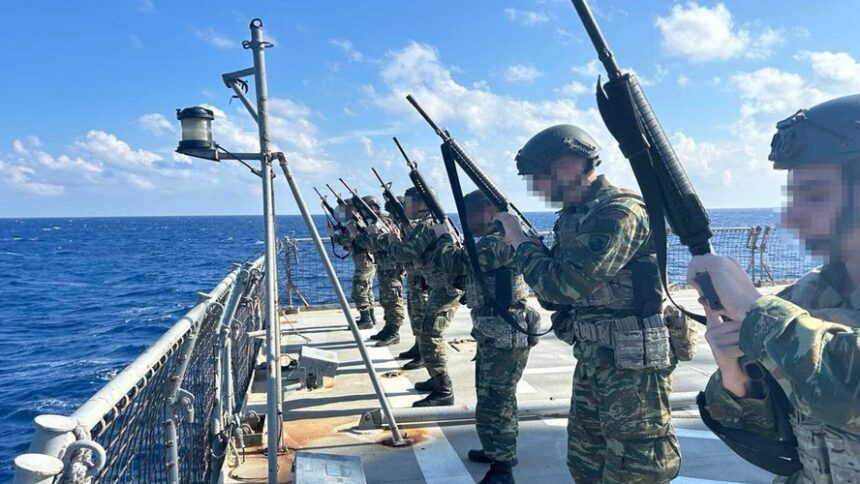

Greek and Egyptian air and naval forces are joining forces in the Cretan Sea and Eastern Mediterranean for the international exercise Medusa-15, which also involves France, Italy and Cyprus. The exercise begins Thursday and will run for 10 days, featuring fighter jets, warships, drones and special forces training in scenarios based on modern threats and operational challenges.
According to official sources, the exercise underlines the participants’ commitment to international law, as all five countries have ratified the UN Convention on the Law of the Sea (UNCLOS). The drills will take place southeast of Crete and south of Karpathos, an area of particular sensitivity for Greek national interests, at a time when Ankara is seeking to promote Turkey’s revisionist “Blue Homeland” doctrine.
The sources also highlight the exercise as a sign of close diplomatic and military ties between Athens and Cairo, following Prime Minister Kyriakos Mitsotakis’s meeting with Egyptian President Abdel Fattah el-Sisi at the Greece-Cyprus-Egypt trilateral summit in El Alamein.
On Wednesday, the Hellenic Navy’s hydrographic service issued a Navtex, or navigation warning, designating an area south and east of Crete, extending south of Karpathos toward western Rhodes. The area is considered strategically important for Greece in light of Ankara’s claims and the Turkish-Libyan memorandum, viewed as illegal and baseless by Athens.
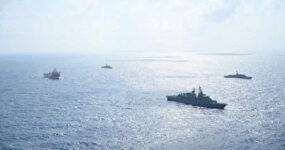
The exercise will feature an airborne operation in Maleme involving paratroopers and amphibious commandos, alongside frigates, missile boats, submarines, fast naval vessels and fighter jets. Egypt’s helicopter carrier, ENS Gamal Abdel Nasser, will serve as a floating headquarters and platform for drone and helicopter operations.
Training scenarios will include protection of critical infrastructure and strategic assets such as hydrocarbon platforms, research vessels and energy facilities, as well as search-and-rescue operations, electronic warfare and coordination between naval aviation and amphibious units.
For the first time, autonomous systems – including UAVs, USVs, FPV drones and anti-drone systems – will play a central role. The exercise incorporates lessons from the wars in Ukraine and the Middle East. Greek-made systems, including the Centaur anti-drone system, FPV drones and USVs, are also expected to be tested in demanding operational conditions. The UAE, Serbia and Mozambique will participate as observers.
Source: Ekathimerini.com









Leave a comment