

Despite the transition to climate neutrality creating frictions in the short-term, politicians should not change course, investors in green technologies said, asking for clear signals that the transition will be followed through.
While the EU has set ambitious climate targets for 2030 and wants to reach climate neutrality by 2050, proposals to implement the transition have been met with pushback.
While this could tempt politicians to roll back on climate policies over the next years, investors in green technologies have warned against this and called for legal certainty.
In the green transition, the most important task for politicians is “to give signals, that there is a strategy that is systemic, that will not be changed”, Diego Pavía, CEO of EIT InnoEnergy, an investor in green technology partly funded by the EU and private companies, told Euractiv.
The legal certainty created in Europe by the European Climate Law and its Emissions Trading System (ETS) would also give Europe an advantage over the US, where the subsidies granted under the Inflation Reduction Act (IRA) have stimulated investments into clean sectors such as renewable energy and hydrogen, Pavía said.
“We have a European way of doing the IRA,” he said. “And for me, that is not paying for companies to come into Europe, but giving them a framework where they will […] come to Europe,” due to its stable political support for the green transition.
“For me, Europe is doing something that is much more structural, because it has built the first climate law,” he said, adding that “only Canada and Europe have enshrined net-zero [emissions] in law”.
While in the US, “maybe Trump comes again into power, and maybe they just abandon [the climate targets]”, Europe would offer investors in green technologies more legal certainty.
Produce green tech in Europe – or China?
The transition towards climate neutrality will see the growth of new industries – but also the phaseout of highly CO2-emitting sectors.
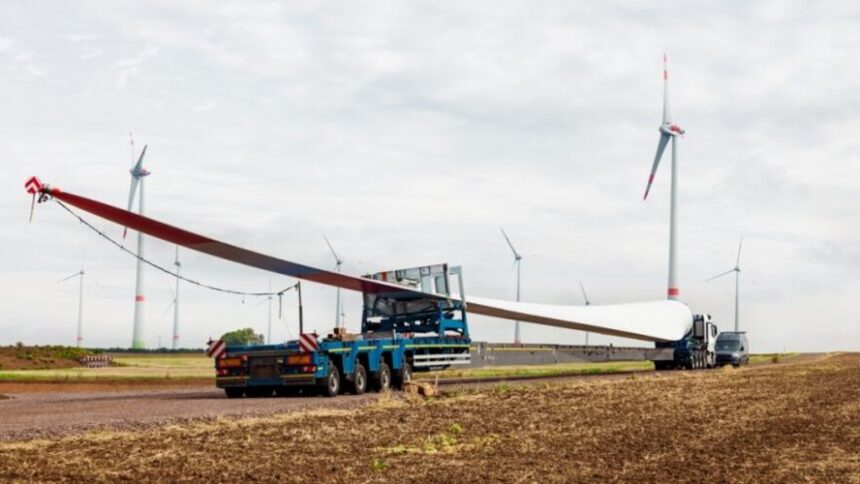
While some have expressed concern that this will open the door to an exit of industry from European soil, Pavía said he’s not too concerned, citing the EU’s Green Deal Industrial Plan. This effectively creates demand for green technologies, but also ensures that they are produced in Europe, thus creating new jobs, he said.
As part of the plan, the European Commission is looking to increase the market share of European producers of key technologies such as wind turbines and solar panels to 40% of the European demand, although it remains unclear how this target will be achieved.
“When we only created the future demand, and the demand was captured by Chinese supply, that could have created a backlash, because the new GDP is captured by Chinese companies,” he said.
But “now, with the industrial strategy, this new GDP is going to be captured by European suppliers. With incentives, not with protective measures,” he added.
Not all green investors share his view, however, as was clear at a conference organised by EIT InnoEnergy in Amsterdam on Wednesday and Thursday (18-19 October). Mareike Bloem, chief economist at Dutch bank ING, said at a panel discussion that “if there are things we can import, we should be happy that we can be importing”.
“If I look at Europe, one of the risks […] is if Europe goes in too far into the sort of geopolitical thinking, its strategic autonomy, which basically means that we’re shielding all our industry from what’s happening in the rest of the world,” she warned.
For instance, “when you think about cars, the situation in which all of a sudden you don’t get your cars […] is maybe a bit different from not getting your gas or getting your medicines,” she stressed, adding that “I understand why the car industry wants to be protected, but it comes at a big price for Europe”.
The EU has launched an investigation into Chinese electric cars which allegedly benefitted from illegal subsidies, which could lead to tariffs against Chinese cars. “Of course, part of it is unfair competition,” Bloem said, “but part of it is also fair competition, to be honest”.
France, meanwhile, has announced it will go further by excluding Chinese cars from public support schemes such as a new electric vehicle leasing scheme.
While recognising that an industrial transformation could create “pain” for workers in existing industries, “the question is when do I want to take the pain,” Bloem said. “Do I take it now or do I take it later? And if I don’t take it now, the price in the end will be much higher,” she added.
Limit consumer choices
While the car industry currently views consumers’ scepticism about buying electric cars as a major hurdle for their uptake, in the future, “you’ll have no choice” but to buy an electric car, Pavía said.
“Which is good, by the way,” he added. “We, as citizens, have to be greener and cleaner, but then we keep on having our gas boiler, we keep on having our bad insulation at home, and we keep on driving. So just by restricting the offer, we’ll only have one choice, that is to go clean,” he added.
“Maybe it’s time that we, as all citizens, take a bit of responsibility,” he said.
Still, he would be optimistic that people would continue to support the green transition, Pavía said, “because they understand that it is good for the medium term, and better quality of life”.
[Edited by János Allenbach-Ammann/Nathalie Weatherald]
Source: Euractiv.com











Leave a comment