

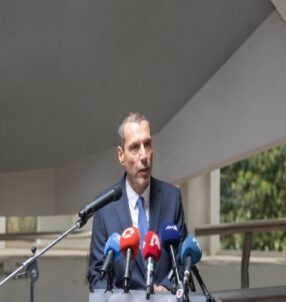
Overseas Cypriots assured that they will continue working to put pressure on Turkey to provide information and allow access to data related to the issue of missing persons.
The missing persons issue was discussed during the World Conference of Cyprus Diaspora, held in Nicosia where participants emphasized that necessary support should be given to the Committee for Missing Persons (CMP) to enable it to complete its work. Despite having located almost half of the missing since the 1974 Turkish invasion, the CMP cannot proceed at a rapid pace, participants said. Officials called for the involvement of the European and international community noting the dramatic reduction in the discovery of remains in the Turkish occupied areas, accompanied by a decline in DNA identifications, is attributed to the destruction of burial sites and the deliberate moving of remains by Turkey.
Anna Aristotelous, Head of Humanitarian Affairs for Missing and Enclaved Individuals, addressed the conference where she expressed her department’s vision of a Cyprus without missing persons, promoting peaceful coexistence, respect for human dignity, and unity among all citizens. She said the most serious result caused by the Turkish invasion and ongoing occupation remains the tragedy of the missing persons and their families, along with those who died, were captive during the invasion and the people who were displaced.
The main goal is to ascertain the fate of each person missing during the 1974 Turkish invasion and the intercommunal fighting of 1963-1964, Aristotelous explained. She noted that their vision is to eliminate missing persons and achieve peaceful coexistence among all citizens, promoting long lasting peace and unity while respecting human dignity and diversity.
The lists included 1,619 missing persons as a result of the 1974 Turkish invasion and 44 missing individuals from the intercommunal conflicts of the 1963-1964 period. Since the 1990s when excavations and exhumations have been carried out, more than 50% of the cases of missing persons remain unresolved to this day.
Her department’s new goal, she noted, is to strengthen our efforts in all relevant areas it handles, with a more active role and a differentiated approach that places human beings and their needs at the epicenter. Specifically, issues concerning the missing and their relatives, as well as the problems faced by the enclaved are addressed directly as humanitarian matters, seeking solutions based on safeguarding their human rights.
Furthermore, on every occasion or opportunity, we encourage citizens to speak about any information they possess regarding the fate of the missing persons, said Aristotelous.
Every piece of information received, she said, even a simple mention, is investigated. Her department, she added, has developed a communication network that is citizen-friendly and no longer uses the deposition methods that were previously in place, which were associated with police-oriented approaches and interrogation profiles. By changing the approach to be more citizen-friendly and informant-friendly, the flow of information has increased with positive results. In just one month, there were 4 identifications, she said.
Aristotelous also said that according to statistical data, from the 118 women missing, 26 have been identified, and out of the 32 missing children, 16 have been identified, with the youngest being 6 months old.
Furthermore, a stable collaboration has been established, maintaining contact with the children of the missing persons.
During the first two months of taking up her duties, she noted, she conducted visits to Turkish occupied villages where enclaved and those who have resettled reside, as well as to Rizokarpasso and the Maronite villages, to personally hear about the problems they face and to work towards their immediate and effective resolution.
As an example, she cited the issues concerning their food supply. After being informed about a specific matter, during unscheduled visits to centres which store foods for the enclaved she found out that food sent to them did not meet the required specifications. She requested the immediate termination of the contract with the particular supplier. She also said she intends to meet with a nutritionist from the Ministry of Health to compile a list of foods for a balanced diet, including nutritional components, vitamins, quantity, and quality.
Furthermore, she has established a network of close contacts and communication with the relatives of the missing, providing them with information and addressing the matters that concern them and their missing relatives.
Up to now, she said, “we have addressed a multitude of requests from enclaved individuals and relatives of the missing, and we have prepared proposals for the revision of the existing humanitarian assistance, which has remained the same since 2007. We are also introducing new incentives, which we will discuss with the Ministry of Finance,” said Aristotelous.
In the event remains are located, she said, a specific process of informing their families is followed. This is intended to ensure that the family of the individual is, as much as possible, psychologically prepared until the funeral. Each of the missing individuals is handed over to their family in a small ossuary containing few or several bones, symbolizing the tragedy that describes the cases of missing persons, stated Aristotelous. At the same time, she emphasised that “Turkey has a legal and moral responsibility to cooperate and promptly proceed with the implementation of the decisions of the European Court of Human Rights from 2001 and 2014, submitting all the information and data held in the Turkish military archives concerning the missing persons and the deliberate movement of their remains.”
The dramatic decrease in the identification of remains in the occupied areas and the consequent decline in DNA identifications in recent years, she said, are due to the destruction of burial sites and the deliberate movement of remains. “Turkey denies access to information from its military archives, particularly information about mass burials by the Turkish army after clearing the battlefields, and there are problems and obstacles regarding excavations, exhumations, and investigation in military zones, which still persist”.
At the same time, she described the involvement of European and international actors in the overall efforts as “very significant,” along with the significant contribution of the Cypriot diaspora in enlightening and promoting the issue of the missing persons in the international and European arena.
Aristotelous also said that Greek Cypriots held captive in Turkish prisons and were released and returned to Cyprus by October 31, 1974, amount to 2,484 individuals. Among them, 481 chose to remain in the occupied areas, close to their families and ancestral homes.
In terms of age, the youngest prisoners who were transferred to Turkey were 14 years old, and the oldest was 70.
Regarding the number of enclaved, she said that while initially it was 20,000 Greek Cypriots and Maronites, due to the gradual abandonment of their villages, the current number of Greek Cypriots and Maronites living in the occupied areas amounts to 764 individuals. Among them, 341 are enclaved while 423 have resettled in the occupied areas.
Speaking about her role, she stated that she shares “the anxiety and drama of the relatives of the missing” and reassured that she will work, like everyone else, “with all our might, so that this ordeal comes to an end”.
Addressing the Diaspora, she said that their contribution and role in the efforts we make are of paramount importance. “Because you carry Cyprus within you, because you are the best ambassadors of our homeland,” she said, adding that our “valuable collaboration will not only continue but will be upgraded and further strengthened, as Cypriots of the diaspora, all of you, are an integral part of Cyprus”.
In his intervention, President of the Pancyprian Organisation of Relatives of Undeclared Prisoners and Missing Persons, Nikos Sergides, emphasized the need for the Committee for Missing Persons to receive the necessary help to successfully conclude its mission without further delay.
He said that everyone is aware that the CMP is an independent body with international participation and recognition, a research mechanism accepted by the Turkish side, working to ascertain the fate of the missing persons both Greek Cypriots and Turkish Cypriots. He said scientists from both communities work harmoniously together, indicating that they can collaborate effectively. “Unfortunately, however, the results are very poor, and in the 20 years that have passed, despite appreciating its efforts, we cannot say that they have achieved as much as they should have.”
Noting the scientists and personnel work correctly, “the problem however, lies higher with those who give instructions”. He stressed that the necessary political decision and will are not yet in place to provide the information that the CMP needs. The information, he said, exists and can be found in Turkish army archives and with the Turkish Cypriot regime. “Here is where the problem with the missing persons lies. If they (Turkish side) do not speak up, the work of the committee will not progress. Here, we need the assistance of all of you and the international community. Turkey must be obligated, convinced, compelled, use whatever term you like, to provide this information, and this can be achieved through our efforts towards governments, states, and organisations that can pressure Turkey.”
Otherwise, he stated, “I’m sorry, and I’ll say it, half of our missing persons will remain forever missing, and sadly, this will be a disgrace for all of us”.
President of the Panhellenic Committee of Parents and Relatives of Undeclared Prisoners and Missing Persons of the Cyprus Tragedy, Maria Kalpourtzi said that “in humanitarian matters, we throw away the clock, we do not look at it, especially at conferences; the missing persons issue is an issue which we have been living with for 49 years.”
She addressed the young members of the Diaspora present and said, “with great joy and honour, we would like to address you and convey the feelings of the relatives of the missing. However, what I would like to emphasize is that our enemy is not only Turkey, but also time. So, what do we want from you? From the Greeks in the diaspora, we expect not to let the issue deteriorate further and to truly exert pressure in every way to provide the information so that the Committee on Missing Persons and all of us can fulfill our duty and task.”
She pledged “we don’t stop, we don’t retreat until the last missing person is found. We ask the same from all of you.”
President of the Committee of Relatives of Missing Persons in the United Kingdom, Neoclis Neocleous said as we approach the 50th year since the Cyprus tragedy, “and as we say that Turkey should provide the information it holds regarding the events of 1974 and should access to archives, the international factor should also exert pressure on Turkey, all our ‘should,’ are very rightly and justly so, but the question remains: when and how will all of this happen, and who is interested or has the power to compel Turkey to do what it hasn’t done for the past 50 years”.
“The young people are essential for this, but we must be very careful not to lose the existing process which, despite the difficulties and slow progress, managed to ascertain the fate of almost half of the missing persons”, Neocleous added.
President of the International Coordinating Committee – Justice for Cyprus (PSEKA), Philip Christopher referred to the four US citizens still missing since the 1974 Turkish invasion and assured that overseas Cypriots will continue efforts from wherever they can to move the issue forward.
Cyprus has been divided since 1974, when Turkish troops invaded and occupied 37% of its territory. Since then, the fate of hundreds of people remains unknown.
A Committee on Missing Persons has been established, upon agreement between the leaders of the two communities, with the scope of exhuming, identifying and returning to their relatives the remains of 492 Turkish Cypriots and 1,510 Greek Cypriots, who went missing during the inter-communal fighting of 1963-1964 and in 1974.
According to statistical data published on the CMP website by July 25, 2023 out of 2002 missing persons 1,204 were exhumed and 1,033 were identified. Out of 1510 Greek Cypriot missing persons 741 were identified and 769 are still missing. Out of 492 Turkish Cypriot missing persons 292 were identified and 200 are still missing.
Source: Parikiaki.com







Leave a comment