
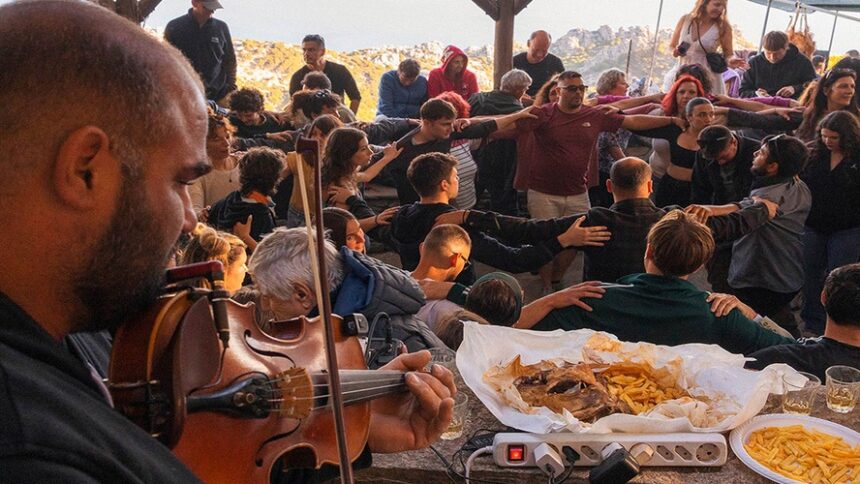

Ikarian panigyria – or panaÿria, as they are known locally – are a centuries-old institution, closely associated with religious feast days dedicated to Christ, the Virgin Mary or the saints. They are held on the feast days of parish churches and chapels built in their honor. Once the church service and religious rituals have concluded, the panigyri begins with a communal meal and drinking, before reaching its high point with music and dancing. The dancing is accompanied by musicians playing traditional instruments such as the lyra, tsambounofylaka (a type of bagpipe), violin and lute – as the local saying goes, “with dancing and song, let the place come alive” – as well as by traditional dance songs: “How can the mad ones dance without lyra and violin?”
The traditional food of the panigyri is prothesi: boiled goat meat served with its broth, bread and wine. In earlier times, these provisions came from offerings made by those who owned or leased church lands, as recorded in church registers known as manes. Contributions toward the feast were specified in kind. One such entry reads: “Sixteen loaves of bread, one goat […] all the above we shall contribute to the festival each year […].” Over the years, the panigyri menu expanded to include ofto (roast goat), goat cooked in tomato sauce and served with pilaf, as well as assorted appetizers, salads and sweets. Despite this evolution and the addition of new dishes, prothesi remains the essential food of the Ikarian panigyri to this day.

The festival is organized either by the parish church committee or by the villages’ cultural associations, with local residents volunteering their time and assistance. According to tradition, participants sit together in rows at communal tables, either in the courtyard of the celebrating church or at the chorostasi, the village dancing ground, in a space specially arranged for the shared meal and the dancing that follows. Each family or group of friends sits down with its own prothesi, or with the food and wine they have purchased.
Beyond their religious character, panigyria serve a variety of functions within Ikaria’s local communities. First, they have a social role, offering an opportunity for relatives and friends to come together, celebrate and enjoy themselves – as the local saying goes, “Honor the lord of your land, the saint of your village.” Second, they have an economic role, as proceeds are traditionally raised for projects benefiting the community, such as water supply systems, the construction and maintenance of roads, and the building of churches or schools. Third, they provide entertainment through the festivities that follow the communal meal, with music, dancing and chorostalismata – prolonged bouts of dancing.

Music and dancing are crucial to the success of a panigyri. If the musicians are good and know how to create a festive atmosphere – aided, of course, by the quality of the wine – people will dance for hours and the celebration may continue well into the following day. The combination of fundraising for communal projects and entertainment has helped transform the panigyria into large-scale gatherings drawing considerable crowds, particularly during the summer months. Many festivals have been moved to this period and, in some cases, are now held independently of their original religious context.
At a panigyri, musicians traditionally begin with tragoudia tis tavlas (“table songs”), including songs of welcome: “A thousand welcomes to you, dear friends…” Others make playful reference to wine: “Wine, I drink you for my good, yet you do me harm; you lead me from the road and take me to the edge of the cliff.” Then comes the Ikarian dance, melodically rich and shaped by the skill and improvisation of each violinist. Traditionally, it had an almost ritual character, with a direct exchange between the dancers and musicians, at a time when people would request and pay for a particular dance.
The kavos, as the circle of dancers is known, consisted of the group accompanying the person who had paid the musicians, together with anyone he invited to join him. The lead dancer was usually the eldest member of the group or another accomplished dancer, known as a zefkalis.* He would bring the Ikarian dance to life with intricate steps and flourishes in the tsamourikos or peramaritikos style, swaying movements in the rachiotikos, or a more restrained step in the papadiotikos. After leading the circle for several turns, the first dancer would move to the end of the kavos, known as the petalo, allowing the next person in line to take the lead. In this way, everyone eventually had a turn at the front. Anyone joining the dance after it had begun would take their place at the end of the circle.

Modern Ikarian panigyria have evolved considerably, with hundreds – and sometimes thousands – of local residents and visitors taking part. The Ikarian tune has become the defining sound of the musicians and orchestras that perform at these festivals, accompanied by the dance that rouses the crowd and brings the celebration to its peak.
Beaches& Islands
Younger generations have enthusiastically embraced the Ikarian music and dance, making them part of their own social life and entertainment. They join the Ikarian dance en masse, though no longer necessarily following its traditional order: dancers enter wherever they choose, creating multiple overlapping kavoi, with no clear beginning or end. This new way of dancing helps explain the remarkable resilience and continuing popularity of the Ikarian dance, both at the island’s panigyria and at its smaller communal gatherings, known as zefkia.
Today, Ikarian panigyria are sometimes described as the island’s “heavy industry,” or as the biggest traditional festivals in the Aegean. Their enduring vitality owes much to the sheer scale of participation and, above all, to the communal revelry with which they have become so closely associated.
*The 2008 documentary “Zefkalides,” directed by Leonidas Vardaros, explores Ikarian culture through the island’s distinctive language and musical traditions, as expressed in its communal celebrations, or zefkia. The documentary is available to watch online.
Sources: Argentoula Paschari-Kouloulia, “Ta Kariotika Panigyria,” Kathimerini, Epta Imeres supplement, June 21, 1998, including the bibliography cited therein; Proceedings of the conference “Promoting Local Festivals and Well-Being in Ikaria,” Ikaria, September 5-7, 2014.
This story first appeared in Greece Is.
Source: Ekathimerini.com






Leave a comment