
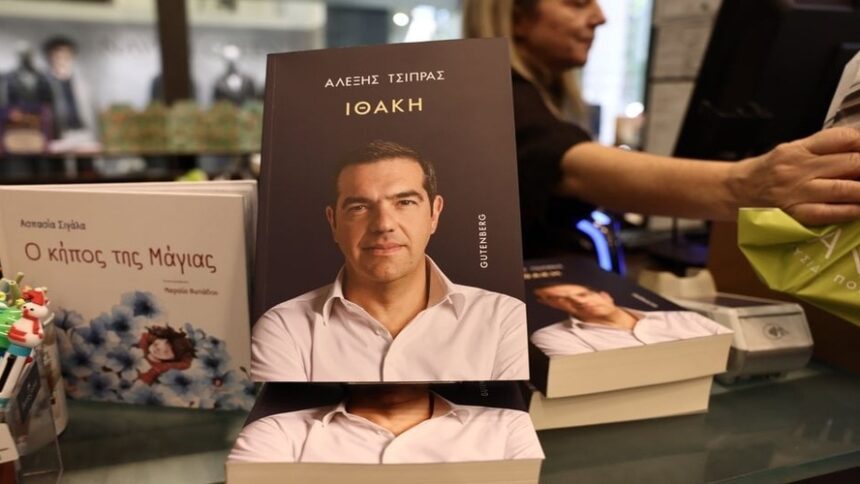

Political memoirs generate passions and Alexis Tsipras knew this well when he wrote “Ithaki” (“Ithaca”). With Monday’s book release, the former prime minister distanced himself from several of his former ministers and SYRIZA cadres who, throughout the tumultuous 2015 negotiations with Greece’s international creditors and EU leaders, were constantly pushing him for a more confrontational approach. “Ithaca” is already causing waves and is obviously a conscious choice of the author, with reactions expected particularly from those who believed he would denounce his coalition with Panos Kammenos’ right-wing populist ANEL. According to Tsipras’ account, his former ministers troubled him more than the president of ANEL, but he did not choose to cut them off early.
The main goal seems clear: The former prime minister wants to clear the shadows of the past. He claims that exiting the euro was never in his strategy, as some of his close associates wanted in 2015, and that is why he reveals – along with the hilarities that were heard by ministers during cabinet meetings – the “bad guys” of the International Monetary Fund (Christine Lagarde, Poul Thomsen), Klaus Regling (chief executive officer of the European Financial Stability Facility and managing director of the European Stability Mechanism) and German Finance Minister Wolfgang Schaeuble. He has always made it clear, both at home and abroad, that he wants to achieve reforms without impoverishing society. He did not succeed and the result was, as he admits, to “lose” the middle class, but also to scrap a benefit for low-income retirees.
The book is the first step the 51-year-old Tsipras wants to take to return to the political fore. According to many analysts, the creation of a new party is a decision that has already been made. All that remains is time and the appropriate political environment – if it comes. A rise in his popularity in subsequent polls could serve as a catalyst for his decisions.

Economic ‘alternatives’
The alternative plans for the Greek economy that were being developed and discussed within the leftist-led administration in the event that negotiations with international creditors collapsed in the first half of 2015, are one of the main hot-button issues that are discussed in the book by Tsipras, who makes particular reference to the proposals of firebrand economist and then finance minister Yanis Varoufakis, as well as to considerations by influential SYRIZA cadres like Panagiotis Lafazanis about a possible return to the national currency.
On the subject of Varoufakis, Tsipras says that the top priority for the government’s controversial finance chief was to secure a haircut on the debt held by the European Central Bank. “If the ECB did not agree – and the ECB was most certainly not going to agree – the second step of his plan called for the unilateral exchange of the bonds held by the ECB with new zero-interest bonds that never mature, or so-called perpetual bonds. In other words, we would have moved ahead with a unilateral haircut. The third step would have been issuing so-called IOUs, in effect a parallel currency intended to address the liquidity shortfall, a currency that, even before it was issued, would have been dramatically devalued against the euro,” he says.
Tsipras says he told Varoufakis very clearly that his own strategy did not include a Greek exit from the common European currency. The finance minister’s response was, apparently, that Greece would not leave the euro, but would issue a parallel currency and, in so doing, would force the country’s partners to back down. Tsipras says that according to the plan presented to him by Varoufakis, Greece would print vouchers to pay pensioners and salaried workers in lieu of actual money, with which they could purchase goods and services.
“When I heard this, I didn’t know whether to laugh or cry,” the ex-prime minister writes. “I reacted: ‘Are you out of your mind? You expect us to pay people with vouchers instead of salaries? We won’t last a day. What pensioner would ever accept a voucher instead of a pension?’ Then he started saying that we also had the option not to print vouchers, but to do the whole thing electronically, by cellphone. That pensioners would conduct their transactions by phone, in 2015! With such a cavalier approach, the discussion was over for me.”
According to Tsipras, the IOUs Varoufakis had proposed were, basically, a parallel means of payment, a type of internal, alternative currency that “could supposedly be used temporarily only within Greece, without the country leaving the euro,” as the former prime minister writes. However, he adds, it was clear that their circulation “would inevitably create instability and trigger capital flight, leading in effect to a de facto exit from the euro.”

The drachma and the BoG
In another part of “Ithaca,” Tsipras tells readers about the proposals developed during the cabinet meeting where he announced his intention to hold the July 5, 2015 referendum on whether Greece should accept the bailout deal presented by the country’s international creditors. He makes particular reference to what was said by Panagiotis Lafazanis, who was the minister of productive reconstruction, environment and energy at the time. Lafazanis spoke of a “state of war,” saying that Greece would need to be ready to transition to a national currency from the day right after the plebiscite. He even suggested that the government should seize immediate control of the country’s central bank.
“In no mood for theoretical digressions,” Tsipras interrupted the minister and asked for clarifications, he writes. “Lafazanis was consistently on a different wavelength: ‘I’m giving you the broad strokes right now, it needs more preparation. But I didn’t know about this proposal [for the referendum],’ he insisted.”
“There were some comrades who made me wonder if they had even a rudimentary grasp of reality. Lafazanis was one of them,” Tsipras recounts.
The referendum
In his book, the former premier clarifies that the referendum, the first to be held since 1974 when democracy was restored in the country, was his own decision. “My close associates learned about it first. I told them clearly that the problem was political. We could not agree to what they were asking of us. Not because we did not want to but because what they were asking for was the humiliation of the people and our political disappearance. The decision was not easy for me.
“It was one of the most difficult moments of my journey. I had the absolute conviction that I was doing the right thing for a people who could not be humiliated by any random Brussels official, every technocrat who believed that Greece was a kind of guinea pig. But, at the same time, I knew that the cost of this choice would be heavy. And that I, personally, had to be ready to bear it,” he writes.
Cyprus peace talks
Tsipras also goes into the high-level Cyprus peace talks hosted in the Swiss resort of Crans-Montana from 2015 until their collapse in the summer of 2017, describing the so-called Guterres Framework – a set of proposals presented by UN Secretary-General Antonio Guterres at the June-July summit – as a “significant achievement of our diplomacy, in coordination with the Cypriot side, and one that could have formed the basis for a fair and sustainable solution.”
The former Greek prime minister goes on to discuss the message sent by Turkey’s then foreign minister, Mevlut Cavusoglu, to Guterres, signalling a conditional willingness to discuss the abolition of guarantees – describing it as a move that “momentarily created positive expectations and great hopes” – as well as the intransigent stance of the Turkish side, which ultimately led to the collapse of the talks.
Tsipras says that in one “important” discussion with Nicos Anastasiades he expressed his desire to travel to Switzerland if a breakthrough in the negotiations was, in fact, likely. The Cypriot president, however, “was extremely skeptical. He believed that the Turkish side was bluffing and did not share my, albeit very reserved, optimism. He had possibly also been affected by the course of negotiations about the internal aspects, which, he had told me, were not going well and were disappointing.”
Then, at the July 6, 2017 dinner where the parties in the negotiations eventually realized that the talks had failed, “Cavusoglu’s official stance was completely different from what Guterres had conveyed. The Turkish side’s refusal to discuss a timetable for the withdrawal of the occupation forces and to openly accept the abolition of guarantees as a basis for a negotiation ultimately led to the failure of the conference.
“I heard the news with disappointment after having spent all night on the telephone,” admits Tsipras, adding that he had been experiencing a sharp pain in his stomach throughout those nine tense days of talks that he had chosen to overlook, for the time being.
“That same morning, after the talks hit the rocks, as soon as I got a moment to attend to myself, I summoned a doctor to the Maximos Mansion to examine me. He told me to go straight to hospital because the situation was serious and I needed surgery urgently for an umbilical hernia, which had clearly been troubling me for days but had by then become dangerous. I was admitted to the Evgenideio at 3 in the afternoon and, before I had fully grasped what was happening, I found myself in an operating theater. Instead of the negotiating table at Crans-Montana, it was the surgical table.”
He describes former foreign minister Nikos Kotzias as a “pillar” of his foreign policy, praising his “knowledge and strategic insight,” saying that they had discussions on foreign policy issues before they co-existed in the government.
The Greek ‘garbage bin’
Among the highlights of his political memoir, are the former prime minister’s two visits to Russia – one to Moscow and one to St Petersburg – along with his broader contacts with the Russian government and President Vladimir Putin during the first half of 2015.
Regarding his first visit to Moscow in April 2015, Tsipras notes that, on the one hand, “the Russian political leadership maintained reservations about the benefits that any outreach by the Greek government to Moscow would offer them.” On the other hand, he himself prepared for the trip “fully aware of the international context,” aiming, as he writes, to strengthen Greece’s negotiating hand vis-a-vis its creditors.

In that first delegation – which, as Tsipras recounts, included Kotzias, former deputy defense minister Kostas Isihos, then-energy minister Panagiotis Lafazanis, and then-deputy finance minister Nadia Valavani – the former prime minister felt that half the members believed they were traveling to the Soviet Union rather than to modern Russia. “Even for me, who was younger and without many memories of the Cold War, this trip inspired a certain awe,” Tsipras admits. Looking back 10 years later, he adds that sensitivity is no bad thing, provided it is tempered by logic.
Tsipras goes on to describe a scene in which, according to him, members of his delegation addressed then-Russian prime minister Dmitry Medvedev as “comrade prime minister.” “I imagined – I could almost hear him thinking to himself: ‘Is it possible? These people aren’t just old communists; they’re time travelers,’” Tsipras writes.
A few months later, Tsipras made a second trip to Russia, this time to St Petersburg. There he had another meeting with Putin – an “important experience,” he writes. Tsipras outlined his intentions regarding negotiations with creditors and raised the possibility of a symbolic Russian purchase of €200-300 million in Greek government treasury bills. Putin’s response, as recounted by Tsipras, was blunt. “He told me he would prefer to give the money we requested to an orphanage, because if he gave it to Greece it would be like throwing it into a garbage bin. Greece was a bankrupt country and would not be saved with 300 million euros. It needed 300 billion, not 300 million,” Tsipras writes, adding that Putin urged him “to come to terms with Merkel.”
Obama’s crucial call
One of the key points that Tsipras describes in his autobiography is the phone call he received from then-US president Barack Obama, following the results of the Greek referendum and during the 17-hour negotiations with European leaders.
“I was at the hotel, just before I left for the summit. After [Obama] congratulated me on the result of the referendum, he said, ‘I have good news and bad news to tell you.
“‘The good news is that, after your victory in the referendum, you are the master of political developments in Greece.’”
“And the bad news?”
“The bad news is that forces have gathered against you that want to torpedo the negotiations today and things are very serious. There is a powerful bloc that wants, mainly for political reasons, the negotiations not to be completed today, and that you be forced to return to the national currency. I cannot tell you the details, but one thing I ask is that you remain calm. And know that we will be on board throughout, we will monitor developments and we will intervene behind the scenes, if necessary…’”

The future of the left
Tsipras categorically denies that Stefanos Kasselakis, the surprising candidate who succeeded him at the helm of SYRIZA, was his choice for the leadership of the party. Instead, he explains that he had already decided to resign after the defeat in the May 2023 general elections, where the conservatives of Kyriakos Mitsotakis swept to power – albeit without being able to form a government (Mitsotakis called for another snap election in June, which he won).
Tsipras says he conceived an alternative plan for the party’s path toward the June elections. He thought of former labor minister Effie Achtsioglou as the appropriate person for a smooth transition.
“The plan was clear: I would appear in Parliament and on the same day that [SYRIZA’s] parliamentary group would meet, I would propose Achtsioglou to take over its leadership.” Tsipras would remain president of SYRIZA, as a change of party leader requires an official party congress and an official election process. “Achtsioglou would become the face of the party, the candidate for prime minister, and would lead the election campaign,” he writes.
But Achtsioglou refused because “she believed that by distancing herself from me, she could overcome the problems within SYRIZA and convince its members by presenting a fresh candidacy, without giving the impression that she was under my tutelage. It turned out that she underestimated the situation and the importance of my own support.”
After the June elections, Tsipras invited Alexis Charitsis, his former deputy minister of economy and current leader of SYRIZA splinter group New Left – to Sounio, believing that he was the only one who could, if elected, secure, if not consensus among MPs, at least more time to change things around. Charitsis stated that he was not ready to take on such a responsibility, Tsipras says.
‘Let’s see what he’s got to say’

The publisher, Gutenberg, is already declaring it a success, as the fourth edition was printed even before sales officially began. “We are already accepting repeat orders,” says Kostas Dardanos of Gutenberg Publications, adding that the success of “Ithaca” also means that “reading is winning as an element of democracy,” adding that “every last small bookstore has ordered the book.”
“A frenzy. You could tell from the pre-orders, but I was still surprised by what happened. People were waiting outside for us to open,” says Alkis Temponeras from the Pleiades bookstore in the downtown Athens neighborhood of Pangrati. He’s still curious about how demand for “Ithaca” will evolve, but judging from the first day it hit the shelves, it is likely not to be “a flash in the pan.”
“Based on the rate of pre-orders, it will do well,” Areti Georgili, from the Free Thinking Zone in Kolonaki, says. She says mainly middle-aged people order “Ithaca,” while students take quick looks from the window. Readers over 35 are also requesting the book at Public in Syntagma, where “Ithaca” “has been selling quickly since the morning,” according to an employee. At the Politeia bookstore, a bookseller informs us that the book is “doing very well, while there are many telephone orders.”
Evripidis Konstantinidis, of the Konstantinidis bookstores in Thessaloniki, says the book “is already doing well, and since we’re talking about a biography of a sitting politician, which is unusual in Greece, it’s a publishing event.” The comments he hears from buyers are along the lines of “Let’s see what he has to say” or “I hope I don’t regret it.”
The audience buying the book from Tsiopelakos in Trikala seems more solid. “Eighty percent are SYRIZA members, 15% former [party] members and 5% ideological opponents,” the bookstore informs us. “In all the copies we’ve sold, I haven’t seen a single kid or a single woman [buyer],” says Spiros Athanasiou of Adagio II in Nafpaktos. “In fact, it’s mainly bought by SYRIZA friends. The rest don’t touch it. It’s a little strange.”
Source: Ekathimerini.com









Leave a comment