
Scrolling through my phone, wedged into a packed subway car, I catch myself daydreaming about my summer vacation. Images flash across my screen in rapid succession – puppies, kittens, recipes, comedy skits, a little bit of everything – until, suddenly, I hear the sound of cicadas.
The pace slows down; a beach, two straw chairs and the unmistakable little blue Greek cafe table perched on the sand beneath a tamarisk tree. Beyond it, the sea. A few fleeting seconds of calm play on a loop on my phone, and it feels like I’m already there.
With a swipe, I’m onto the next video: the rush of a river, a natural pool hidden in a lush green forest. The algorithm already knows what I’m longing for. Or am I just following it along?
In search of what’s truly behind the summer’s biggest Instagram and TikTok trends, I spoke with three Greek content creators.

For Stefanos Antimantos, better known online as stef_greece, the pandemic marked a turning point for Greece’s vacation-goers. Since then, the mainland’s mountains have become increasingly fashionable, with alpine lakes such as the Dragon Lake of Tymfi drawing growing numbers of hikers each summer.
Even so, the image of the “Greek summer” online continues to be dominated by familiar cliches: whitewashed Cycladic houses against blue skies.
“International audiences tend to see Greece’s islands as one homogeneous destination,” Stefanos says. “Among foreign travelers, I often come across the same narrative: ‘Don’t go to Santorini, go to Milos instead. Don’t go to Paros, go to Astypalaia – it’s basically the same, just cheaper.’ But that’s simply not true. Every island has its own identity, its own history and its own natural landscape. And every season has its own beauty. The islands aren’t just rocks that come alive in the summer. They’re there in winter, in spring and in autumn, too.”
That is precisely what Stefanos hopes to convey through his work: a Greece that can be appreciated in all four seasons, while encouraging visitors to engage with destinations respectfully and with local communities in mind.
His content, primarily on Instagram, has a distinctly cinematic feel, with slow, first-person shots accompanied by centered white captions in English.
Natural storytelling
With a similar goal but a different approach is Dimitris Karvelis, known online as Kdexplorer. His audience is primarily Greek, as he usually speaks directly to the camera or presents locations with voice-over narration in Greek, creating a more personal connection with his followers.
“I want to show the soul of a place in a direct way,” he says. “Most of my videos are posted in the moment – I want to share the experience as I’m living it.”
But not everything can always be captured in real time. Sometimes a delayed approach is necessary – as in the reels created by Eleanna Kiouki, known as thecookietraveller, when she explores some of the country’s most remote and inaccessible corners, also speaking primarily to a Greek audience.

Eleanna, a chemical engineer and influencer, also shares her passion for speleology, descending as deep as 100 meters underground with a camera and headlamp. Through her videos, she aims to raise awareness about sustainable travel and respect for nature and place. “The algorithm does bring me an audience that wants to treat the environment with respect and keep these places pristine,” she says.
Dimitris notes that in the age of artificial intelligence, when perfect images can be generated in seconds, users still value authenticity.
“They want natural sounds, natural storytelling, unfiltered footage,” he says. But how do you preserve authenticity when you always have a camera in your hand, creating content? Do you truly enjoy each moment as you capture it – or not at all?
“I enjoy it fully,” Stefanos tells me with an honest smile. With more than a decade of experience, he has learned that the secret is to simplify the process – and, of course, to know your visual framing, your identity as a creator.
He mainly works with a Sony camera or his phone, travels with friends or his girlfriend, and follows one basic rule: not to let the job become an obsession. Of course, those who travel with him know that when there’s a beautiful table set, “the camera eats first, and then we do.”
A ‘golden’ balance
The calm and composure Stefanos’ projects are not common among content creators. Dimitris recalls that early in his career, his obsession with the perfect frame cost him a lot.
“As soon as I sat down somewhere, I would immediately set up the tripod, thinking about this angle or that background. There were actually trips early on that I barely remember – I was only thinking about the video.”
Over time, Dimitris learned to find balance, always returning to his starting point: his love of travel. He has now found a way to slow things down. Before filming a waterfall or a lake, he first takes it in with his eyes, and only then does he bring out his equipment. And that, he says, is how he manages to stay true to himself.

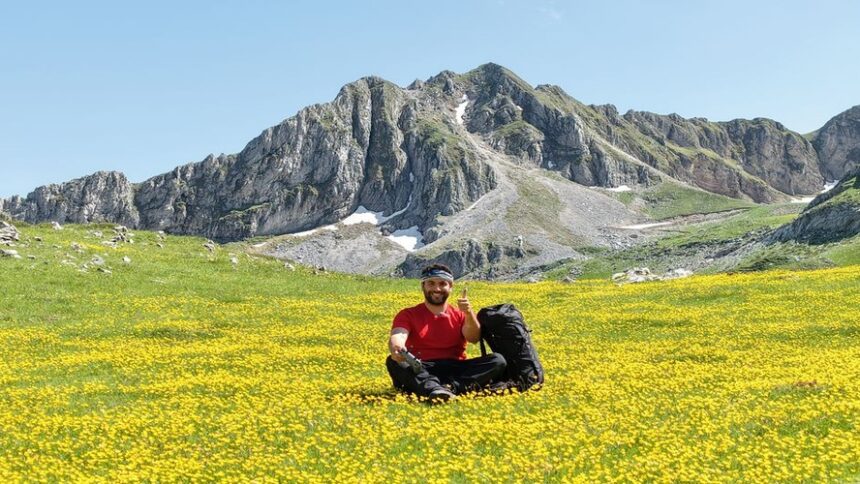
Eleanna ascending to the summit of Profitis Ilias, in the Taygetus mountain range. [thecookietraveller]
Sometimes spontaneity is consciously sacrificed in order to make content creation sustainable – after all, it is a job that generates income. “Greek audiences don’t really understand that part,” Dimitris says. “When I include brand collaborations, the response isn’t the same as with other types of videos.”
That is one of the ways content creation is monetized: through collaborations with companies or brands that request specific deliverables – and purchase them for a fee that usually depends on the size of your audience.
Often, the exchange doesn’t involve money at all. For smaller businesses, a video might be traded for a meal or a couple of nights in a guesthouse. “That’s mostly how I work,” Eleanna explains. “That’s why, at the moment, I still have two jobs and don’t live solely off social media.”
Having earned certification as an autonomous mountain guide, she also organizes hiking trips in Greece and abroad with other experienced climbers – and, of course, her followers are the first to know.

Pack your bags
Stefanos, where should we go this year?
“Nisyros captivated me from the very first moment. Perhaps because the people who visit it already know exactly where they are going. My favorite spot is Nikia, the village with one of the most beautiful squares in the Aegean. You absolutely have to try eggs with kavourmas, a dish that reflects the island’s Asia Minor influences.”
Dimitris, where should we go this year?
“Leros, which I discovered almost by accident. I had gone to Kalymnos, had a few free days, and thought: why not make a quick stop? The island’s challenging recent history initially had put me off – I assumed it wasn’t a beautiful place. I was wrong. Since then, I return every year. My favorite walk is in Panteli, for an ouzo and fresh fish at the tavern Psaropoula.”
Eleanna, where should we go this year?
“To the Fournoi islands near Ikaria, to hike up Mount Korakas. The route (about 5 km) is suited to more experienced hikers and follows a narrow trail above the sea. From the summit, the view is extraordinary – you can see the equally imposing peak of Vigla on Samos. It’s rare to stand on one peak and see another across open sea stretching between them.
For an easier hike, try the Saronic peak in Aegina – a gentle one-hour ascent best done early in the morning to take in the shifting colors of sunrise and, below, the Temple of Ellanios Zeus, one of the oldest in Europe.”
This story first appeared in Kathimerini’s K magazine.

[thecookietraveller]
Source: Ekathimerini.com









Leave a comment