
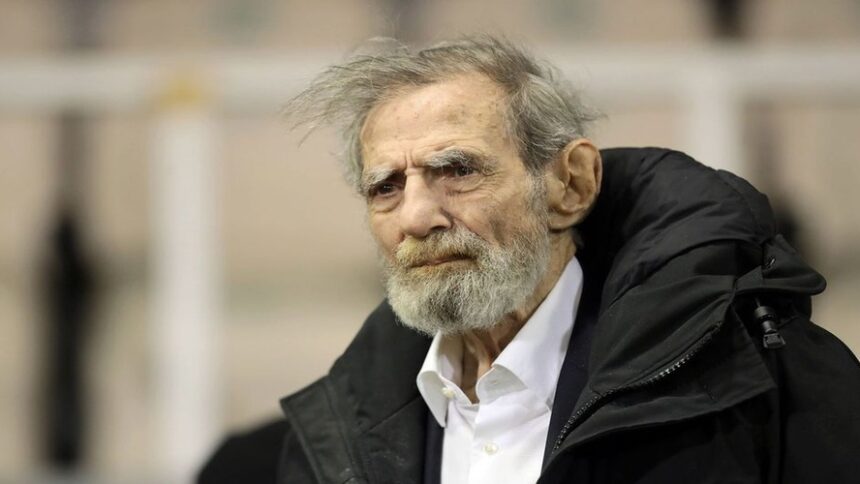
Giorgos Vardinogiannis, the shipping magnate who led Panathinaikos for more than two decades and became one of the most influential figures in Greek soccer, has died at the age of 89 following a brief hospitalization.
Known as the “Captain,” Vardinogiannis headed the Athens club from November 1979 until May 2000, a period in which Panathinaikos won six Greek league titles and nine Greek Cups and twice reached the semifinals of Europe’s premier club competition.
Born in 1936 in Episkopi, near Rethymno, on the island of Crete, Vardinogiannis was one of 10 children in a prominent family with extensive interests in shipping, business and politics. He studied at the Southampton School of Navigation in England before pursuing a career in the merchant navy and shipping. He also served two terms on the board of the Union of Greek Shipowners.
His nickname reflected his maritime background and became inseparable from his public identity. Accounts of his early career linked it to an alleged role in circumventing a fuel embargo imposed on Rhodesia, now Zimbabwe, during the white-minority rule of Ian Smith in the 1960s.

His defining public role, however, was at Panathinaikos. In 1979, as Greek soccer entered the professional era, his family acquired a majority stake in the company established to run the club. He assumed the presidency on November 14 that year and remained in the post for nearly 21 years.
His tenure brought major domestic success and some of the club’s most memorable European campaigns. Panathinaikos won league titles in 1984, 1986, 1990, 1991, 1995 and 1996, completing the league-and-cup double four times. The club also won three Greek Super Cups during his presidency.
In the 1984-85 European Cup, Panathinaikos eliminated Feyenoord, Linfield and IFK Göteborg to reach the semifinals, where it lost to Liverpool. Eleven years later, the team came close to another European final. After advancing through the Champions League group stage and defeating Legia Warsaw, Panathinaikos beat Ajax 1-0 in Amsterdam in the first leg of their 1996 semifinal, thanks to a goal by Polish striker Krzysztof Warzycha. Ajax won the return leg 3-0 to advance.
Vardinogiannis’ era was also defined by players who became club icons, including Warzycha, Dimitris Saravakos, Juan Ramón Rocha, Velimir Zajec, Józef Wandzik and Juan José Borrelli. He also made high-profile signings of players associated with archrivals Olympiakos, including Giannis Kyrastas, Mike Galakos, Nikos Sarganis and Stratos Apostolakis, moves that stirred controversy.

A hands-on president, Vardinogiannis took a personal interest in transfers, coaching appointments and the team’s day-to-day direction. He later acknowledged that he often handled transfers himself, while explaining that he sometimes refrained from making too many signings to preserve the balance of an established squad. His approach made him central to the club’s fortunes but also a source of debate and controversy.
Under his leadership, Panathinaikos established its training center in Paiania, east of Athens, and invested in its youth academies, helping shape the club’s operations for decades. The facility, later named the Georgios Vardinogiannis Sports Center, became the property of the Hellenic Football Federation (EPO) in 2025 for use as a training base for Greece’s national teams.
By the late 1990s, Panathinaikos was losing ground in the domestic championship, and criticism of the club’s management and transfer policy had grown among sections of its fan base. Vardinogiannis stepped down on May 29, 2000, handing the presidency to his nephew Giannis Vardinogiannis, known by the nickname “Jigger.” The family retained control of the club until 2011.
Despite the controversies surrounding his leadership, Vardinogiannis remained closely identified with Panathinaikos. In a rare television appearance in June, he recalled becoming a supporter during his school years, inspired by Panathinaikos central defender Takis Linoxylakis, and later attending matches regularly.
“I was a passionate president, but I never lost my identity as a fan,” he said.













Leave a comment