
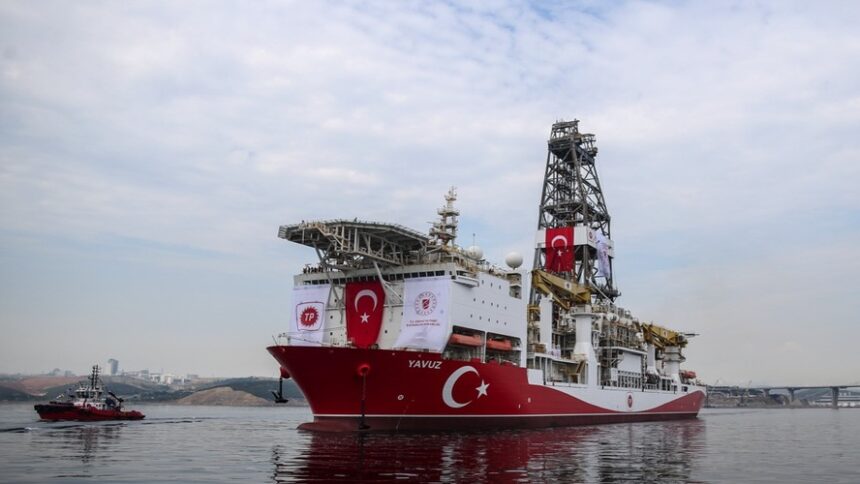

Turkey possesses the world’s fourth-largest fleet of seabed research, seismographic and drilling vessels – and it is using it as a means to conduct foreign policy.
The amassing of such a considerable fleet – 54 vessels – has not come cheap. Over the past decade, Ankara has spent over one billion dollars to build or acquire the ships.
A large part of this fleet is currently deployed in the western and central parts of the Black Sea, drilling for oil and natural gas. Research vessel Oruc Reis, notoriously used as a prop during one of Turkey’s standoffs against Greece in the Aegean in August and September 2020, is in the Eastern Mediterranean, ostensibly conducting research in the waters between the Turkish-occupied northern part of Cyprus and the Turkish port of Mersin.
Turkey’s fleet of research and drilling vessels is not confined to its coastal waters: drilling vessel Cagri Bey, for example, currently operates off the coast of Somalia, where it arrived last April 9 and was welcomed with great fanfare in the port of Mogadishu before starting drilling in the Curad-1 field, some 370 kilometers off the Somali coast.
According to the specialized website www.drillingcontractor.org, Cagri Bey, drilling on behalf of the Turkish Petroleum Corporation (TPAO), has nearly completed its drilling 7,500 meters below the surface and 4,000 meters under the seabed.
In October, Turkish seismographic – seabed mapping – vessels will be deployed in three separate fields offshore from Pakistan to search for oil and natural gas.
Greek authorities, accustomed to Turkey’s using its research and drilling field to underscore and enforce its maritime claims, closely follow its movements. On August 19, Turkey issued a navigational warning about Oruc Reis conducting seabed mapping in the Eastern Mediterranean between Mersin and Iskenderun. For now, this presents no cause for heightened alert, but officials believe the vessel’s movement should be more carefully monitored around mid-October. Based on past Turkish practices, if Oruc Reis were to be used to stoke tensions, it would be accompanied by Turkish Navy units.
Turkey’s expansion of its specialized fleets has its roots in 2011, when the Republic of Cyprus decided to carve hydrocarbon research fields south of the island. This provoked Turkey in two ways: first, it ran counter to its claims – disputed in international practice – that islands cannot have continental shelves or exclusive maritime zones of their own. Second, it insists that any resources in the area should be shared equitably with the Turkish-occupied north of Cyprus, recognized only by Ankara.
Turkey had dispatched seabed research vessel Piri Reis in the fields delineated by Cyprus. But the vessel was soon disabled and forced to spend four months in the port of Famagusta. Turkish requests to Italy and Norway to provide vessels were not answered, to Ankara’s dismay.
Source: Ekathimerini.com








Leave a comment