
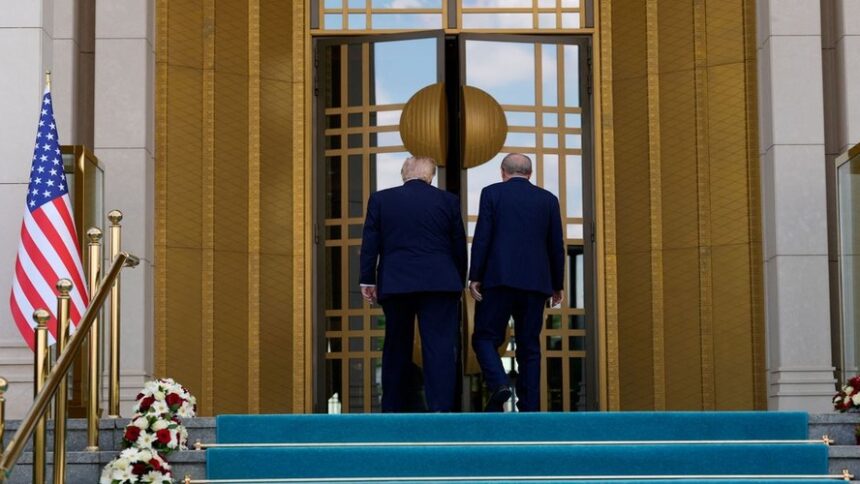
Announcements made by US President Donald Trump in Ankara on Tuesday regarding the possibility of Turkey’s return to the F-35 program are the product of lengthy, slow-moving processes that have been underway since the first weeks of his return to the White House. Arriving at the NATO summit, Trump said on Tuesday he would lift sanctions on Turkey and make a decision on a potential sale of F-35s to Ankara.
Athens has been aware of these developments, often through the Americans themselves. However, a series of military incidents in the Middle East since last summer, along with parallel frictions between the government of Benjamin Netanyahu in Israel and US officials in both the executive and legislative branches, had pushed the issue into a temporary impasse.
Greek officials recognize that any solution to sanctions imposed under CAATSA would not automatically remove the separate obstacle concerning the export of the fifth-generation F-35 fighter jet. Such a step would require separate legislation by Congress.
Experienced observers told Kathimerini that, given Trump’s broader willingness to overturn established approaches on a range of issues, they would not rule out what they described as the ideal scenario for Turkish President Recep Tayyip Erdogan: a gradual return to the F-35 program while retaining the Russian-made S-400 missile system, coupled with a pledge that the system would not be activated except in cases of absolute necessity.
Because the discussion is a bilateral matter between Turkey and the United States, Greece is not participating and has avoided public interventions. Instead, the government has emphasized that Greece is expected to receive its first F-35 aircraft within a few years and, in any case, before Turkey.
“As we speak today, Greece has secured 20 state-of-the-art F-35s, with an option to increase that number to 40. By contrast, Turkey in 2019 was in the process of securing F-35s and now is seeking them,” said government spokesman Pavlos Marinakis.
On the NATO dimension, the government has highlighted Greece’s commitment to defense spending targets. Government sources say Greece has already exceeded the Defence Investment Pledge agreed in 2025 and is among the first five NATO countries that, by 2026, have reached the target of defense spending equal to 3.5% of gross domestic product, as well as the additional 1.5% target. Poland, Estonia, Latvia and Lithuania are also cited. Greece, however, continues to lag in domestic industrial production capacity.
Source: Ekathimerini.com










Leave a comment