

World Greek Language Day has entered a new era, with the initiative now officially trademarked and formally established as an incorporated Victorian organisation.
The milestone marks a significant step in transforming the annual celebration into a long-term movement dedicated to protecting, promoting and strengthening the Greek language for generations to come.
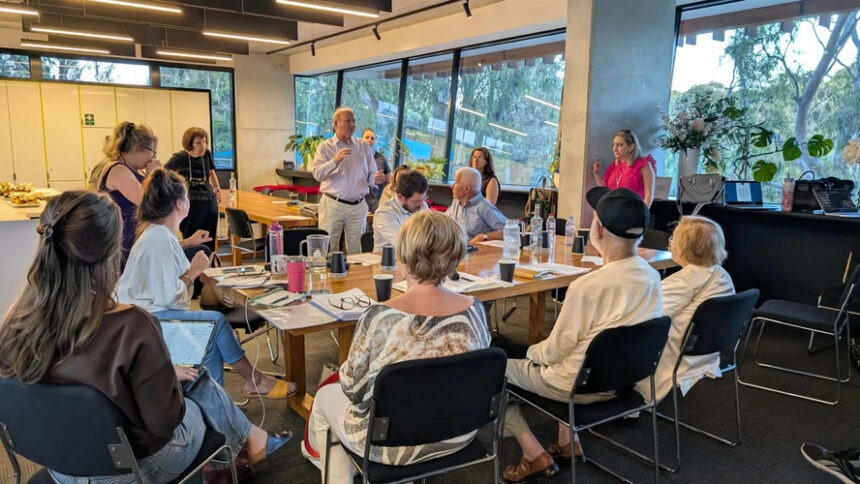
With this goal in mind, the committee met at Alphington Grammar School on Thursday, July 23. Committee members present endorsed an ambitious program extending well beyond the annual February celebrations, with a focus on education, advocacy, cultural events and ensuring the Greek language continues to thrive in Australia and around the world.
The meeting also marked a leadership transition, with Leonidas Vlahakis appointed Chair, succeeding Professor Anastasios Tamis. Since the day was first declared by UNESCO, Professor Tamis’ work has been instrumental to making sure the day is observed in Victoria.

Under the new leadership structure, the committee’s ambition is to transform the initiative from a yearly celebration into a broader cultural movement dedicated to preserving and promoting Greek language and heritage.
“The Greek language has given invaluable value to humanity for centuries, as no objective observer could disagree,” Mr Vlahakis told The Greek Herald.
“I consider it the greatest honour to undertake this role and to work alongside outstanding people to achieve our shared goals.”
Already well known for his leadership of Melbourne’s Antipodes Festival and Greek Film Festival, Mr Vlahakis said the committee wanted the initiative to belong to the entire community.
“This is not just about one community, it is about recognising the contribution of Greek language and culture to the world,” he said.
Professor Tamis said the new legal status of the Day would facilitate greater collaboration with institutions and donors.
“The legal body exists so it can receive grants and donations, enter into agreements and officially represent the organisation, while the committee continues leading the vision and organising the celebrations,” Professor Tamis told The Greek Herald.
He said the committee had already begun discussions with government and opposition representatives, with the ultimate goal of securing ongoing support for World Greek Language Day.
“We want this day to receive permanent support so that every year we can continue to celebrate and promote the Greek language, without having to start from scratch,” Professor Tamis said.
Former Victorian minister Theo Theophanous welcomed the new structure, saying it would strengthen the committee’s advocacy efforts.
“They’re setting up a legal structure so they can apply for funds from government and other sources,” Mr Theophanous told The Greek Herald.
“My suggestion was that they should reach out to members of parliament, not just Greek MPs.
“I don’t think enough parliamentarians have been approached to understand just how important it is that the Greek language is maintained in Australia and throughout the world.”
Initiatives to support Greek language
The committee has already outlined an ambitious agenda for the years ahead, including a major concert featuring Dimitris Basis and From Byzantium to Today, student performances, an interactive map tracing the spread of Greek as the world’s first international language, educational resources, advocacy for Classical Greek programs and stronger engagement with governments and schools.
“I have undertaken the map initiative,” Mr Tamis said.
The interactive map project is now progressing, with plans for its development in Australia through the expertise of a software developer and graphic designer.
The World Greek Language Day committee has also supported Greek language programs at Xavier College and MLC with great success.
“We’re always willing to help, and whenever we are invited,” Professor Tamis said, adding that the team’s intervention had positive results.
In an effort to promote Greek language learning in schools, a children’s book celebrating the Greek Australian experience will also be produced.
Committee member Ioanna Nikoloulea said the project aims to inspire children from all backgrounds to discover Greek language and culture.
“We are developing a children’s book inspired by the Greek Australian experience that reflects the journey shared by many Australian families, preserving language and culture while embracing the identity that comes from growing up between heritage and contemporary Australian life,” she said.
“Through this book, we hope to open the door for children across Australia to discover the richness of the Greek language and culture.”

She added that the committee hopes young Greek Australian artists will help bring the project to life. The aim is to create a practical language resource that can be distributed to students and support Greek language learning in schools and communities.
The committee also discussed a student concert planned for 7 February 2026, ahead of the annual World Greek Language Day celebrations.
All initiatives will be promoted through the soon-to-be revamped World Greek Language Day website and social media platforms, which will be managed by Demi Bourdopoulou.
“We’ll work on all publications, our website, social media and everything that’s front-facing,” Ms Bourdopoulou said.
“Getting the word out is something I’m very passionate about.”
Other appointments include Christina Despoteri (Public Relations Officer), Katerina Poutachidou (Events Convenor), John Milides (Media Officer), and Maria Bakalidou and Theofani Karapatsa (Secretaries).


Committee member Peter Patisteas also pledged an initial $5,000 donation to support the organisation’s fundraising efforts.
As planning begins for the next generation of World Greek Language Day celebrations, organisers say the committee is eager to welcome more volunteers, organisations and supporters who share its vision of promoting one of humanity’s greatest cultural treasures.
“The Greek language belongs not only to Greeks,” Professor Tamis said.
“It is part of the cultural heritage of humanity.”
The committee is open, all-encompassing and interested in growing its members. Anyone interested in helping it achieve its goals is invited to email [email protected]
Source: Greekherald.com.au










Leave a comment